The formula for most face wash is a small con you have agreed to. It is mostly water, a scaffold of surfactants and preservatives, a fragrance you will never trace, and a plastic bottle that outlives everyone who touches it. Shubhangini Prakash spent years reading those labels and eventually asked the question that becomes a company: if you cannot pronounce what is in your face wash, why is it on your face?
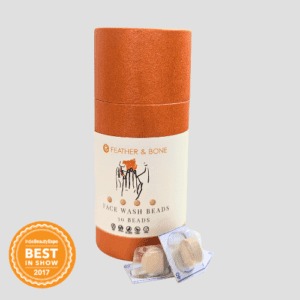
Her answer is Feather & Bone, a woman- and minority-owned skincare brand with a two-person team and a very short shopping list. Its flagship, the Face Gem, is a dime-sized tablet made of three ingredients. It cleanses, exfoliates and moisturizes, and it contains no added water. The bet underneath the whole business is that in a category built on adding things, someone will pay for the discipline of taking them away.
Feather & Bone makes waterless, three-ingredient skincare for mothers, babies and anyone who finds their bathroom shelf more alarming than reassuring.
01The reaction that started it
The origin is not a boardroom. Prakash was 12 when a face wash gave her a severe reaction, and the fear that followed - of ingredients she could not identify or trust - never fully left. Years later, pregnant and then holding a newborn, that fear returned with stakes attached. She went looking for skincare simple and transparent enough to use on a baby, could not find it, and did the thing that turns a private anxiety into a product line: she made her own.

Prakash's path there is its own small circumnavigation. Indian by heritage, raised in Dubai, schooled in England, she landed in New York banking - then left it after the 2008 crash for what she has called a year of soul-searching, during which she recorded an album and raised money for survivors of human trafficking. She went back for an MBA at Babson, returned to banking for a couple more years, and then quit a second time to build the company she had needed at twelve.
That biography matters because it explains the brand's peculiar confidence. A former banker knows how to read a balance sheet and is not easily impressed by a claim without evidence. A daughter of Indian tradition grew up around sandalwood and clay long before either became a wellness buzzword. Feather & Bone sits exactly at that intersection: skepticism about marketing, familiarity with the actual ingredients, and a mother's low tolerance for anything she cannot vouch for on a baby's skin.
02What is actually in the gem
The Face Gem is the clearest expression of the brand's whole argument, because you can hold the entire ingredient list in your head. It is three things, drawn from Indian skincare tradition and pressed into a tablet the size of a coin.
The mechanic that makes this interesting is the missing ingredient: water. A conventional cleanser is largely water you pay to manufacture, ship, refrigerate-proof with preservatives, store in plastic, and then rinse down the drain. Remove it, and a bottle becomes a bead. You ship less weight, use less packaging, and - because there is no water for microbes to grow in - lean on far fewer preservatives. The environmental story and the ingredient-simplicity story turn out to be the same story.
To see the pitch in one picture, line the gem up against the label on your sink. This is illustrative, not a lab measurement - but it captures the direction Feather & Bone is arguing for.
03Who it is really for
The tablet gets the attention, but the customer explains the catalog. Feather & Bone is built for mothers - expecting, new, and exhausted - and for the babies whose skin makes ingredient anxiety rational rather than neurotic. For that shopper, a short, plant-based, readable label is not a lifestyle flourish. It is the difference between buying and putting the bottle back.

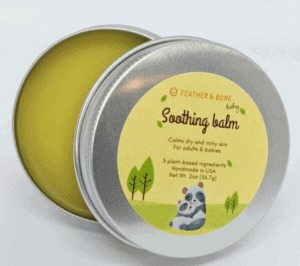
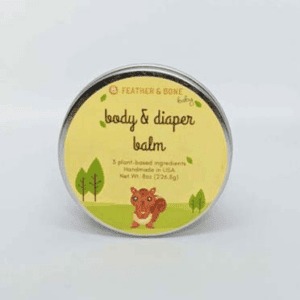
Around the gem sits a tight family range: a multi-purpose Soothing Balm and a baby Diaper Balm at $13.99 each, a $3.50 Lippo lip balm, plus an Ayurveda-inspired hair oil and a handful of cleansers and moisturizers. Nothing sprawls. The SKU list is deliberately small, which is what lets a two-person team keep every label honest.
The pricing is worth pausing on. At $20 for a month of cleansing and $3.50 for a lip balm, Feather & Bone is not chasing the luxury-clean shelf where a serum can cost three figures. It is priced like a household staple, which fits the customer: a parent restocking, not a collector splurging. That choice keeps the brand honest to its own thesis - if the point is fewer, safer, everyday products, they should be affordable enough to actually be everyday.
04Competing by subtraction
Clean beauty is a crowded, loud aisle, and most brands compete by addition - more actives, more claims, more syllables that sound like science. Feather & Bone competes the other way. Its rivals are the waterless and Ayurveda-adjacent labels - the plastic-free bar makers, the modern Ayurvedic lines - but its real differentiator is restraint. When the whole formula is three things you recognize, there is nowhere for a marketing claim to hide.
That ethos has a hashtag - #BEGROUNDED - and a philosophy attached: caring for your skin as a grounding ritual, with the ingredient clutter removed. It reads as lifestyle copy, but it is also a product spec. Fewer ingredients is the marketing and the manufacturing decision at once.
05The business, honestly sized
This is an early-stage company, and it is worth saying plainly. Feather & Bone sells direct to consumers from its own storefront, with affiliate networks and education-led marketing - trade shows, influencer partnerships, workshops at schools and offices - doing the work a big ad budget would otherwise do. The prices are low, the team is roughly two people, and the funding is modest: a convertible note around 2017 tied to XRC Ventures, plus a place in the Target Accelerator. No mega-round, no unicorn math.
Prakash has been unusually candid about what that actually feels like - the loneliness of a solo founder, the thin funding, being second-guessed as a woman of color. It is a useful counterweight to the tidy origin story, and it is the part other founders can most directly borrow: build the small, defensible thing you understand completely, and be honest about the size of it.
The Target Accelerator seat is the most telling outside signal. Big retailers run accelerators partly to scout what shoppers will want next, and a slot suggests the waterless, minimal-ingredient idea reads as a trend and not a novelty. It does not guarantee shelf space or a windfall - accelerators rarely do - but it puts a two-person brand in the same room as the buyers who decide which ideas scale. For a company competing on subtraction, being taken seriously by an addition-driven giant is its own kind of validation.
06Where it fits
Feather & Bone will not out-spend the conglomerates, and it does not appear to be trying to. It occupies the narrow, real slice where sustainability, baby-safe formulation and radical transparency overlap - a slice mass brands struggle to reach because their whole model runs on adding ingredients and shipping water. Whether "subtraction" is a durable moat or a starting position is the open question. But as a piece of product logic, the gem is hard to argue with: it is smaller than a coin, you can read it in one breath, and it is gentle enough for a newborn.
Pick a category bloated with additions, then win by removing. Make the constraint - three ingredients, no water - the product and the pitch at the same time, so the marketing claim and the manufacturing spec never contradict each other.