The useful thing about a tube of lip balm is that it can expose an entire industry. Around 2009, Canadian graphic designer Sasha Plavsic was home in Vancouver when her mother suggested she read the ingredients on the balm she used every day. Plavsic did, disliked what she saw, and spent roughly two years developing an alternative that behaved like lipstick but felt like care. The product became ILIA’s Tinted Lip Conditioner. The company that followed became something more consequential: a test of whether “clean” makeup could stop asking customers to tolerate weaker color, shorter wear or medicinal packaging.
ILIA launched in 2011 with Sasha and her brother Zachary Plavsic, an Olympic sailor who became her business partner. The founder brought an unusual credential to the cosmetics counter. She had studied typography in London and New York, worked in branding, and understood that a product could communicate restraint before anyone twisted the cap. The spare tubes, neutral colors and short name made natural beauty look less like a food co-op and more like a design object.
But visual fluency only got the brand so far. Its more durable insight arrived when Plavsic admitted that an early premise was wrong.
“Clean” became useful when ILIA stopped treating it as a list of forbidden words.The formulation pivot01 / The productive compromise
Natural was the brief. Performance became the test.
For its first several years, ILIA pushed toward natural and organic formulations. The results did not always meet the standard of conventional prestige makeup. Pigment, stability, glide and longevity are technical problems, and a plant-derived answer is not automatically the best one. Plavsic changed course: ILIA would use natural and organic bases where they worked, and selected synthetic ingredients where those produced a safer or better-performing formula. Each product would be judged on its own job.
That is less romantic than an all-natural promise and more defensible. It also clarifies the problem ILIA solves. Its customer wants makeup that looks polished, but may have dry, reactive or texture-conscious skin. She reads ingredient lists, dislikes heavy foundation and would prefer fewer layers in the morning. ILIA compresses the routine: tint plus serum ingredients, cheek color plus lip color, face prep that sits between essence and primer. The brand sells fewer decisions inside more expensive objects.
A serum tint is also a tiny business model
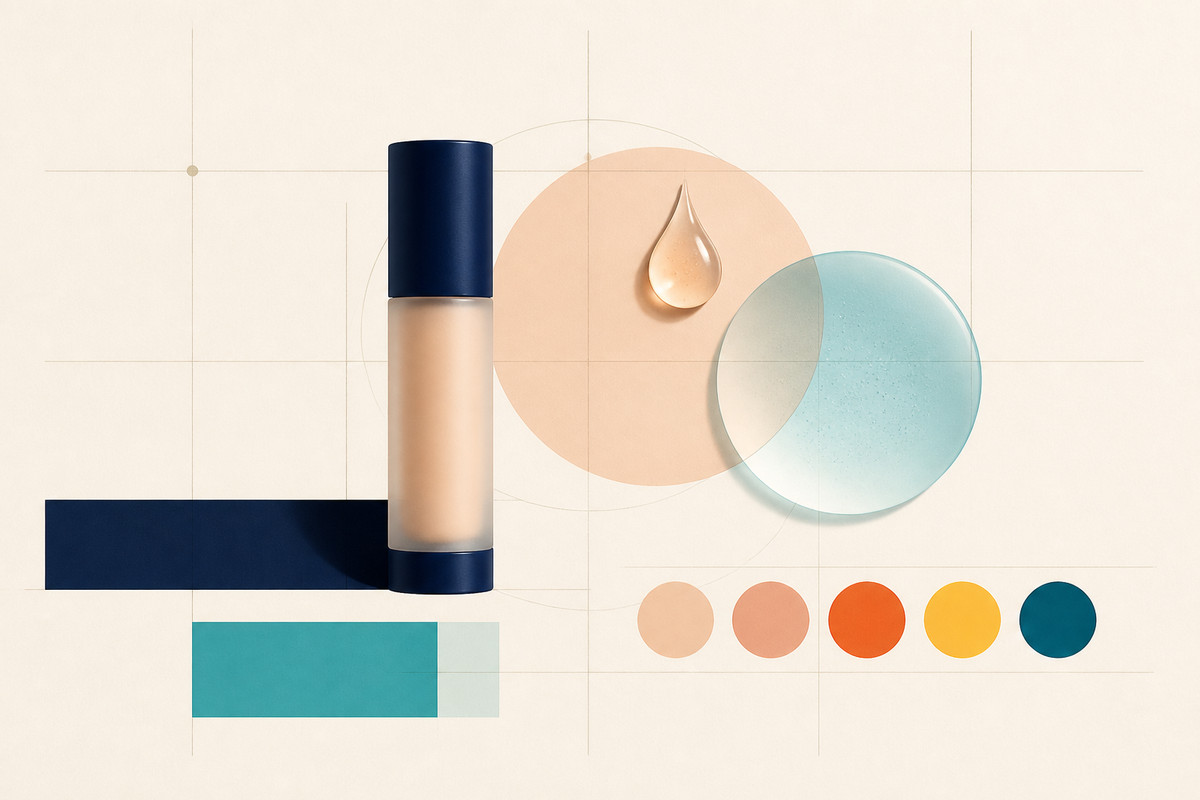
Super Serum Skin Tint SPF 40, launched in 2020, made ILIA’s proposition legible in one bottle. It offers light, dewy coverage; mineral zinc-oxide sun protection; and familiar skincare ingredients including squalane, niacinamide and hyaluronic acid. It is neither a full-coverage foundation nor a substitute for every dermatologist’s sunscreen advice. It is a high-frequency complexion product with several reasons to become habitual. At prestige pricing, that habit matters.
Limitless Lash Mascara supplies the other half of the argument. Clean mascara had a reputation for smudging or underperforming. ILIA went after that difficult category, reportedly testing more than 100 brush iterations before settling on a dual-sided design. One side builds and lifts; the other separates. Warm water removes the formula. The customer does not need to admire the chemistry. She only needs it to survive the day without sprinkling black commas under her eyes.
2018
2021
2024
The surrounding range now covers complexion sticks, concealer, powder blush, multi-use color, lipstick crayons, eyeshadow sticks, eyeliner, mineral SPF and barrier cream. The pattern is consistent: take a familiar beauty format, add a credible skin benefit or application shortcut, then package it in a way that can live on a bathroom shelf without shouting.
03 / DistributionThe company said no to Sephora before saying yes
The retail story contains a useful act of restraint. Sephora approached ILIA early, but Plavsic knew the company lacked the capital and operating plan to support a national opportunity. She declined. ILIA eventually launched with Sephora in 2017, after the product range and business were sturdier. That shelf gave customers a place to test texture and match complexion shades, while the brand’s own ecommerce store supplied education, bundles, loyalty rewards and direct customer data.
Capital arrived alongside that expansion. A reported $3 million financing in 2018 helped ILIA recruit experienced leadership and rethink the range. Silas Capital led a Series A late that year. Sandbridge Capital led a Series B in January 2020, with Silas participating. The amounts for the named rounds were not disclosed publicly. In 2022, Famille C, the Courtin-Clarins family holding company, acquired a majority stake on undisclosed terms.
Figures are company or executive disclosures reported in public interviews. The 2024 figure is net revenue.
The pandemic tested the new machinery immediately. A planned Sephora relaunch collided with mall closures in March 2020. ILIA reassigned field staff toward online marketing and customer service, kept buying ads while others pulled back, and leaned into ecommerce. Reported sales rose 400 percent that year. The episode did not eliminate physical retail; complexion remains a category where trial and shade matching matter. It proved that ILIA could sell the explanation as well as the bottle.
04 / PositionBetween the makeup counter and the medicine cabinet
ILIA sits in prestige beauty’s crowded hybrid lane. Kosas and Saie compete for the skincare-forward color customer. Westman Atelier and RMS Beauty bring luxury and founder authority. Tower 28 emphasizes sensitive skin; Merit and Jones Road pursue edited routines and natural finishes. Larger brands can place niacinamide, SPF or serum language into a complexion launch overnight. “Clean” itself is unregulated and no longer a private moat.
Room for better components, sampling and specialist retail.
Multiple jobs create a practical reason to repurchase.
Light coverage and texture-conscious formulas meet modern demand.
Selected synthetics keep performance inside the promise.
ILIA’s differentiation is therefore cumulative rather than singular. It has a decade of formulation memory, recognizable product design, two established hero products, retailer trust, a broad complexion vocabulary and the backing of a beauty family with global experience. Its customers are buying a coherent system: breathable color, familiar skincare actives, sensitive-skin consideration, inclusive shades and the social permission to look like themselves on a rested day.
The business earns revenue through direct online sales and wholesale partners including Sephora and Ulta Beauty. Bundles turn hero products into routines. Shade tools and samples reduce complexion anxiety. Loyalty and subscription mechanics encourage return visits. Retail supplies discovery; direct commerce supplies margin, education and a customer relationship. The model is conventional consumer goods made stronger by products that run out.
05 / ResponsibilityThe package is still the awkward part
Beauty’s environmental problem does not vanish because a compact looks tasteful. Pumps, mirrors, mixed plastics and tiny components are difficult to process in curbside systems. ILIA uses materials including recycled aluminum, glass and responsibly sourced paper where feasible, and works with Pact Collective on a mail-back program. Customers can send up to 10 eligible empty beauty packages per month, including products from other brands, for sorting and responsible processing.
That program is useful, but it is not the same as proving every package becomes another package. Collection, sorting and material markets remain the hard infrastructure beneath a soft-focus industry. ILIA also participates in 1% for the Planet and has supported reforestation. The honest version of the sustainability story is progress with friction: better material choices, fewer empties in landfill, and plenty of packaging engineering left to do.
ILIA’s advantage is not a perfect ingredient list. It is a product system built around fewer tradeoffs.The market position06 / The next face
More pigment, more countries, more discipline
Paul Schiraldi became chief executive in October 2024, succeeding Lynda Berkowitz. His brief is to give a founder-shaped brand a more formal operating cadence without sanding away its taste. ILIA finished 2024 just shy of $200 million in net revenue. Management has said it wants to double that within three to five years, deepen productivity in existing retail doors and become a top-five player in core categories such as mascara, skin tint and eyes.
A clinically trained beauty executive arrives to structure the next phase.
Eye Stylus and the first standalone powder blush expand the palette.
A 34-shade serum concealer, mineral SPF and new eyeliner continue the hybrid pipeline.
Sampling, events and local voices carry the brand into its priority international market.
The new-product sequence already shows the method. Eye Stylus was delayed after editors reported fragile early packaging, then relaunched in 20 shades after more development. Soft Focus Blurring Blush moved ILIA into standalone powder color. Skin Blur Serum Concealer arrived in 2026 with 34 shades. Barrier cream and mineral SPF push outward from makeup without turning the company into a general skincare shelf.
The risk is familiar: too many launches can blur the edit, international expansion can dilute the local trust that built it, and every prestige customer now expects actives in her foundation. ILIA’s answer is the same compromise that rescued its formulas years ago. Keep the useful tension. Let color be color. Let skincare do measurable work. Use the synthetic ingredient when it solves the problem. And never confuse an attractive restriction with a reason to make a worse product.