Prima began with a design problem disguised as a chemistry problem. In 2019, CBD was everywhere and trusted almost nowhere. It had escaped the dispensary and wandered into coffee, dog treats, bath bombs and beauty counters. The compound was fashionable; the category was a yard sale. Labels were vague, dosages wandered, and customers were expected to perform their own tiny toxicology review before buying a face oil.
Three founders saw room for a grown-up brand. Christopher Gavigan had co-founded The Honest Company and spent years advocating for environmental health. Laurel Angelica Myers had led brand strategy and product development there. Jessica Assaf had been campaigning for safer beauty products since she was 15 and later earned an MBA from Harvard. They formed Prima in Santa Monica in 2018, raised $3.275 million before launch, and introduced products in June 2019.
Their pitch was less “cannabis lifestyle” than “credible bathroom shelf.” Prima paired broad-spectrum hemp extract with familiar botanicals, put the formulas in restrained glass packaging, and explained what was inside. It sold direct online and moved into retailers including Sephora, The Vitamin Shoppe, Nordstrom and Thrive Market. The customer was not necessarily a cannabis enthusiast. It was the ingredient-conscious shopper who wanted softer skin, a cooling rub or a more ceremonial bath without buying from a brand that looked as if it had been designed in a dorm room.
Sell the proof before the potion
Prima’s advantage was not that it discovered CBD. It made uncertainty easier to buy. The company published lot-level batch references and said it used independent accredited laboratories to check quality, purity and potency. It described ingredient sourcing and packaging materials. In July 2020, five products became the first hemp CBD skincare products to receive EWG Verified status. That meant an outside organization had reviewed ingredients, disclosure and manufacturing standards in a category still short on common rules.
This is the most portable part of the Prima playbook. In a low-trust market, every unanswered question becomes friction: Is the ingredient clean? Is the dose real? Will the package be wasteful? Does anyone independent agree? Prima turned those objections into visible artifacts. A batch page is not glamorous, but neither is reading a suspicious label in a store aisle. The best trust systems do quiet work.
“Consumers need guardians and protectors and peace of mind and champions of their health.”Christopher Gavigan, on why buyers should not have to research every ingredient themselves
The brand also understood that proof has to arrive in the right costume. Its bottles looked at home beside luxury skincare, not novelty supplements. Clinical language focused on hydration, firmness and skin feel, while regulatory disclaimers stayed visible. That helped Prima compete against CBD specialists such as Lord Jones and Saint Jane, but also against a bigger group of conventional facial oils, body butters and recovery sticks. The real alternative was often not another CBD product. It was skipping CBD entirely.
A smaller shelf with a clearer job
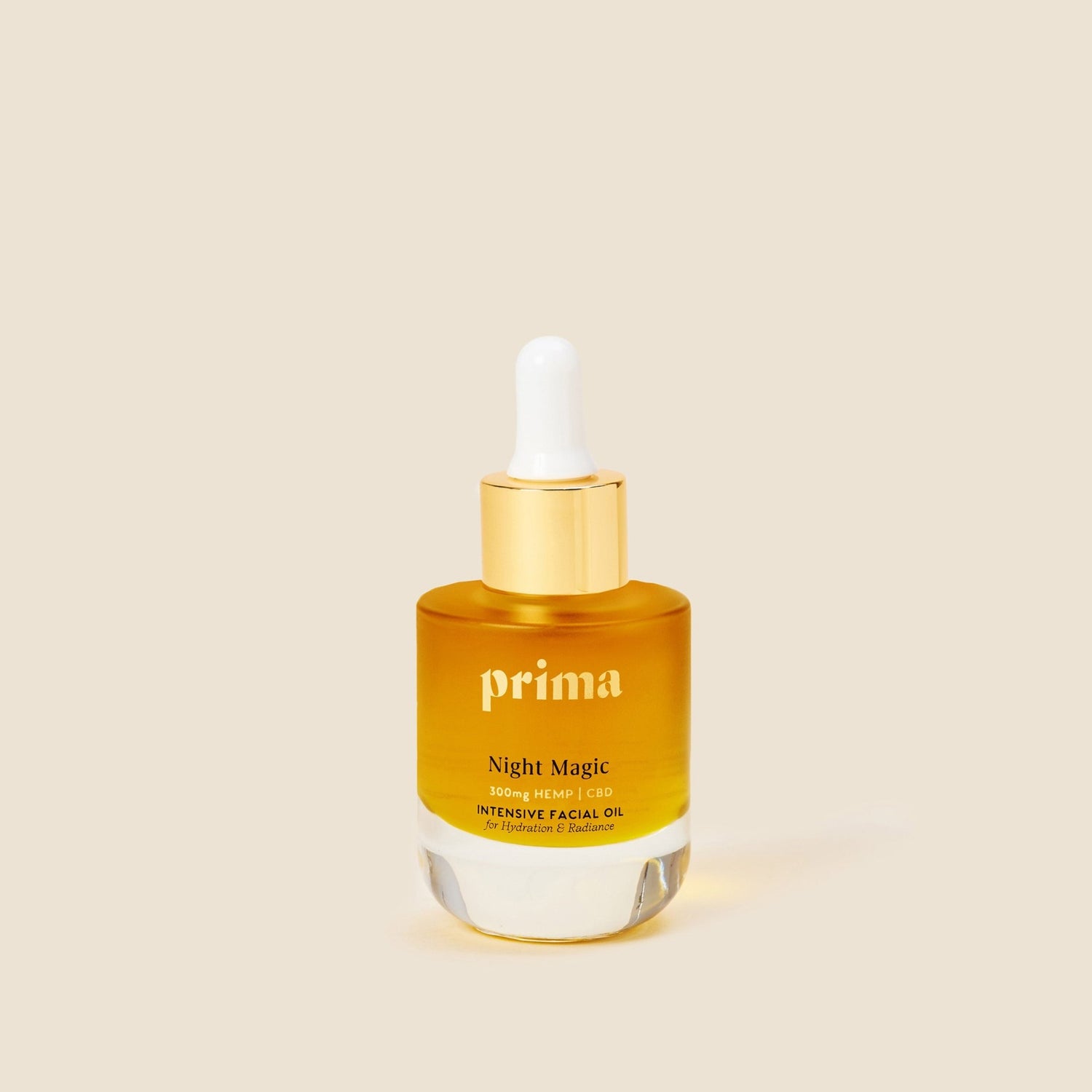
The revived storefront centers on four care products. Beyond Body Oil is a $56 blend with 600 milligrams of organic hemp CBD, magnesium, squalane and botanical oils. Night Magic is a $68 facial oil positioned around hydration, firmness and radiance. Skin Therapy is a $32 body butter for dry skin. R+R Stick starts at $40 and combines CBD with arnica and menthol for targeted cooling. Prices and availability can change, but the architecture is easy to read: face, body, dry skin, sore spot.
That is narrower than old Prima. Earlier catalogs included supplements, powders, bath gems, capsules and more facial care. The range once attacked “stress” as an enormous wellness condition. Today’s assortment tackles jobs a shopper already knows how to shop for. It is less grand and probably easier to merchandise.
Capital in / disclosed rounds
The 2025 sale price was not disclosed. Funding is not the same as acquisition value.
Prima’s business model is familiar consumer packaged goods: gross margin on physical products sold through its Shopify store, plus wholesale economics through retailers. The 2021 financing was meant to support expansion, clinical research, product refinement and education. It also brought a distinguished cap table: Greycroft, H Ventures, Defy and Lerer Hippeau led the round, with Global Founders Capital, Emerald Health and others participating.
03 / The breakWhat failed first: the platform, not the jar
In December 2022, Prima announced that it was acquiring Prospect Farms to form Uplifter Brands. The logic looked terrific on a slide. Prospect Farms brought a 250-acre organic hemp farm, greenhouse, formulation, manufacturing and fulfillment. Its relationships stretched into spas and hospitality. Prima brought products, branding and national retail. Together they could own more margin, move faster and spread across beauty, supplements, hotels, pets and private label.
Then the transaction failed. Prospect Farms later closed. Prima was picked up by turnaround specialist The Hedgehog Co., and the brand paused operations in 2023 while it reassessed the plan. The exact cost of the failed combination has not been made public, and neither has a detailed postmortem. What is public is the sequence: ambitious integration, unsuccessful merger, operational pause.
The conditions were hostile. CBD companies faced continuing legal ambiguity, retail restrictions, payment and advertising friction, and a cooling consumer trend. Vertical integration adds fixed assets and managerial complexity even in calm markets. Doing it while also broadening into multiple categories made the organization more exposed to a category-wide slowdown. The farm did not remove regulatory risk; it concentrated the company’s commitment to the market carrying that risk.
The brand had built a convincing answer to “Can I trust this bottle?” It had a weaker answer to “Should one company own everything behind it?”04 / The return
What changed their mind: a buyer with cannabinoid plumbing
The comeback began with a different kind of owner. In February 2025, Austin-based Sky Marketing Corporation acquired Prima from The Hedgehog Co. for an undisclosed amount. Sky already operated Hometown Hero, known for hemp-derived products, and ORCA, a microdosed line for athletes. It understood the category’s compliance, distribution and operational headaches. What it lacked was a credible skincare and body-care brand.
This is strategic fit in plain English. Prima did not need another owner learning cannabinoids in public. Sky did not need to invent beauty authority from scratch. Prima co-founder Jessica Assaf stayed as a brand advisor to help preserve formulation standards and values. The center of gravity moved from building a sprawling platform to filling a specific gap inside an existing one.
Form, fund, launch
Three founders turn clean-product experience into an education-led CBD brand.
Verify, distribute, raise
EWG recognition, B Corp status, retail growth and a $9.2 million follow-on.
Integrate, then stop
The Prospect Farms combination fails and Prima pauses operations.
Sell, simplify, return
Sky Marketing buys the brand and a focused care range comes back online.
The founder copy sheet
Five moves worth borrowing
Teach before launch. Prima opened with education about hemp and cannabinoids, reducing the category-learning burden before asking for a purchase.
Make trust inspectable. Publish testing, ingredients, packaging facts and the limits of the claim. “Transparent” is weak until customers can click something.
Borrow familiar codes. Prima used prestige-beauty design and recognizable skincare benefits to make an unfamiliar ingredient less alien.
Win one credible shelf. Sephora gave the brand a validator that direct-response advertising could not imitate.
Preserve the brand separately from the machinery. The operating plan stopped, but the name, formulas, customer affection and retail credibility remained buyable.
There is also a lesson in what not to copy. A founder should not assume a trusted brand naturally wants to become a holding company, farm, manufacturer, hotel supplier and pet-wellness platform. Those may be good businesses. They are not automatically the same business. Expansion works when demand is durable, capital can tolerate long payback periods, regulation is legible and the team has deep operating skill in each added layer.
- Third-party badges will not rescue a product that customers cannot feel, understand or afford.
- Premium packaging fails when the category competes mainly on price or medical authority.
- Retail validation can become expensive inventory if repeat purchase is weak.
- Vertical integration is dangerous when regulation, demand and financing can all turn at once.
- A strategic buyer only helps when it supplies the capabilities the brand lacks without erasing what customers valued.
Where Prima fits now
Prima now sits at the overlap of clean beauty, premium body care and cannabinoid wellness. That is smaller than the “stress platform” envisioned at its venture-funded peak, but it is a real position. Its most defensible expertise is translating a contested botanical into an orderly consumer experience: doctor-informed formulation, familiar benefits, visible testing and tasteful packaging.
The company’s future depends on repeat purchase and distribution, figures it does not publicly disclose. It also depends on a CBD market whose rules and reputation remain uneven. Conventional skincare can promise hydration without a hemp compliance file. Pain-focused topicals can lean on menthol or arnica without explaining cannabinoids. Prima must prove CBD adds enough value to justify both the price and the footnotes.
Still, its survival says something useful. Brands are not the same thing as the operating structures built around them. Prima’s platform dream collapsed, but its original work - making a confusing ingredient feel credible and pleasant - retained value. The comeback is not a return to 2021. It is a narrower wager that the bottle was the good idea all along.