Shing Chow left poker after he had learned how to win. That is the detail that makes his career more interesting than a tidy tale about a gambler who got lucky. He had spent years turning a hobby into a profession. By his own account, the money eventually gave him financial independence. Then he began asking whether this was how he wanted to spend the rest of his life.
The arithmetic bothered him. His winnings required somebody else’s losses, with the house collecting its share along the way. Success had answered the question of whether he could make a living. It had left the question of what that living was for. In 2009, he stopped playing professionally. He would spend roughly four years looking for another pursuit before founding the business that became Lalamove.
Today, that business matches people who need something delivered with drivers who can carry it. The contrast is satisfying without needing to be dressed up: a former poker player making a business out of other people arriving where they are supposed to. But the route between those two occupations was neither straight nor comfortably predictable. Chow’s story contains long waits, impatient decisions, and several occasions when the original calculation needed another look.
“I wanted to do something that creates value.”
Shing Chow
A respectable beginning, with a detour
Chow grew up in Hong Kong’s New Territories. His early academic record supplied the sort of credentials that make a conventional career look almost inevitable: ten distinctions in the Hong Kong Certificate of Education Examination in 1995, followed by study in the United States. He studied physics at UCLA, transferred to Stanford for economics, and graduated in 1999.
He returned to Hong Kong and joined Bain & Company. Consulting gave him a respectable destination for those achievements. Three years later, he left it to play Texas Hold’em professionally. The journey from exam distinctions to a poker table was unlikely to appear on a school’s careers noticeboard.
There was no immediate financial triumph. For the first four years, he has said, he barely broke even. That stretch matters because the familiar version of a founder’s biography tends to hurry past the parts in which nothing seems to be happening. Poker became profitable only after a sustained period when the decision to pursue it offered little reassurance.
His later account of the career change was candid about family expectations. He kept the professional poker chapter from his parents until after he had left it. Friends knew; parents did not. A Stanford graduate could apparently handle uncertainty at the table more easily than the prospect of explaining the table at home.
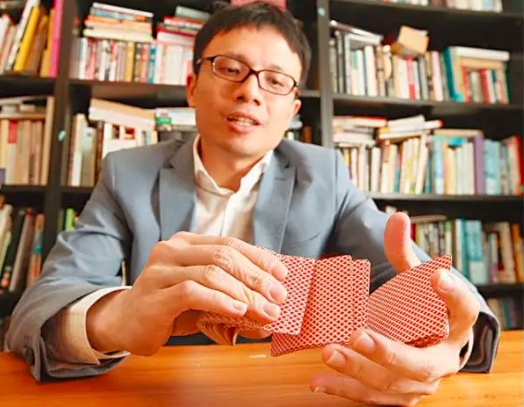
He also returned to academic work, earning an MPhil in economics at the Chinese University of Hong Kong. The résumé refuses to behave. Economics, consulting, professional poker, postgraduate study: the pieces suggest someone willing to reconsider the next step rather than treat the last achievement as an instruction.
Seven weeks to an unfamiliar business
By 2013, Chow had found a promising question in a familiar inconvenience. Hong Kong’s van-delivery market already connected customers and drivers through telephone dispatch. There was demand, there were vehicles, and there were people whose job was to bring them together. Uber’s approach to matching passengers with drivers suggested another way of arranging those encounters.
Chow applied the idea to goods. He did not need to persuade people that things sometimes required transporting. He needed to make the existing transaction easier to organize. This is a less glamorous starting point than inventing a need, but it gives a founder something useful: customers whose problem exists before the presentation does.
Co-founder Gary Hui described the early work as conversations with drivers, call centres, delivery companies, and frequent van users. Location, driver quality, and the customer’s requirements could inform the match. The challenge was to turn what people knew about the market into something a customer could actually use.
Chow could not build the software himself. His early recruitment method was direct: show a candidate an existing app, ask whether they could make something like it, then ask whether they could finish in four weeks. A good deal of technical complexity was being squeezed into a very short interview.
The product took longer. Hui recalled seven weeks from the first line of code to rollout; Chow later described about eight weeks to get the app out. Either account leaves the initial four-week timetable looking optimistic. Yet the product reached customers. The founder’s impatience had an observable result, along with an observable limit.
- 01A requestWhat needs moving?
- 02A matchLocation + requirements
- 03A pickupA driver takes the job
- 04An arrivalGoods reach their destination
Conceptual view of Lalamove’s delivery marketplace.
When a van became a motorcycle
The company began as EasyVan. It was a useful name for a service that made finding a van easier. It also contained a small geographical assumption. When expansion brought motorcycles into the service, the name began describing only part of what customers could book.
The change to Lalamove followed that practical problem. A brand that had been clear in Hong Kong needed to accommodate different vehicles elsewhere. It is a nicely unceremonious reason for a company to rename itself: the business had acquired two wheels, and the sign still said four.
Behind the name was a more demanding adjustment. Cargo varies. A package and a bulky piece of furniture impose different requirements on a vehicle and its driver. Taking the model into another city meant understanding what people moved there, how they expected to book it, and which vehicles made sense.
Chow wanted the business to extend beyond Hong Kong from the beginning. Mainland China operated under the Huolala name, while Lalamove developed internationally. The company separated teams for China and Southeast Asia, giving the different markets their own people and operations. Expansion required more than translating the words on a screen.
This is where the poker comparison begins to lose some of its usefulness. At a table, Chow could rely heavily on his own judgment. A company needed people whose knowledge he did not possess. Local decisions had to be made by someone who understood the locality. The founder’s job included making room for expertise, even when his own appetite was to move quickly.
The bill for moving quickly
Chow initially thought HK$2 million would be enough to get the business going. As he learned what building it required, that estimate grew. He put in more money, then sought outside funding. His account of those changing expectations is refreshingly free of the suggestion that the whole thing had been calculated correctly from the start.
An app can give a business an appearance of simplicity. A customer sees a booking, a price, and a driver. The company must make the encounter happen repeatedly, across different places and circumstances. It has to recruit, support, improve, and explain. A small rectangle of glass is an efficient hiding place for a large amount of work.
Chow’s original budget for the venture. Building the business led him to commit more capital and raise outside funding.
His colleagues describe the early hiring challenge in similar terms. Blake Larson recalled having to convince people to join when there was still an idea rather than a finished service. Later, the emphasis shifted toward hiring people who would raise the abilities of the team. Recruiting changed as the company changed.
Chow’s own public reflections on his headquarters team extend beyond headcount. He has described wanting employees to experience personal growth and use their talents on a larger stage. That aspiration gives a different measure of the founder’s transition: the work now included creating opportunities for other people to improve.
None of this makes speed an uncomplicated virtue. A fast decision can produce a useful experiment or an expensive correction. What stands out in Chow’s accounts is his willingness to revisit an assumption once experience has challenged it. An early budget, a proposed timetable, even a company name could be changed. The business did not have to defend every first answer forever.
A brand that travels without him
The international ambition has continued to acquire addresses. Lalamove launched in Tokyo and Istanbul in 2024. Dubai followed in 2025. Its July 2026 announcement of an official launch in Riyadh also confirmed that Berlin operations had begun in May. These are dated milestones in the company’s expansion, rather than a promise about where it might go.
Riyadh brings the original matching problem into another setting. The announced service includes sedans, vans, pickups, and larger trucks, with multi-stop orders and Arabic-English customer support. The underlying proposition remains recognisable. The details have to meet the city.
Chow’s aspirations for the brand are more personal than a map alone suggests. In his 2022 alumni interview, he described wanting Lalamove to become synonymous with delivery. That ambition sits comfortably beside his preference for keeping the company more visible than its founder.
“Lalamove should be a lot more famous than I am.”
Shing Chow
There is also a guitar in the story. His alumni profile describes his playing as another occasion to test the value of finding a method and staying with it. It is a modest detail beside international expansion, but a revealing one. Practice remains part of the picture even after the professional poker chapter has closed.
Chow’s career makes persistence look more interesting than simply remaining in place. He stayed with poker through difficult years, then left when it was working. He stayed with the delivery idea while changing how he funded it, what he called it, and whom he needed beside him.
The decision to leave the table was therefore more than an unusual prelude to a startup. It set the terms of the story that followed. He had learned how to win a game and then asked what he wanted the winnings to make possible. Lalamove supplied a practical answer, one booking at a time: somebody has goods to move, somebody else has a vehicle, and there is work in getting the two together.