The shark was an advertisement. That was part of its charm. In Back to the Future II, a gigantic holographic predator lunges at Marty McFly outside a cinema advertising Jaws 19. Shawn Frayne watched the scene as a child and acquired a question that would follow him into adulthood: how do you make an image behave like something in the room?
Other viewers could enjoy the joke and wait for the next scene. Frayne wanted the equipment. Today he is co-founder and CEO of Looking Glass, working between Brooklyn and Hong Kong on displays that let people see digital content with depth, without putting on glasses or headsets. The cinematic future had given him a deadline of sorts. The film was set in 2015. Reality has required rather more development time.
A shark with unfinished business
Frayne got started with conventional holography while still in high school. His parents gave him the Holography Handbook, and he built a studio with his father. There were lasers and mirrors; his first successful subject was a small pewter Mickey Mouse. It was a respectable beginning for someone whose expectations had been set by an airborne shark.
He has recalled taking that first hologram outside and running around the cul-de-sac in Tampa in the early hours to celebrate. The image was static. The excitement was considerable. There is something wonderfully specific about a teenager treating a captured Disney figurine as an event worthy of a neighborhood victory lap.
At MIT, where he studied physics, Frayne trained in holography with Stephen Benton. He expected the moving, computer-controlled version to be hiding somewhere in the institution’s laboratories. Instead he found a gap between what movies could promise and what the available technology could deliver. He graduated in 2003. The shark would have to wait.
The useful detour
For years, Frayne pursued other ways of making things. Some were concerned with electricity rather than images. Work in Haiti brought him up against a practical problem: how to make a wind-powered generator small and inexpensive enough for modest electrical needs, including lights and radios. Shrinking a familiar turbine was proving an awkward answer.
The Windbelt took another route. Air passing over a tensioned membrane made it flutter. Magnets moved relative to coils, generating electricity. The idea drew on aeroelastic flutter, a phenomenon associated with the collapse of the Tacoma Narrows Bridge in 1940. A behavior engineers usually try to suppress became the useful part of the device.
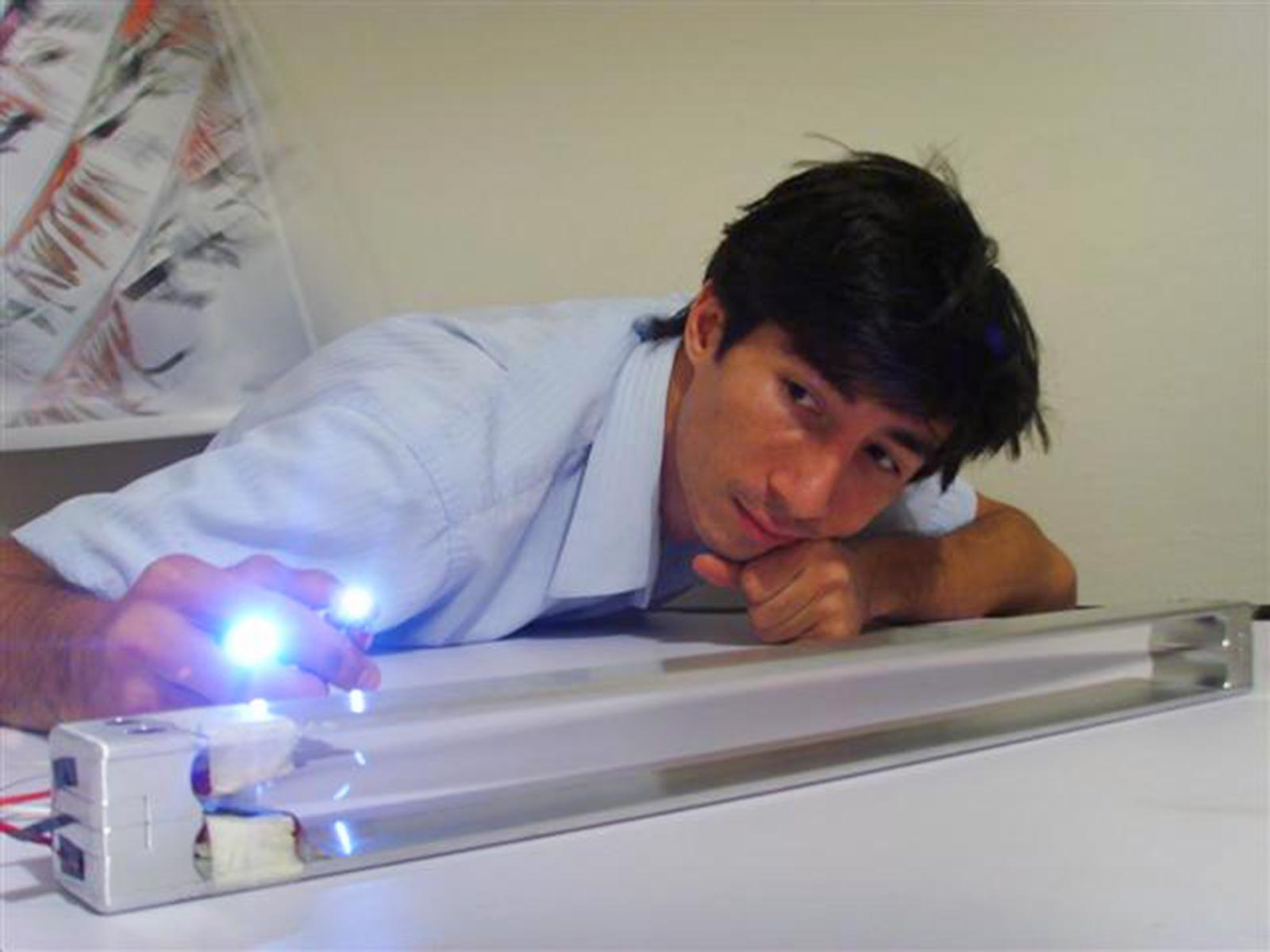
The project earned a Popular Mechanics Breakthrough Award in 2007 and recognition from the Curry Stone Design Prize in 2008. Humdinger Wind Energy, which he co-founded, pursued the technology. In 2009, he appeared in Inc.’s 30 Under 30, with the company operating between Honolulu and Hong Kong.
This part of his career deserves more than a footnote beneath the holograms. It placed cost, size, materials, and actual use at the center of an invention. The challenge was to make something work under constraints. A movie audience rarely asks who will manufacture the prop or how much friction its gearbox creates. An inventor eventually has to.
A factory small enough to argue with
By 2012, Frayne and fellow inventor Alex Hornstein were working on the Solar Pocket Factory. Their ambition was to automate the production of small solar panels with a compact machine. The project’s Kickstarter campaign raised more than $70,000. Frayne took pieces of the prototype into a backyard for a Science Friday demonstration, giving the proposed factory a suitably domestic stage.
The pair described the idea as closer to a microbrewery for solar panels than a machine intended for every garage. The distinction suited the problem: manufacturing could become smaller and more local without becoming another appliance everyone had to own. It also showed a partnership taking shape around practical experiments well before Looking Glass became their shared business.
In June 2014, Hornstein and Frayne gave a university seminar in Hong Kong about the modern invention lab. They asked what forms of collaboration might replace the large laboratories associated with earlier industrial eras. Their work already included volumetric printing and a 3D video display. A career that can look like a sequence of unrelated devices was also a continuing investigation into how inventors could work together.
Looking Glass dates its founding to 2014. Its early products included volumetric prints and an LED cube; a desktop holographic developer kit followed in 2018, then Looking Glass Portrait in 2020. These were successive attempts to put depth, motion, and accessible creation tools into physical objects people could actually use.
Leave room for the other person
Frayne’s ambition contains a social preference. People should be able to gather around the same digital object. Someone arriving at the display should be able to look, rather than first arrange a private viewing through a wearable device. That choice creates its own engineering demands.
His description of the earlier technology is direct: “Technically our displays are light field displays.” Those systems send multiple perspectives of a scene in different directions. A viewer who moves sideways sees a changing view. Another person standing nearby can receive a different perspective at the same time.
“Technically our displays are light field displays.”
Shawn Frayne, 2022
That helps explain both the appeal and the difficulty. The display has to distribute its image information across views. Software, optics, and the content being shown all matter. Putting the effect into a photograph inevitably compresses the experience back into the sort of flat image Frayne has spent years trying to move beyond.
In 2022, Looking Glass introduced a 65-inch display, with a volumetric documentary, Zanzibar: Trouble in Paradise, shown at Tribeca. The scale opened the experience to a larger gathering. The small object on a desk and the installation at a festival were different settings for the same invitation: come over and look.
The company also worked on a Mandalorian fan experience with Jon Favreau’s team. Production assets appeared in three 32-inch Looking Glass displays, allowing visitors to see spacecraft in a dimensional presentation. Frayne’s childhood fascination had acquired an enjoyable symmetry. Film had supplied the original provocation; now film productions supplied material for his displays.
The CEO enters the picture
Frayne is willing to put himself inside a demonstration. For the 2025 launch of Looking Glass’s Hololuminescent Display, he introduced a supposedly personal revelation on LinkedIn: “A holographic video of me dancing.” It was a reasonable way to show the product. It also gave the company’s chief executive a role that few organizational charts bother to specify.
His curiosity extends beyond displays. In his personal newsletter, he has written about attempts to make enormous bubbles, prototypes for socks intended to help their wearer moonwalk, and regret over a self-inflating bubble-wrap invention called Wonderfil. Packaging has seldom enjoyed such distinguished company.
A Code Story interview describes his team’s nickname for him: Frugal Frayne. His idea of relaxing included a cold beer and thinking about other inventions. These details make the career easier to picture. The public persona leaves room for odd experiments, inexpensive pleasures, and the possibility that another device might be worth making.
The screen learns an ordinary trick
The newer Hololuminescent Display, or HLD, takes a different technical route from the company’s multi-view light-field products. Introduced in September 2025, it combines a conventional display panel with an integrated holographic volume. It is designed to make adapted video appear dimensional while fitting familiar production and digital-signage workflows.
Multi-view light field
Different perspectives of a 3D scene travel in different directions.
Content prepared for multi-view displayHololuminescent Display
A display panel works with an integrated holographic depth layer.
Adapted video in familiar workflowsThe distinction matters. A shop or event team may have an existing library of videos, an editing process, and a system for scheduling screens. HLD addresses that environment. Familiar tools and panel manufacturing become part of the proposal. The difficulty of introducing a display includes everything the owner must do after opening the box.
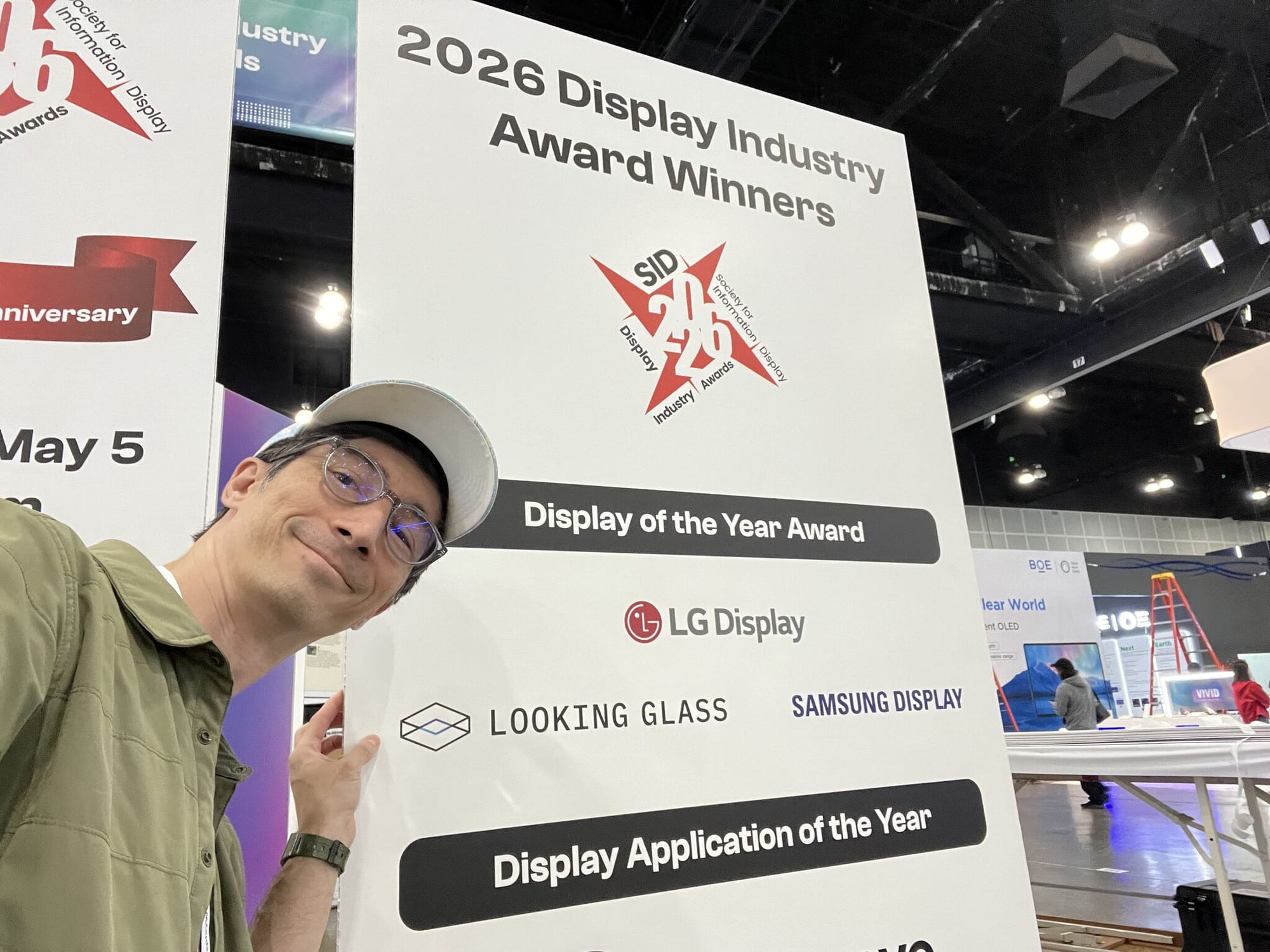
In April 2026, the Society for Information Display awarded HLD a Display of the Year honor. At Display Week in Los Angeles the following month, Looking Glass demonstrated an 86-inch version. Frayne appeared beside the award-winners sign, wearing a cap and the expression of someone happy to have located his company’s name.
The year also brought musubi, announced in March: a seven-inch photo and video frame using HLD technology. Its desktop application converts existing images and video into files for the frame. The same broader ambition could now take the form of an object intended to sit among personal belongings, rather than dominate an exhibition booth.
In June, Frayne announced a further experiment: a prototype that switches electrically between full-resolution 2D and holographic modes, without moving parts. Looking Glass showed it with JCDecaux at VivaTech in Paris. It remained a prototype, intended to lead toward a second generation of HLD.
His stated requirements were revealing. The desired display should need no headgear, work for groups, compete on cost at large manufacturing volumes, and preserve ordinary 2D resolution. After all those years pursuing images that could escape the flat screen, he was insisting the screen should still do its everyday job properly.
The shark remains a useful beginning. What followed has involved collaborators, wind, coils, solar panels, patents, software, and manufacturing. Frayne has kept the childhood question alive while repeatedly changing the machinery around it. The next person who walks up to one of his displays will ask a simpler question: what am I looking at? He has spent a considerable portion of his life preparing an answer.
Follow the experiment
Projects, conversations, and Frayne’s own writing.