In December 2015, Looking Glass had a ghost in a box. A small volumetric display showed a moving image of a friend wearing a hat. To the team that built it, this was a breakthrough: a computer could update a three-dimensional scene, and they thought the hardware might eventually cost less than $1,000 to manufacture at scale. To almost everyone else, it was difficult to make out.
“The resolution was just too low,” the company recalled in its 2018 account of those experiments. That is a wonderfully inconvenient sentence for a company selling the future. The machine had done something remarkable. The audience still needed a better picture.
- Shared depth: Looking Glass makes spatial displays people can watch together, without headsets.
- Two distinct jobs: light field for multi-view 3D scenes; HLD for video staged with holographic depth.
- The commercial turn: preserve familiar video workflows so buyers have less new work to do.
A decade later, that same tension makes Looking Glass worth watching. Its products have become clearer, thinner and more varied. But its most revealing change concerns the person making the content. The company now offers a way to create a dimensional display experience without first becoming a specialist in 3D production. The spectacle goes out front. Much of the complexity stays backstage.
A screen that lets you point
Looking Glass was founded in 2014 by Shawn Frayne and Alex Hornstein. Today it operates from Brooklyn and Hong Kong. Frayne’s interest in holography began early: his company biography describes a laser-interference studio he built in high school, followed by further training at MIT. The origin has the pleasing shape of an obsession acquiring an office.
The early office contained plenty of experiments. The team tried spinning LED arrays, optical reimagers and large woofers attached to projectors. Some prototypes worked well enough to become developer kits; proceeds went back into research. By July 2018, the company was launching a desktop Looking Glass for 3D creators, normally priced at $600, with a limited $399 launch offer.
The proposition was social as much as optical. A headset puts a person inside a private view. Looking Glass puts a spatial object in front of several people. They can look, move their heads and point while remaining in the same room. For a design review or a museum encounter, that changes the choreography: the experience can begin with someone simply saying, “Look at this.”
Two kinds of depth, two kinds of buyer
There is a distinction here that the word “hologram” tends to obscure. Looking Glass’s light field displays generate multiple perspectives of a scene. As a viewer changes position within the viewing cone, the view changes too. This makes them useful for content whose spatial structure matters: a model, a terrain map, an interactive application.
The company’s ArcGIS demonstration is a concrete example. Built in Unity, the beta application brings terrain, elevation, buildings and other geospatial layers onto a Looking Glass display. Users can orbit, pan and zoom. The company’s Unity integration captures multiple views and combines them for the display. A planning team gets a shared spatial presentation of data that already exists in three dimensions.
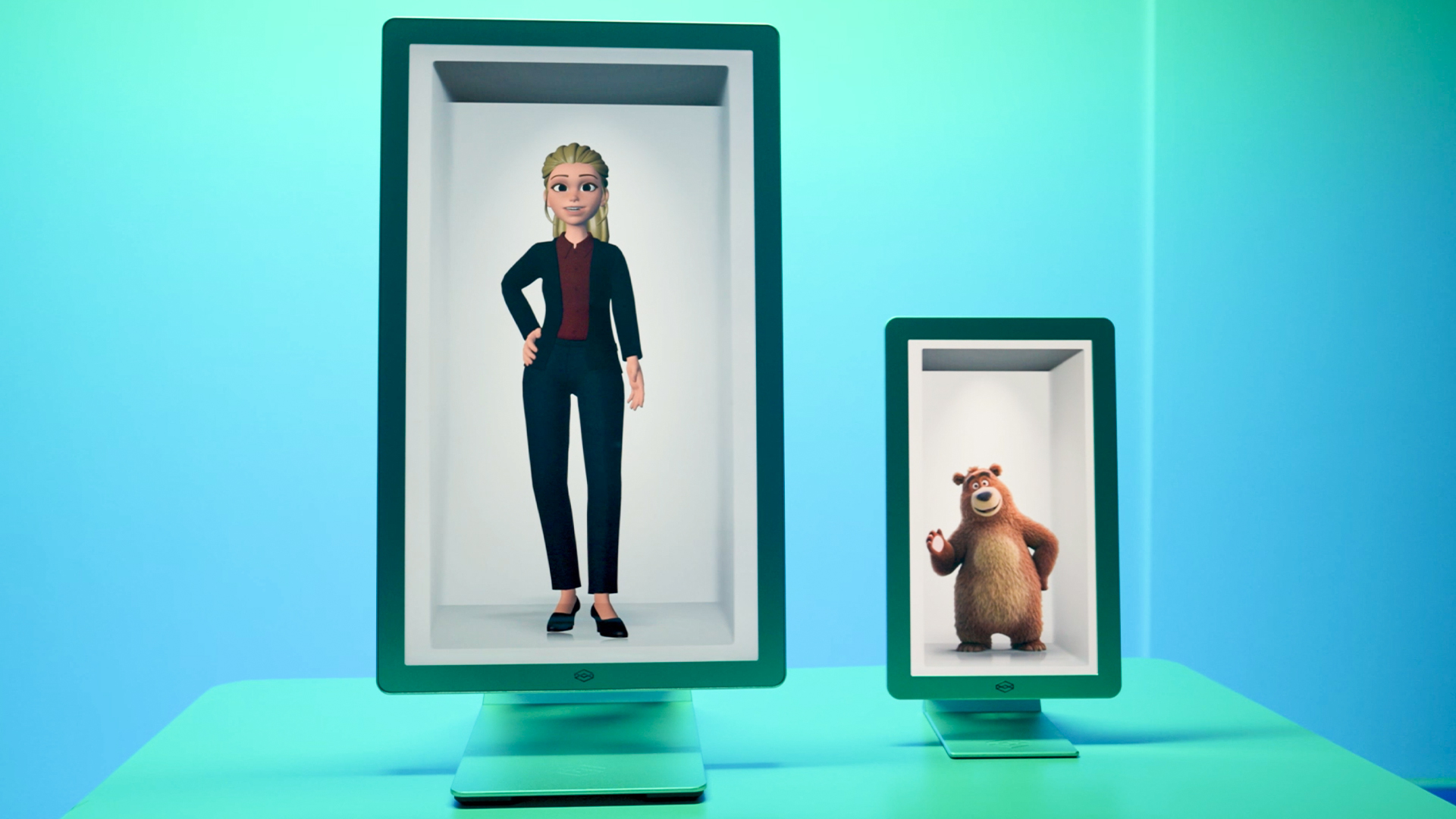
Hololuminescent Displays, announced in September 2025, solve a different problem. HLD combines a fixed holographic volume with a high-resolution display panel. Video content appears on a dimensional stage. It does not recreate the same multi-view spatial scene as the light field range. That difference matters to anyone considering a purchase.
Inspect the scene.
Multiple perspectives
3D models and applications
Research, design, visualization
Stage the subject.
Fixed holographic volume
Prepared standard video
Retail, characters, brand moments
A retailer showing a character or a product may want presence more than geometric inspection. An engineer reviewing a complicated model may need the changing viewpoints. Both audiences can enjoy depth. They have different reasons for paying for it.
The expensive part can be the workflow
In a September 2025 essay, Looking Glass described the question behind its new direction: “What if you just want the magic?” The company explicitly separated the demands of advanced spatial work from the desire to make someone pause in front of a screen. It had found a second customer problem worth solving.
The resulting HLD pitch is unusually practical for this corner of technology. Use video tools such as Premiere or After Effects. Deploy through familiar video infrastructure. Connect through HDMI. The company also offers HLD Author, a browser tool for framing content, previewing treatments and exporting an appropriate MP4.
“What if you just want the magic?”
Looking Glass, September 2025
This is the part another product team can copy: identify what the buyer already knows how to do, and preserve as much of it as possible. An unfamiliar output becomes easier to commission when production resembles work already on the calendar. The display can surprise the audience without requiring an equally surprising staff retraining programme.
There is still preparation to do. Framing, backgrounds and visual composition affect how convincing the result looks. An ordinary video workflow is not a promise that every existing advertisement will become a good spatial advertisement. The buyer needs to choose material that benefits from the stage, then test it on the hardware.
The price tag has several neighbours
As researched in October 2026, Looking Glass lists its 16-inch HLD at $2,000, its 27-inch version at $4,000 and its 86-inch version at $20,000. Those figures establish the equipment scale. They do not constitute a finished installation budget.
Listed hardware prices, October 2026. Content, mounting and deployment are separate decisions.
The light field range has its own economics. When the 27-inch light field display began shipping in July 2025, its announced MSRP was $10,000. The company also described iPad-powered operation and an approximately 60% system-level cost reduction from its predecessor. That reduction is a company claim about the system, not a discount applicable to every installation.
Computing, content creation, integration and mounting all belong in a buyer’s calculation. The sensible experiment is to begin with one display and one use case, then assess whether shared spatial viewing helps the actual task. A longer glance at a character and a better understanding of terrain are different outcomes; each deserves its own test.
From the lab to the family photograph
The customer list on Looking Glass’s careers page includes Pixar, Nvidia, Disney and LVMH. It also says the displays reach tens of thousands of creators. These are the company’s own descriptions of its reach. A more specific enterprise example comes from Accenture, which reported using a 65-inch Looking Glass in its San Francisco lab when it announced a strategic investment in February 2023.
Accenture’s Project Spotlight programme offered access to enterprise clients and expertise alongside the investment, whose terms were undisclosed. Earlier, Foundry had announced participation in a $10 million financing in March 2017. Together, those announcements show outside backing for an expensive combination of optics, hardware and software.
Partnerships also make the use cases visible. In 2025, Looking Glass and VeVe displayed digital collectibles at DesignerCon Hong Kong and New York Comic Con. The HLD screens provided a physical place to gather around assets usually encountered on a phone. It is a particularly apt setting for a product whose first requirement is an audience willing to look.
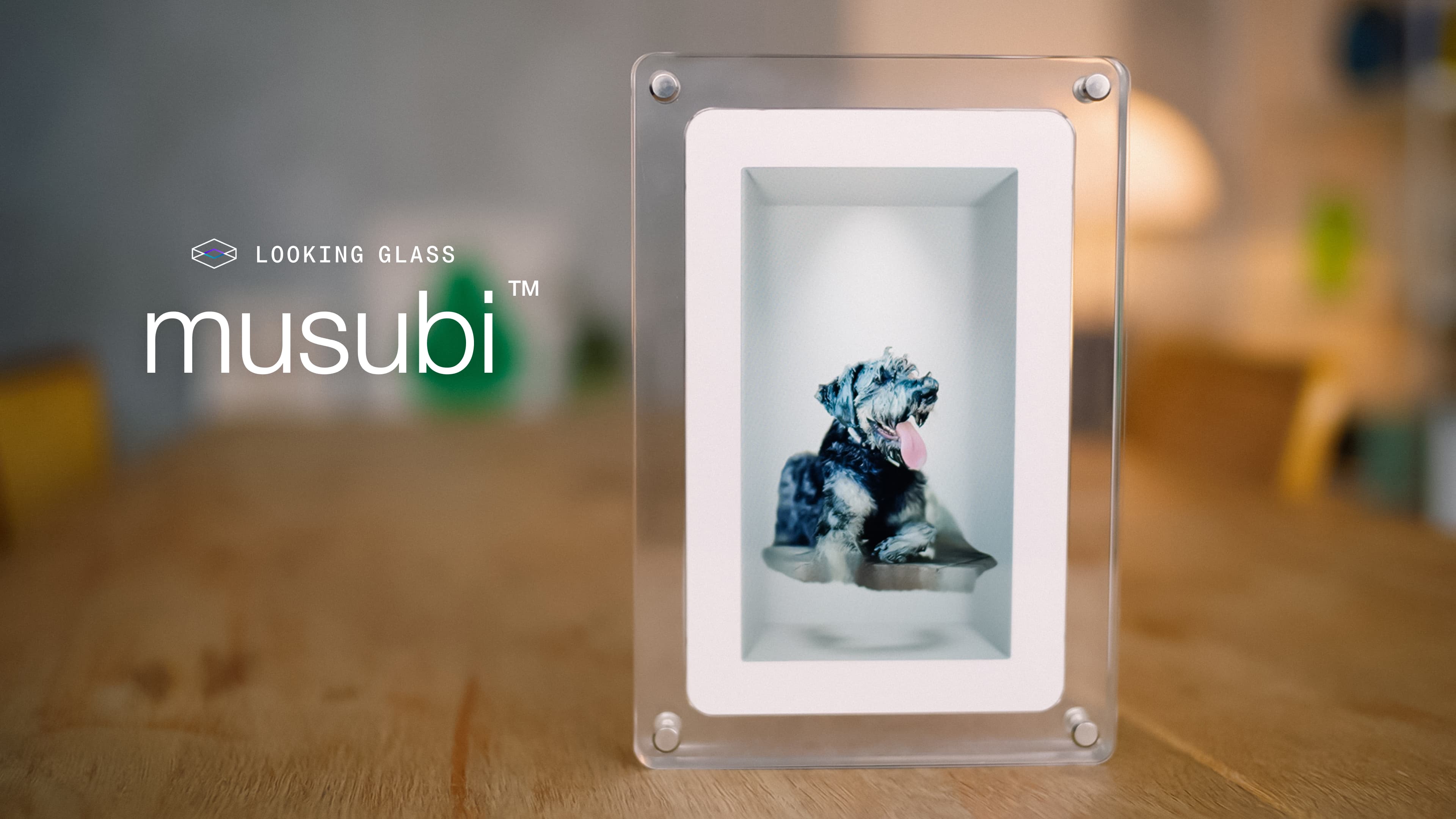
With musubi, announced in March 2026, the invitation became domestic. Its $149 list price belongs to a different spending decision from enterprise signage. A free Mac or PC app converts photos and short videos; files transfer to the seven-inch frame over USB-C. The company advertises local storage, no Wi-Fi setup and no subscription.
The advertised limits are useful rather than glamorous: up to 1,000 converted images or clips, videos up to 30 seconds and battery operation up to three hours. A launch campaign offered a $99 first-day price. The business proposition is understandable without a tour of an innovation lab: put a familiar memory somewhere you will see it again.
The next trick is being useful when nothing floats
In 2026, the Society for Information Display named Looking Glass’s 16- and 27-inch HLDs among its Displays of the Year. In June, the company revealed another direction: a prototype that switches electrically between full-resolution 2D and hologram mode. It demonstrated the technology with JCDecaux at VivaTech in Paris.
The prototype remains a development announcement. Looking Glass’s claim that future versions could approach ordinary display costs at manufacturing volumes of millions is an ambition dependent on scale, rather than a current price promise. But the design question is telling: can the same screen handle ordinary work without a penalty, then become spatial when the content calls for it?
The boundaries of the current products remain part of their usefulness. HLD’s fixed stage is poorly suited to work requiring precise multi-view inspection. Light field scenes require the right content and rendering, and the viewing cone limits where the audience can stand. A conventional screen may already do a particular job adequately. Depth earns its place when people gain something from seeing together.
Looking Glass’s early ghost needed a clearer picture. Its newer displays need an easier route from an idea to something worth watching. That is the company’s most transferable lesson: an invention becomes a product through the small, unromantic decisions that let someone else use it.
Looking Glass · Display guides · GitHub · Company blog
LinkedIn · X · Instagram · Facebook
Watch: the 86-inch HLD demo ↗
More product videos ↗
SID’s 2026 display awards ↗
Accenture’s investment announcement ↗