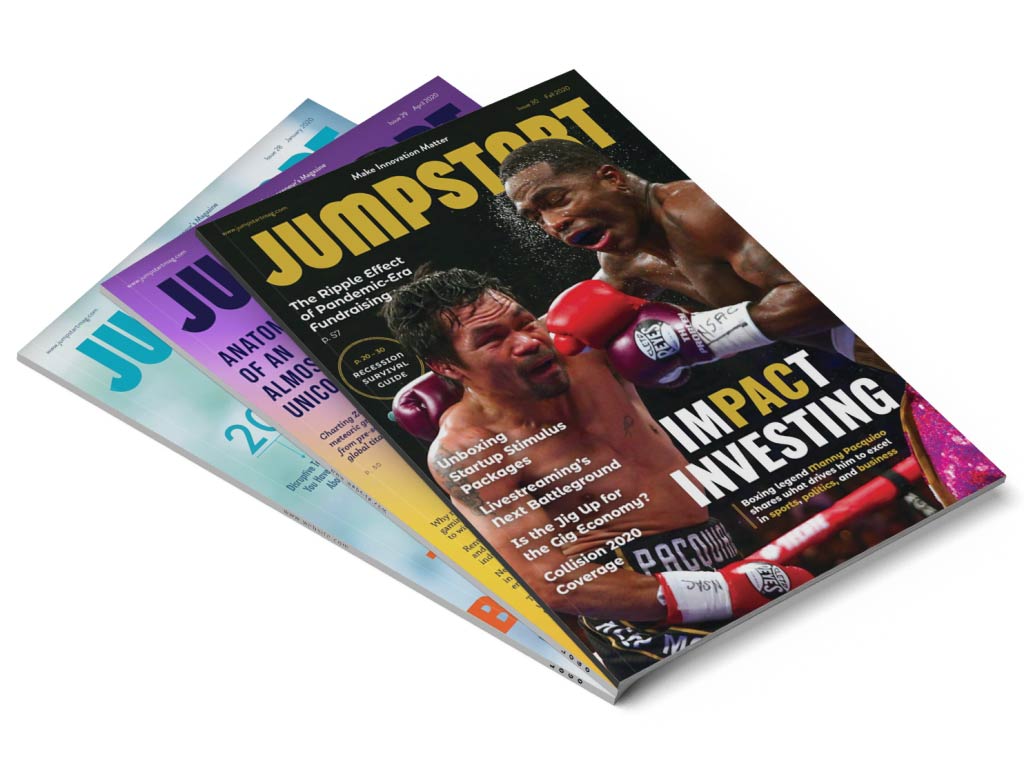
In September 2014, a reader opening Jumpstart could find advice on getting a product into Hong Kong supermarkets. Nearby were lessons on opening a shop at PMQ, improving customer service and making a first $1,000. The magazine’s ambitions were rooted in wonderfully unglamorous questions. Someone had made something. Now they needed a shelf, a customer, perhaps a person who would return a call.
That early issue helps explain the company Jumpstart became. A publication serving entrepreneurs soon encounters problems that another article cannot solve. A founder needs an introduction. A corporate team needs a startup it can work with. An investor needs a reason to pay attention. Jumpstart built services around those encounters.
- A startup publisher that also builds programs and connections.
- Customers include founders, corporate teams, investors and educators.
- Acquired by TNGlobal in August 2026; still carries the Jumpstart name.
First, help someone sell something
Yana Robbins founded Jumpstart in Hong Kong in 2014. The September/October issue named her Editor-in-Chief and invited experts to share practical knowledge. Its contents treated entrepreneurship as a collection of learnable tasks: sales, distribution, hiring help, choosing a space. Even its education theme came with homework. Could a new business generate $1,000 in its first month?
There is a useful editorial instinct here. An audience becomes easier to understand when you know what its members are trying to accomplish. “Entrepreneurs” is an enormous category. People trying to get a product into a supermarket have a shared obstacle. Answering their questions gives a publisher a reason to exist beyond filling pages.
The reader becomes the introduction
Today, Jumpstart describes four divisions spanning media and events, corporate partnerships, youth outreach and venture engagements. Under those headings sit recognizable activities: publishing, workshops, accelerators, investor matching and education. Its expertise lies in assembling people, explaining their work and designing opportunities for them to meet. The company calls this “Innovation as a Service.”
The distinction matters for customers. A founder can read coverage to understand a market or explore opportunities to present a product. A corporate innovation team can discuss a tailored program. Investors can seek connections and deal flow. Students enter through education. Those groups share an interest in new businesses, but they arrive with different jobs to do.
Money enters through advertising, media partnerships, sponsorships and program collaborations. Jumpstart’s advertising pitch claims more than 145,000 readers across 11 countries. Treat that as the company’s audience claim. The commercial proposition is straightforward: reach a defined professional community, then build services relevant to it. For a buyer, the useful question is which people a particular engagement can actually reach.
a reason to read.
people together.
partners and buyers.
For a corporate buyer, the sensible starting point is a defined assignment: a workshop, a startup search or a showcase for a particular audience. Agree on the deliverables and the price before judging the promise of access. For a founder, ask who will attend and why. A crowded event is useful only if the relevant conversation can happen there.
The classroom had a publishing deadline
The most charming demonstration came from children. In 2016, a Jumpstart Kids group aged eight to eleven wrote a babysitting book in four days. They brainstormed more than 30 ideas before choosing their subject. The planned 38-page guide would appear in English and Cantonese, with proceeds supporting Hong Kong Dog Rescue.
The children also worked on layout, approached sponsors and practiced media interviews. Their crowdfunding campaign reached its goal in three days. Entrepreneurship became a sequence of decisions with consequences: choose a reader, make something useful, ask someone to support it. A babysitting guide is a pleasingly concrete answer to the otherwise slippery instruction to “be innovative.”
In September 2020, Family Mask and Jumpstart announced a Young SDG Leaders junior program introducing the United Nations and its 17 Sustainable Development Goals. The subject had widened to social responsibility. The practical educational question remained: what can a young person make, explain or contribute?
A signature did not become cash
Close connections create complications. In June 2020, Jumpstart published an investigation into WorkTech and disclosed its own commercial connection. WorkTech had discussed investing in Jumpstart, and a SAFE agreement had been signed. Jumpstart said it ultimately received no funds. It also disclosed a WorkTech advertorial in its January 2020 issue.
That episode deserves space in the company’s story because it exposes the pressure inside this model. The people a publisher covers can also become advertisers, partners or prospective investors. Disclosing those ties helps readers evaluate the reporting. For founders, the narrower lesson is equally practical: a signed agreement and money received are separate milestones.
THE PRACTICAL DISTINCTIONA signed agreement and money received are separate milestones.
Analysis of Jumpstart’s 2020 disclosure
A bigger room, with the same local door
By March 2020, incoming CEO Relena Sei was already describing Jumpstart as “much more than just an entrepreneur’s magazine.” James Kwan moved from CEO to executive chairman, focusing on partnerships and expansion. The change made the company’s direction explicit: its relationships could support activities beyond publishing.
On August 4, 2026, TNGlobal announced its acquisition of Jumpstart. The plan paired Jumpstart’s Hong Kong relationships with the wider TechNode group’s regional network. Jumpstart would retain its established brand and editorial identity. The attraction, as described in the announcement, was access across markets, capital, partners and talent.
An October trade-fair appearance supplied a tangible example. TNGlobal reported that Jumpstart’s Hong Kong Electronics Fair pavilion showcased five companies across AI hardware, robotics, wearable technology, edge computing and AI-enabled commerce. There were products to inspect and people to question. A network had acquired a floor plan.
Bring a specific problem
In the market, Jumpstart sits where specialist technology publishing meets events and startup support. Publications such as Tech in Asia, e27 and Digital News Asia are alternatives for readers; accelerators and event operators compete for particular projects. Jumpstart’s pitch combines these activities around a Hong Kong base and regional connections. That combination is most useful when a customer needs both visibility and an introduction.
The copyable idea is modest: serve a clearly defined audience, learn where its work gets stuck, then create a useful encounter. The conditions matter. A corporate contact needs authority and budget. A startup needs something worth buying. An introduction cannot supply missing demand. Jumpstart’s story begins with a supermarket shelf because access only matters when someone has a product ready to put on it.
Step into the conversation
Read Jumpstart Magazine, browse the print archive or explore media partnerships.