Before Saeed Amidi had a global startup platform, he had tenants. That distinction gives his career a pleasingly practical beginning. At 165 University Avenue in Palo Alto, the family’s office building brought him close to companies whose names would later become part of everyday speech. Google and PayPal passed through. Logitech established its first American office there. The property acquired a nickname: the Lucky Building. Most landlords would have been satisfied with a memorable letting history. Amidi found a second occupation.
In 2026, marking twenty years of Plug and Play, he described himself and his brother as accidental investors. Their move from property into technology had been unexpected. The ambition that followed was deliberate: give founders access to funding, corporate relationships and useful people. The interesting question in Amidi’s story is how much of an address can be reproduced. You can buy another building. Arranging for the future to move in requires rather more work.
The allowance stopped. The work began.
Amidi was born in Tehran in 1960 and grew up in an affluent family. By the time the Iranian revolution overturned the family’s circumstances, he was a student at Menlo College in California. His father would continue paying tuition, but living expenses were now his own responsibility. It was an abrupt revision to the comfortable future he had expected. The instruction came with a possible route forward: help find business opportunities, and get paid for doing so.
Packaging and bottled water became his early working world. These were businesses with material, shipping and customers at the centre of them. Long before he was evaluating software founders, Amidi was learning what it meant to build revenue and keep an enterprise going. His father remained a formative business influence.
He still returns to that reversal when discussing entrepreneurship. In a September 2026 conversation recorded before an audience in San Jose, he revisited the end of his privileged student life and the pressure that pushed him into work. His own beginning makes the question of commitment personal. He has lived through having to replace an expected future with a business that could pay its way.
- 1979Student into entrepreneur
Packaging & bottled water - ThenProperty into proximity
The Lucky Building, Palo Alto - 2006A place for founders
Plug and Play, Sunnyvale - 2026A wider circle
Applied AI & global partnerships
Selected milestones, from the early businesses to the global organisation.
Twenty attempts at a useful conversation
His first opportunities arrived through a business bulletin listing overseas buyers. One inquiry sought 400 metric tons of high-density polyethylene for vegetable-oil bottles in Saudi Arabia. Amidi replied. The buyer was making his first purchase; Amidi was making his first sale of that material. Neither participant was suffering from an excess of experience.
The transaction led into packaging and a long relationship with Savola and its buyer, Adel Fakih. Amidi’s account of the episode includes the mechanics: finding a supplier, arranging freight, making the payment structure work. The customer relationship endured. A short inquiry had become an education, a line of business and a friendship.
Later, while building Plug and Play, Amidi used a rule of twenty new calls or emails a day toward a goal. He asked colleagues to do the same. The number gave a hazy ambition a daily unit of effort. Universities, investors and entrepreneurs had to be contacted. A network could be counted, at least at the beginning, in attempts to start a conversation. The lucky reply needed something to reply to.
“Relationships is the center of your success.”
Saeed Amidi · 2011 interview
A rug shop with an unusual clientele
The family’s Medallion Rug Gallery supplied another meeting place. Venture investors were customers; Pejman Nozad, who worked in the rug business, built relationships there too. Amidi, his brother Rahim and Nozad became associated through Amidzad, the investment firm. A shop selling Persian rugs offered a surprisingly serviceable entrance into a business that tends to advertise its analytical sophistication.
The ingredients were quite ordinary: conversation, trust, repeated contact. The setting happened to be Silicon Valley. Rugs gave people something to discuss before they began discussing companies. Property put entrepreneurs within reach. Investing added a reason to keep paying attention after the introduction.
This history helps explain Amidi’s tolerance for an indirect route. He arrived in technology through other businesses, and those businesses had supplied relationships he could use. The carpet shop and office building belong in the story because they show where the encounters happened. The later investment operation grew from a place where people already had reasons to meet.
The building needed more than desks
Plug and Play opened in Sunnyvale in 2006. Amidi’s property experience gave him a starting point, but the founders inside needed more than space. They needed money, advice and introductions. Each need suggested another service. The organisation developed around the work of helping young companies move forward.
An earlier experience in Los Angeles had helped shape his thinking. At Hollywood Production Center, productions could share equipment, knowledge and people. Film projects assembled teams around an idea, then dispersed. He recognised something familiar in startups: different projects, overlapping practical requirements. Bringing companies together could reduce the loneliness and duplication of starting from scratch.
The name was chosen to suggest readiness and connection. Plug and Play promised entry into Silicon Valley’s business community, with a little playfulness left in the wording. By 2026, its work linked startups, corporations and other partners internationally. Expansion had given the original property idea a much wider task. A founder could need an introduction across an ocean as readily as one across a corridor.
A customer on the other side of the door
Amidi’s corporate relationships give that task a concrete shape. In an October 2024 interview about Orlando, he pointed to Platform Science’s partnership with Walmart on supply-chain operations and its fleet of 13,000 vehicles. The example put an operating problem at the centre of the conversation. A startup’s technology had a large, identifiable place to work.
Barilla’s Good Food Makers programme offers a European version of the same approach. In its 2024 announcement, the food company described working with Plug and Play to find startups for defined business challenges. More than sixty startups had been connected with Barilla’s organisation over three years. The programme’s focus included artificial intelligence and processes running from production to distribution. Pasta, it turns out, supplies ample work for people who spend their lives thinking about software.
Such programmes depend on knowing who inside a corporation can act. A promising introduction still needs a business unit willing to test a product, people able to evaluate it and a problem worth solving. Amidi has described the value of working close to corporate headquarters, where pilots and implementation can move forward. The introduction is only the opening move. A working relationship has to survive the less photogenic business of getting something done.
A simplified illustration of the corporate-startup programme model.
The investor who asks for help
Amidi has been unusually direct about the technical knowledge he lacks. He turns to experienced entrepreneurs and specialists to evaluate technology. That arrangement makes relationships part of the investment process itself. Knowing a capable engineer matters when you need someone to assess another engineer’s work.
He also looks hard at the founding team. Mutual respect, complementary abilities and a willingness to work together matter in his account of a promising company. Speaking to Menlo students in 2011, he stressed choosing the right partner and staying close to classmates with drive. He admitted that business could bring him to tears, and that films could too. A colleague’s value included being there on the difficult days.
The record includes missed opportunities. He has spoken about passing on Airbnb and regretting the chance to invest in Facebook. The admissions give some perspective to a career often told through famous successes. An investor can recognise a future he failed to buy into. Amidi’s willingness to describe those decisions leaves room for fallibility in a story that might otherwise become a parade of logos.
The next address has an AI agenda
In his twentieth-anniversary account, Amidi put Plug and Play’s network at more than sixty locations and more than 550 partners across over twenty-five industry verticals. Those are the organisation’s reported figures. They describe the distance travelled from a single building, while leaving the daily work recognisable: find people with something useful to offer one another.
His recent attention has turned to artificial intelligence and the institutions that could put it to work. In Madrid in March 2025, he discussed ambitions for AI centres of excellence in Spain. At the Silicon Valley May Summit in 2026, he spoke about bringing corporations, universities, governments and startup talent into that work. Education remains close to his plans for finding and supporting entrepreneurs.
He is also interested in the infrastructure behind national AI ambitions. In a February 2026 interview about Korea, he argued that a domestic AI ecosystem still needed connections to international data centres and cloud infrastructure. The instinct to connect extends beyond founders and investors.
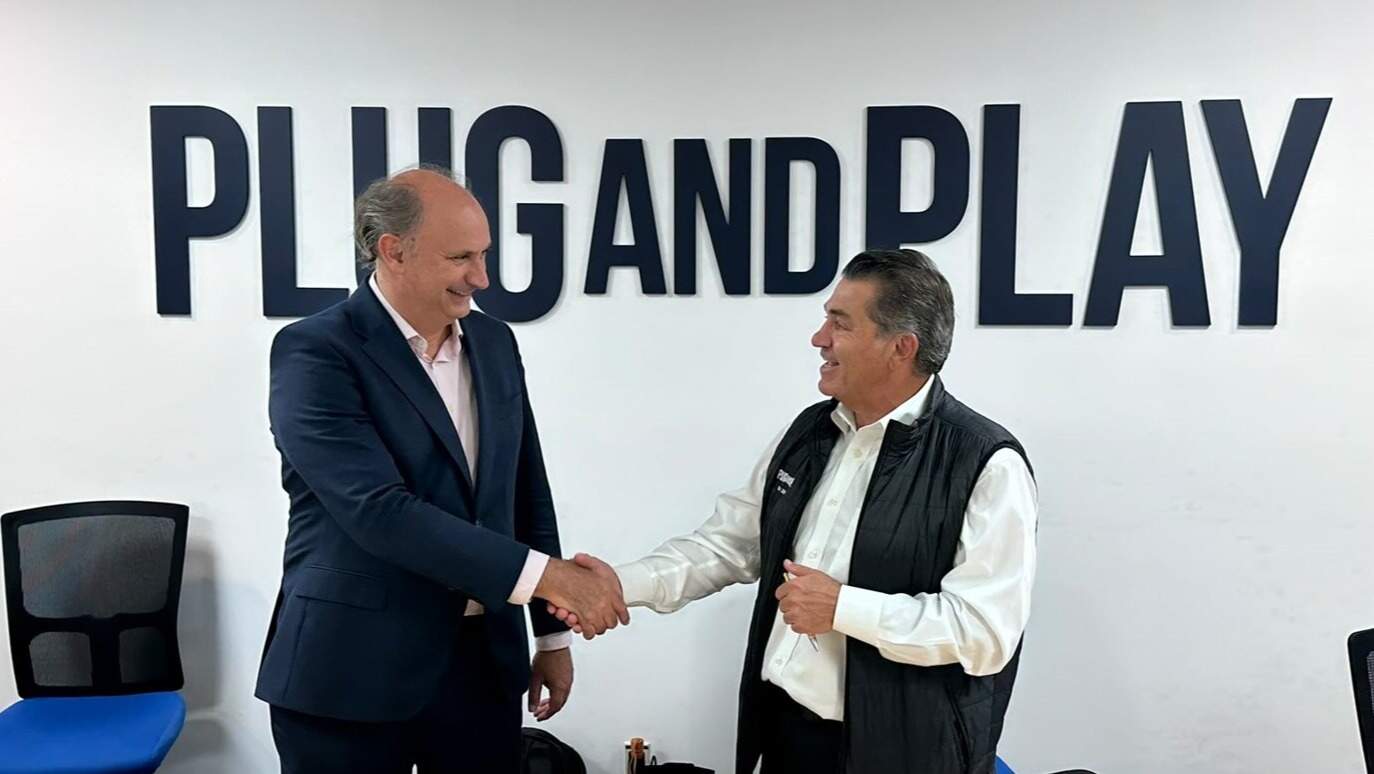
That September, Madrid’s digitalisation minister Miguel López-Valverde visited Plug and Play in California and met Amidi. An agreement of intent aimed to link Madrid’s planned AI centre with Silicon Valley. Technical discussions were to define the collaboration. The distinction matters: an agreement begins a relationship; delivery takes more meetings. Amidi’s latest European work is still recognisably in the business of opening doors.
Figures reported by Amidi in his twentieth-anniversary post. Network measures, not investment returns.
Enough golf to complicate retirement
There is a cheerful complication to any theory that Amidi simply cannot stop working. In 2021, he said he played golf about 120 days a year, took at least a month’s holiday and enjoyed time with his family and granddaughters. Retirement would have to compete with a life that already contained a fair amount of retirement’s advertised programme.
Asked about his future, he wanted Plug and Play to last as an innovation platform that others could benefit from. His stated mission is plain: “Our mission will always be to connect people”. The organisation’s scale gives that sentence reach, but the sentence itself could have been used in the rug gallery.
Amidi also tells founders that most of the work remains theirs. Access can improve a company’s chances; it leaves the building to the people building it. His own career offers a useful illustration. A fortunate address supplied encounters. He kept answering inquiries, making introductions and finding another reason to call. The Lucky Building had good tenants. Its landlord developed the habit of staying interested.
Keep the conversation going
Interviews, films and places to follow his work.
- Plug and Play / Official website
- Saeed Amidi / LinkedIn
- Saeed Amidi / X
- The early years / Wharton interview
- Twenty calls a day / Mixergy interview
- Golf, ambition and corporate connections / LA Venture
- Teams and missed investments / Leaders League
- Madrid’s AI plans / September 2026
- Watch / EO interview with Amidi and Alireza Masrour
- Watch / Professor Mash, September 2026
- Watch / TeqTalk at the 2026 Silicon Valley May Summit
- Read / Amidi’s twentieth-anniversary reflection
- Read / Barilla’s Good Food Makers programme
- Read / Amidi on Orlando and corporate customers
- Read / Menlo College speech excerpt, page 9
- Read / AI and global infrastructure
- Read / Plans for AI centres in Spain
- Read / The rug gallery and early network