In a house in Arlington, Texas, a boy arranged strings and pulleys so he could turn the lights on and off without walking to the switch. Geoffrey von Maltzahn also built with LEGO, recruited family and friends for strategy games, and liked the unnerving freedom of a blank page. The pulley system was modest, but its logic was durable: if a task could be turned into a mechanism, the mechanism could change what a person was able to do.
More than four decades later, that interest has acquired an industrial address. Von Maltzahn is the co-founder and CEO of Lila Sciences, a company developing AI systems that propose hypotheses, direct robotic experiments, inspect the results and use those results to plan the next test. The distance from a homemade light switch to an automated laboratory is considerable. The question beneath both is familiar: how can a useful action lead to another useful action, with less waiting between them?
He comes from a family of engineers - four generations, by his account - yet art was an early attraction. He liked making something from scratch. His mother read him exploration stories, and the feeling of setting out into unknown territory stayed with him. At Thomas Jefferson High School for Science and Technology in Virginia, mathematics gave that appetite a language. At MIT, engineering supplied tools for turning it into work.
The appeal of an empty page
Von Maltzahn earned his MIT degree in chemical engineering in 2003, followed by a master's in bioengineering at the University of California, San Diego, in 2005. He returned to MIT for doctoral work, completing his PhD in 2010. These are conventional milestones on paper. The more revealing detail comes from his recollections of what happened between them: mentors let him wander, make mistakes and follow improbable ideas. He later said an undergraduate research mentor gave him enough rope to fail repeatedly in the laboratory. What he remembered was the creative freedom.
His doctoral adviser, Sangeeta Bhatia, encouraged him to challenge his sense of what was possible. He mentored younger students himself; he had guided 14 undergraduates by 2009. He also kept what he laughingly called an “ideas book,” a notebook for possibilities that had no immediate place in the experiment at hand. It is a charmingly low-tech precursor to his present ambition: retain questions, connect them, and find a way to test more of them.
In 2009, he won the $30,000 Lemelson-MIT Student Prize. The award recognized his inventiveness as a graduate student. Later accounts from MIT put his name on more than 200 patents and patent applications, alongside 20 peer-reviewed publications. Those counts describe productivity; the notebook explains its direction. The attraction was never simply to repeat an established procedure efficiently. He wanted to make room for an idea that had not been available at the beginning of the day.
While working toward the doctorate, he helped start Nanopartz and Resonance Therapeutics. He later recalled the intensity of startup work with a kind of affection: close partnership, rapid learning, and a feeling that everything might collapse on a Tuesday. The line is funny because it carries a practical observation. When resources and time are scarce, a team has to decide what it believes, test it, and change course quickly. That rhythm would become a career.
A succession of first drafts
Von Maltzahn joined Flagship Pioneering in 2009. The Cambridge firm creates and backs science companies, and he became one of its repeat founders. The roster associated with him spans Indigo Ag, Generate:Biomedicines, Tessera Therapeutics, Quotient Therapeutics, Sana Biotechnology and Seres Therapeutics. He served as a founding CEO at several of them. He has helped launch a dozen startups. The common thread was an interest in platforms: methods that can generate many possible answers rather than one fixed product.
Indigo Ag took his work into agriculture, where the problem is literally spread across fields. Farming has a way of resisting clean laboratory assumptions. A plant grows amid weather, soil, microbes, machinery and human judgment. The attraction of a platform approach there is easy to see: finding a repeatable way to learn from many environments matters more than the elegance of a single controlled result. His public articles about visible yield differences and agricultural research partners show an inventor paying attention to what happens beyond the lab bench.
This kind of founding can look like an endless row of company names. For von Maltzahn, the more useful unit is the experiment. Each venture begins with an account of what the world might permit, assembles people with complementary skills, and tests the premise. Some companies survive that test; some ideas have to be revised. The public record records the launches and prizes more readily than the ordinary days when an idea fails. His own description of those precarious Tuesdays supplies the missing texture.
Flagship also connected him with colleagues whose expertise could push the next idea out of its disciplinary lane. Lila Sciences was founded in 2023 with a team that brought together science, AI, software and robotics. Noubar Afeyan, Flagship's founder, is among its co-founders. At Lila, von Maltzahn works with leaders including CTO Andrew Beam and AI researcher Kenneth Stanley. The point of assembling such a group is not to put every specialty in the same room for a photograph. It is to make an experimental system that can cross the boundaries between them.
The laboratory as an instrument
A conventional AI model can find patterns in existing data. Lila's proposed loop asks for something harder: create a question, send it into the physical world, and bring the answer back into the model. Von Maltzahn has described the goal as a “scientific method machine.” There is a plain account behind the phrase. A model proposes a hypothesis. Software translates it into an experiment. Instruments and robots run it. Measurements return. The model updates its picture of the world and chooses another experiment.
The sequence sounds simple when compressed into four boxes. It becomes more demanding when the boxes must agree about physical materials, error, timing and what counts as a useful result. A plausible sentence generated by software has no special standing in a laboratory. It must survive contact with an instrument. This insistence on verification is the heart of the Lila project. Von Maltzahn argues that fresh experimental results can become the training material for the next generation of scientific AI, letting the system learn from the world as well as from published records.
In 2025, Lila emerged publicly and announced a $235 million Series A that later closed at $350 million. The company said its total capital raised had reached $550 million. Such figures fund equipment, teams and time; they do not confer scientific truth. That still has to come from results. Its first AI Science Factory had closed the loop across hundreds of thousands of AI-directed experiments by the time of the funding announcement. The claim is significant because it describes repeated physical work, not just a software demonstration.
The company's September 2026 account of a green-hydrogen catalyst search gives the process a more graspable scale. Over three months, its AI-directed lab proposed, synthesized and screened 2,942 catalyst candidates, identifying six high-performing material families. A reader need not know the chemistry to understand the experimental bargain. The system explores many possibilities, compares them against measurements, and spends the next round of effort where evidence points. The number of candidates matters. So does the fact that the result is reported as families of materials, clues for further work rather than a final flourish. Scientists still moved samples between instruments in this campaign; Lila describes full robotic transfer as work in progress.
The scientist returns to the podium
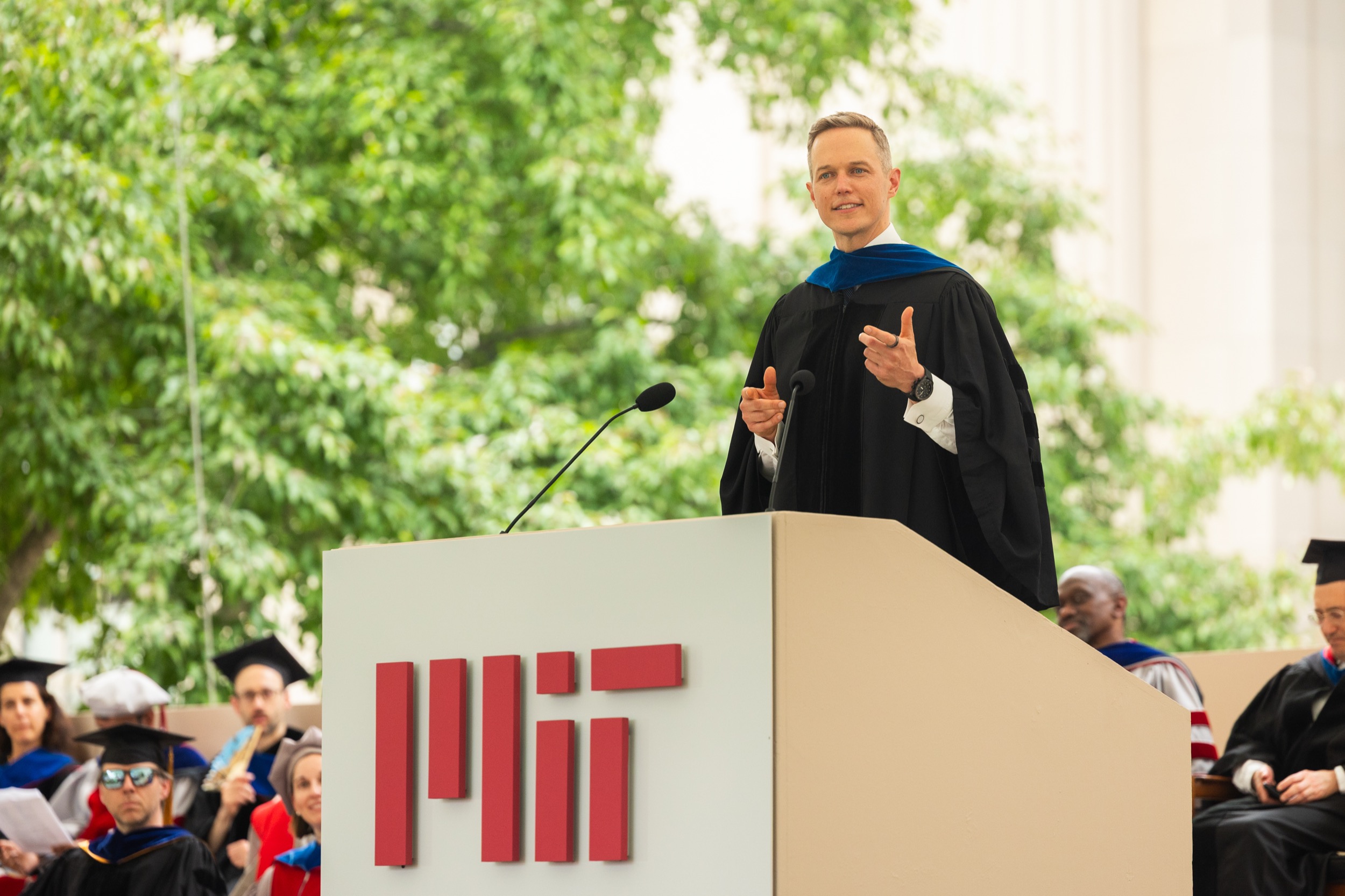
In May 2026, von Maltzahn stood before MIT's engineering and computing graduates on Killian Court. He had a confession for them. He had skipped his own doctoral graduation years earlier because a startup seemed more urgent. Looking at the 1,343 graduates in attendance, he told them they had made the wiser choice. The ceremony, he said, was a chance to receive what they had earned and to be with the people who had helped them earn it.
That admission complicates the familiar founder's sermon about permanent motion. Here was a man who had built a career on moving to the next problem, telling young scientists to stay with the moment they were in. He remembered running down a hallway at two in the morning when an experiment finally went his way. He also asked them to find work that humbles them and people who sharpen them. His compact instruction was, “Protect your thirst.”
The phrase reaches back to the boy with the pulleys. Curiosity is easy to celebrate in a child building a contraption for the lights. In a company, it has to coexist with budgets, machines, deadlines and the awkward possibility that the latest promising idea does not work. Von Maltzahn's bet at Lila is that curiosity can be made more systematic without making it small. The machines can continue through the night, but the choice of worthwhile questions still carries the mark of the people who built them.
Lila's next chapters will be written in data from its labs and in the judgment of the scientists interpreting it. For now, the picture is of an inventor still attracted to the blank canvas, only with a much larger workshop. He once wanted a light to answer a tug on a string. Now he wants an experiment to answer a question, and the answer to suggest a better one.