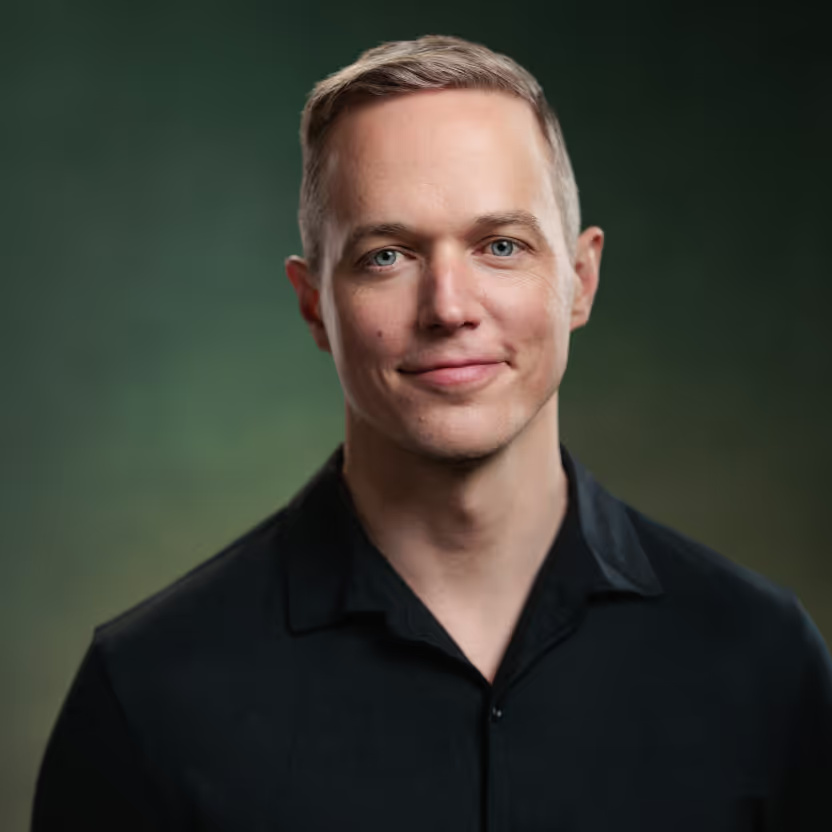
In a Cambridge lab, robots run experiments through the night. No one goes home. The machines propose a hypothesis, pipette the reagents, read the result, and decide what to try next. Geoffrey von Maltzahn calls this an AI science factory. His company, Lila Sciences, calls its goal scientific superintelligence.
The premise is disarmingly simple and quietly radical. For centuries the scientific method has run at human speed - one grad student, one bench, one experiment at a time. Von Maltzahn's bet is that the method itself can be automated: reasoning, experimentation, learning, all folded into a loop that runs at a scale and pace no university lab can match. Lila emerged from Flagship Pioneering's foundry in 2025 and reached unicorn status in under a year, pulling in a $235 million Series A at roughly a $1.23 billion valuation, with Nvidia among the backers.
He is, on paper, an unlikely candidate to lead an AI company. His degrees are in chemical engineering and bioengineering. His expertise runs to genomes, microbiomes and nanotechnology. But that is precisely the point. Von Maltzahn has spent fifteen years watching biology transform from expensive trial and error into something predictive and deterministic. Lila is his argument that discovery in every field can make the same leap.
"All competitive advantage in science will flow to those who can run the most brilliant next experiment with the highest intelligence, largest scale, and fastest speed."
The founder who keeps founding
Most people build one company and call it a life. Von Maltzahn builds them in sequence, sometimes in parallel, from inside Flagship Pioneering's innovation foundry in Cambridge. He is a general partner there, which means he is often both the investor writing the check and the founder cashing it. The line between the two blurs on purpose. Flagship incubates ideas, and von Maltzahn has become one of its most prolific inventors of companies.
The roster is unusual for its range. Indigo Agriculture put plant microbiome science to work on crops. Seres Therapeutics and its microbiome medicines. Tessera Therapeutics, working on gene writing. Generate:Biomedicines, using AI to design proteins. Sana Biotechnology in cell engineering. Quotient Therapeutics, reading somatic mutations at scale. Each began as a thesis about where science was heading. Together they carry more than $10 billion in public and private market value.
Lila is the synthesis. If Generate taught him that AI could design biology, and if his other ventures taught him how much of discovery is still manual grind, Lila asks the obvious next question: what if the AI could run the whole loop itself? Reasoning, hypothesis, experiment, result, revision - autonomously, and around the clock.
He frames the stakes in almost civilizational terms. Lila's mission, he has said, is to responsibly achieve scientific superintelligence because it is "the most important opportunity of our time." The leader, in his telling, will be whoever runs the scientific method at the largest scale, speed and intelligence. It is a big claim. He has a track record that makes people take it seriously.
"Most AI in science runs out of things to learn because it's trained only on public data. The next leap forward will come from AI that creates its own data."
What "scientific superintelligence" actually means
Strip away the grand phrasing and the thesis is mechanical. Language models have gotten very good at reading the scientific literature, but reading is not knowing. The frontier of any field is the set of experiments no one has run yet, and those results do not exist in any training set. An AI trained only on published papers eventually hits a wall: it has learned everything humanity already wrote down, and there is nothing left to absorb.
Von Maltzahn's answer is to close the loop. Pair the reasoning of large models with robotic laboratories that can physically test what the model proposes. The AI generates a hypothesis, the lab runs the experiment, the result feeds back, and the model updates. Because the system creates its own data, it never runs out of things to learn. That is the difference between an AI that summarizes science and one that does it.
Lila describes the output as an AI science factory: automation, robotics and machine intelligence stitched into a single production line for discovery. Run enough of these loops in parallel and the constraint stops being human attention and becomes compute and reagents. The company points its platform across life, chemical and materials sciences at once, which is a deliberate choice - the same autonomous method, aimed at drug candidates one week and green hydrogen catalysts the next.
It is an ambitious framing, and von Maltzahn does not soften it. He talks about the venture as the most important opportunity of the era and insists the advantage will accrue to whoever runs the method with the most intelligence, at the largest scale, at the fastest speed. The word "responsibly" recurs in his phrasing too - a nod to the obvious question of what it means to hand the engine of discovery to a machine.
A career in company form
Read them in order and you can watch an idea evolve: from the microbiome, through gene writing and protein design, to machines that invent. Each is a chapter.
Texas, then a very good high school
He was born in Arlington, Texas, in the summer of 1980, and grew up in Alexandria, Virginia, where he went to Thomas Jefferson High School for Science and Technology - the kind of place where teenagers argue about differential equations for fun. From there it was MIT for chemical engineering, San Diego for a master's in bioengineering, and back to the Harvard-MIT Division of Health Sciences and Technology for a PhD under Sangeeta Bhatia, a giant of tissue engineering and nanomedicine.
By 2009, the year he finished the work that would earn him the Lemelson-MIT Student Prize, he had a choice: the professor track, or the startup track. He picked startups. Academia, he felt, rewarded the solo climber. He wanted the partnership, the blurred disciplinary lines, and the pressure to learn voraciously. He joined Flagship that same year, in the teeth of the financial crisis, betting that the direction of biology mattered more than the mood of the markets.
His training left him with a rare breadth. He knows genome engineering and the microbiome, nanotechnology and bioengineering - fields that rarely share a bench, let alone a single practitioner. That range is why his companies do not cluster in one corner of biotech. It is also why the jump to AI reads less like a pivot and more like the logical next rung: if you have spent a decade making biology programmable, the obvious frontier is a system that writes the program itself. He collected the honors along the way, including the National Inventors Hall of Fame's graduate prize in the same banner year of 2009, but the credential that matters most is the pattern - the willingness to keep starting over.
SB in Chemical Engineering, MIT.
MS in Bioengineering, UC San Diego.
Joins Flagship Pioneering; wins the Lemelson-MIT Student Prize.
PhD, Harvard-MIT Division of Health Sciences and Technology.
Co-founds Generate:Biomedicines and Tessera Therapeutics.
Becomes a general partner at Flagship.
Co-founds Quotient Therapeutics.
Lila Sciences unveiled; raises $235M and hits unicorn status.
A prayer about losing sight of land
Von Maltzahn keeps a Sir Francis Drake prayer that has come down through his mother's family. Its message is a nudge toward the horizon: stop hugging the safe shoreline, venture onto wider seas. He reads it as a working philosophy rather than a keepsake. "The reward in losing sight of land," he has said, "is to find the stars."
It is a revealing thing to carry around. The whole Flagship model - and von Maltzahn's version of it in particular - runs on being willing to leave the coast. He argues that many of the most important life science companies have not been founded yet, and that the scarcest resource in any venture is not money but "the time and passion of extraordinary people." Capital is easy to find. Conviction is not.
"The reward in losing sight of land is to find the stars."
Notes in the margin
- His PhD advisor, Sangeeta Bhatia, is one of the most celebrated engineers in medicine - a hard act to grow up under, a good one to grow up with.
- He collects companies the way some people collect stamps: at least eight founded or co-founded across agriculture, gene therapy, the microbiome and now AI.
- On many of his ventures he is both the investor and the founder, incubating them inside Flagship's foundry before spinning them out.
- He is named on more than 200 patents and patent applications and has co-authored 20-plus peer-reviewed papers.
- Thomas Jefferson High School, his alma mater, is routinely ranked among the most competitive STEM schools in the country.
- He joined Flagship in 2009 - the middle of a financial crisis - on the theory that the trajectory of biology outweighed the panic in the markets.
In his own words
A conversation with von Maltzahn, general partner at Flagship Pioneering, on invention, risk and the future of discovery.
Where to find him
Sources: Lila Sciences, Flagship Pioneering, Wikipedia, PR Newswire, Bloomberg and public interviews. Facts drawn from public reporting as of mid-2026. Figures such as valuations and headcounts change; treat them as snapshots, not live numbers.