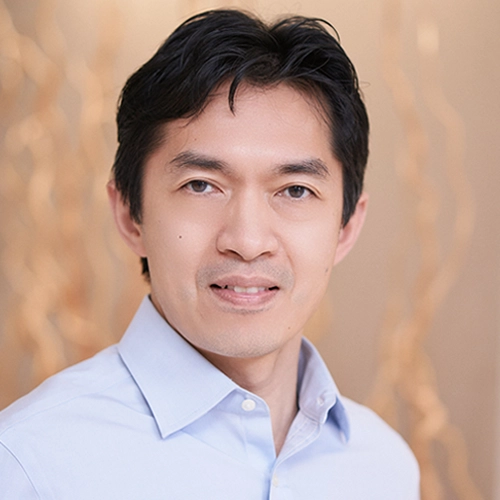
JESSE CHEN, in Waltham. The first scientific hire becomes the boss.
Founder / President / CEO
Jesse Chen
He builds the discovery engine before there is a discovery engine. Three times and counting.
He builds the discovery engine before there is a discovery engine. Three times and counting.
The Dispatch
In January 2026, a small company in Waltham, Massachusetts went public with its plan and a check for $13 million. The company is Fortitude Biomedicines. The plan belongs, in large part, to Jesse Chen, who founded it and runs it as president and CEO.
Chen has spent close to two decades in the part of biotech most people never see: the early years, the bench, the long stretch between an idea and a molecule that does something. He earned a Ph.D. in biological chemistry from MIT and was a Harvard Origins of Life research fellow, which is to say he started his scientific life thinking about how molecules first learned to do anything at all.
What sets him apart is not a single discovery. It is a habit. At Kymera Therapeutics he was not the tenth scientist or the fifth. He was the first, the founding member of the scientific team, the person handed an empty lab and a hard problem: build an industry-leading targeted protein degradation platform from nothing. He did. Then he went and did the founding part again, and again.
Before Fortitude there was Avilar Therapeutics, which he co-founded. Then TRIANA Biomedicines, which he co-founded and served as chief technology officer. Somewhere in between he sat on the other side of the table as an entrepreneur-in-residence at RA Capital Management, watching how companies get funded so he could turn around and found one more.
Some founders chase the easy target. Chen keeps picking the ones the field has labeled undruggable.
GLUE-DAC is a powerful modality that aims to redefine precision medicines and bring new hope to patients.Jesse Chen, on Fortitude's launch
What He Is Building Now
Antibody-drug conjugates are some of oncology's best weapons. But tumors learn. Resistance is creeping across the whole ADC landscape, blunting drugs that once worked.
Instead of the usual payloads, Fortitude arms its antibodies with molecular glue degraders, small molecules that stick a disease protein to the machinery that destroys it.
Precision delivery plus targeted protein degradation in one package. The science traces back to Professor Jin Wang's lab at Baylor College of Medicine.
The same precision is being aimed at autoimmune disease, a bet that the toolkit built for tumors can quiet an overactive immune system too.
Most antibody-drug conjugates work like a guided missile: an antibody finds the cell, the payload kills it. Fortitude's twist is the warhead. Rather than a conventional toxin, it carries a molecular glue, a small molecule that does not poison a protein so much as condemn it, gluing the target to the cell's own disposal system.
Chen calls the platform GLUE-DAC. The pitch is that glue-based payloads bring a mechanism the field is short on, which matters because resistance to the usual payloads keeps showing up. The deeper bet is that this same precision can travel out of oncology and into autoimmune disease, where the goal is not to kill cells but to selectively turn down the signals driving them.
That is where Fortitude pointed its first program. In April 2026 the company named its lead candidate: a first-in-class T-cell targeting bispecific antibody for axial spondyloarthritis, an inflammatory disease of the spine. In animal studies it produced what the company described as selective and durable suppression of the disease-driving T-cell signaling. The clinic is the next stop, planned for the first half of 2027.
How GLUE-DAC Works, Roughly
An antibody seeks out the diseased cell and locks on with precision.
The conjugate carries its molecular glue payload directly inside.
The glue binds the target protein to the cell's degradation machinery.
The protein is destroyed, sidestepping the resistance that defeats classic payloads.
The Long Way Here
From Millennium's labs to his own corner office, the through-line is not a single employer. It is the willingness to start at zero.
Discovery research roles at Millennium Pharmaceuticals.
Led novel platform and discovery program efforts at Moderna Therapeutics.
First and founding scientific hire; Senior Director of Discovery, building the targeted protein degradation platform and pipeline.
Entrepreneur-in-Residence, evaluating the kind of companies he would go on to build.
Co-founded Avilar Therapeutics.
Co-founded TRIANA Biomedicines and served as Chief Technology Officer.
Founded Fortitude Biomedicines; launched with $13M and became president and CEO.
With more than 50 percent of AxSpA patients unable to achieve adequate disease control, there continues to be a large unmet need.Jesse Chen, announcing the lead program, April 2026
Notes In The Margin
He has had a hand in founding three biotech companies: Avilar, TRIANA, and now Fortitude.
His platform has a name that sounds like a craft-store aisle: GLUE-DAC.
He was a Harvard Origins of Life fellow before he started inventing new ways to end disease.
Fortitude runs across two continents, with a site in China led by Yan Wan as China Site Head.
At Kymera he was employee one on the science side, not five or ten. The discovery engine was his to build.
Before founding companies, he learned how they get funded, from the investor's seat at RA Capital.
Follow The Thread