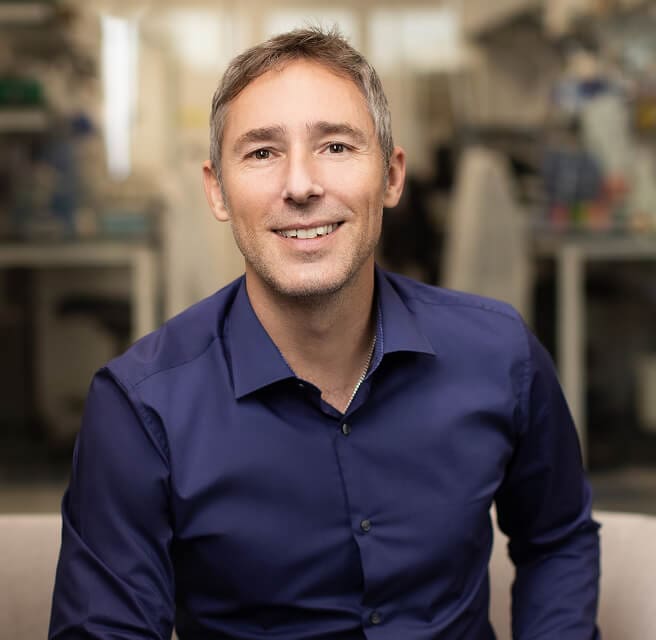
A protein with no pocket to grab. So he glued it to the shredder.
Most drugs work like keys. They find a pocket on a protein, slot in, and jam the lock. The trouble is that roughly four out of five proteins in the human body have no good pocket at all - smooth, featureless, officially undruggable. Phil Chamberlain decided not to look for a lock. He decided to glue the whole protein to the cell's garbage disposal and walk away.
That is the elevator version of molecular glue degraders, the technology at the heart of Neomorph, the San Diego biotech where Chamberlain is co-founder, president and CEO. A glue is a small molecule that doesn't inhibit a target protein so much as introduce it to an E3 ubiquitin ligase - the enzyme that tags proteins for destruction. The cell does the rest. The disease-driving protein gets marked, shredded, and gone. No pocket required.
When Chamberlain started in this field, the pitch sounded like fiction. He says so himself. The bet he made was that the science would catch up to the ambition, and that the proteins everyone else had filed under "impossible" were exactly the ones worth chasing.
The idea that a small molecule could selectively destroy a disease-driving protein was viewed almost like science fiction. Now we're seeing molecular glues move from an emerging scientific concept into a real therapeutic modality.
How a molecular glue works
From a thalidomide footnote to a platform
Chamberlain trained as a structural biologist at the University of Oxford, where he earned both his BA and his DPhil. He crossed the Atlantic to work at the Genomics Institute of the Novartis Research Foundation on respiratory and inflammatory disease, and in 2007 joined Celgene in San Diego. There he built and led the Structural and Chemical Biology department, eventually rising to Executive Director of Protein Homeostasis and Structural Biology.
His defining scientific work centered on thalidomide - the drug whose mid-century use caused one of medicine's worst tragedies. Chamberlain helped determine the first structure of thalidomide bound to human cereblon, explained the structural basis for how it recruits new substrate proteins, defined the "structural degron" those neosubstrates share, and offered a plausible molecular reason for why the drug caused the birth defects it did. In other words: he read, at the atomic level, why the most cautionary molecule in pharma history behaves the way it does.
That reading was the key. The same mechanism that made thalidomide dangerous - recruiting proteins for destruction - was a programmable tool. At Celgene he led the cereblon modulator platform, a pioneering effort in what would become the molecular glue field, and his work appeared in Nature, Nature Structural and Molecular Biology, and Nature Chemical Biology. He picked up the John W. Jackson leadership award along the way, described as the company's most prestigious achievement honor.
He describes his decade in big pharma as "entrepreneurial work, but within a bigger company setting." The science was going well. The environment was favorable. And then he decided to do it without the bigger company.
The environment was very favorable, and the science was going so well. It was entrepreneurial work, but within a bigger company setting.
Founded months before the world shut down
In early 2020, with backing from Deerfield Management, Chamberlain co-founded Neomorph alongside three scientists - Eric Fischer, Benjamin Ebert and Scott Armstrong - all heavyweights in protein degradation. The timing was almost comic: the company launched just months before pandemic lockdowns. It grew anyway, into a team of 85-plus researchers and an 80,000-square-foot headquarters in Sorrento Mesa.
The name is a tell. "Neomorph" nods to neomorphic substrates - the new protein targets a glue recruits for destruction. The whole company is an argument that the proteins everyone wrote off can be addressed, one neosubstrate at a time, across cancer, neurodegeneration, rare disease, immunology and cardiometabolic disease.
By 2026, the validation arrived in the form of partners. Neomorph signed collaborations with AbbVie, Biogen and Novo Nordisk - a combined potential value approaching $5 billion. The AbbVie option-to-license deal alone, struck in early 2025 for oncology and immunology, carries milestones up to roughly $1.64 billion. In April 2026 the company closed a $100 million Series B led by Deerfield, with Regeneron Ventures, Longwood Fund, Alexandria Venture Investments and others joining, to push its lead degrader forward.
Who bet on the undruggable
NEO-811 leaves the lab
Platforms are cheap to promise and expensive to prove. The proof is a molecule in a patient. Neomorph's lead candidate, NEO-811, has entered a Phase 1/2 first-in-human trial - an open-label monotherapy study testing safety, tolerability, pharmacokinetics and early anti-tumor activity in people with advanced or metastatic clear cell renal cell carcinoma. The bulk of the Series B is aimed squarely at moving it through.
For Chamberlain, who has spent more than twenty years getting molecular glues from a structural curiosity to a real drug class, the first patient dose is the line that matters. Everything before it is preparation.
He also has a soft spot for where it's all happening. San Diego, he says, attracts people who commit - who come to build a life and stay the course. "That's a pretty incredible proposition," he says of the city that has been his lab for nearly two decades.
What he's actually done
First structure of thalidomide bound to human cereblon
Defined the neosubstrate "structural degron"
Built and led Celgene's pioneering cereblon modulator platform
Co-founded Neomorph with Fischer, Ebert and Armstrong
Signed AbbVie, Biogen and Novo Nordisk - ~$5B potential
Advanced NEO-811 into Phase 1/2 clinical trials
Won the John W. Jackson leadership award at Celgene
Published in Nature, Nat. Struct. Mol. Biol. & Nat. Chem. Biol.