In Amsterdam, Shardul Bhatt had a problem that no programming language could solve. The people he met needed software. He had a team that could build it. Between these agreeable facts stood a collection of disagreeable stories about outsourcing, and the suspicion that his company might supply the next one.
Before the trip, he had used LinkedIn to arrange coffee with owners and chief executives of small businesses. Some employed only ten or twenty people. They were interested, but wary. For a young services company, another firm's bad reputation can arrive at the meeting before you do, take the comfortable chair, and order first.
Bhatt and his colleagues changed the proposition. They offered a short engagement with limited commitment, giving prospective customers a way to test the working relationship. In his April 2015 account, he reported starting work with more than half a dozen companies. A little evidence had done what reassurance could not.
That episode is a useful entrance to Bhatt's career. Co-founder of BoTree Technologies and Tntra, he has spent years working where software, commercial judgment and the willingness to trust another team meet. The code matters. So does making the arrangement credible enough for somebody to let you write it.
The engineer on both sides of the screen
His education took him through physics and then computer science at the Maharaja Sayajirao University of Baroda: physics from 1996 to 1999, computer science from 1999 to 2002. By June 2002, he was working as a software engineer at Actax Infotech. His responsibilities began with understanding requirements and writing the code to meet them.
At C-SAM, where he worked from 2004 to 2006, he gained experience in Java development and quality assurance. That combination put him on both sides of an application's claims about itself. A developer asks whether a feature has been built; a tester has the impolite but necessary habit of asking whether it actually works.
Subsequent roles took him through Real Soft, Imriel, DigitasLBi and CIGNEX Datamatics. He worked on architecture, client communication, integration and team leadership. At FlightNetwork in 2011 and 2012, he helped build a Java team in Ahmedabad and managed the migration of existing Perl applications to Java. His technical career increasingly included the people and decisions around the application.
- 2002Begins professional software work
- 2013BoTree Consulting CEO role begins
- 2020Co-founds Tntra with Mehul Desai
- 2023Tntra announces its Seed Group partnership
A small contract with a larger purpose
BoTree brought those responsibilities into one business. Bhatt's professional history records a co-founder role at RedKivi Consulting in 2012, followed by leadership of BoTree Consulting from January 2013 and BoTree Technologies from March 2015. The succession matters more than an artificially tidy founding legend: he was moving from delivering projects to taking responsibility for a company.
The Amsterdam trial model made a particular concession to the customer. A first contract could be small enough to make experimentation tolerable. For a founder of a modest business, entrusting development to an unfamiliar team overseas is a decision about scarce money, working time and personal reputation. Enthusiasm in a sales meeting does little to reduce those stakes.
Bhatt's account included a company that needed a technology his team had not yet worked with. They showed comparable work in another technology and won the chance to proceed. The point was to give the customer something concrete on which to base a decision. Trust had to survive contact with a task, rather than remain a pleasant adjective.
“My primary responsibility I believe is to enable and facilitate my team to grow and succeed.”
Shardul Bhatt, describing his BoTree Consulting role
That description of the chief executive's job is revealing. His responsibilities also included sales, strategy, finance, operations and human resources. Yet the purpose he chose to state was the team's development. A founder may enjoy being indispensable. A services business still needs colleagues who can exercise judgment when the founder is occupied elsewhere.
Three things worth handing over
In early 2020, Bhatt and Mehul Desai established Tntra. Their working connection reached back to the early mobile payments business. The new company's proposition joined engineering with incubation and venture support, bringing several kinds of help into the same relationship. A customer might begin with a development requirement and later need assistance building a business around it.
The partnership paired their experience of products and professional services with an interest in intellectual property. Tntra's early vocabulary was unusually concrete beneath the word “ecosystem”: products, patents and people. A functioning product, a body of protectable work and a team capable of continuing it were meant to reinforce one another.
The ambition: leave a client with assets and the ability to keep developing them.
One early example involved Japan. Bhatt described a plan for engineers from India to work alongside a Japanese team, helping establish its engineering and incubation capability. The engagement allowed an offshore team to move gradually closer to the client. Geography became part of the design of the working relationship, rather than simply a line on an invoice.
Read alongside the Amsterdam episode, the progression is suggestive. The earlier model made it easier to begin a relationship; the later one considered what the customer would own as it matured. Both addressed the awkward dependency at the centre of software services: buying expertise is easier than absorbing the knowledge required to keep using it well.
Dubai, with three people in the frame
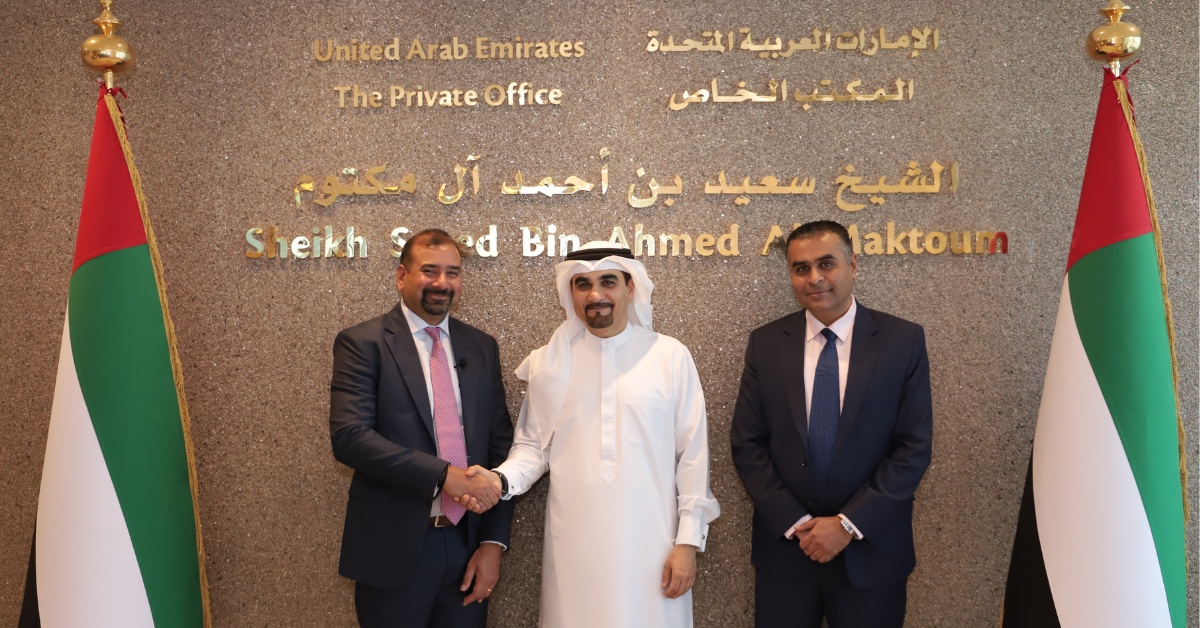
On July 4, 2023, Seed Group announced its partnership with Tntra. The arrangement was intended to support expansion into the United Arab Emirates and the wider Middle East and North Africa. The announcement identified Bhatt as CEO and co-founder, alongside Desai as chairman and co-founder.
Seed Group, a company of the Private Office of Sheikh Saeed bin Ahmed Al Maktoum, would contribute regional knowledge and access to decision-makers. Tntra would bring engineering and its broader support for innovation. Their stated plans included introducing its academy and enterprise platform as well as providing product development and work on existing software systems.
The photograph is formal: suits, flags, a handshake. The business question behind it is less photogenic. How does an engineering company enter a market where knowing the technical answer is only part of knowing how to proceed? A local partner can help with the institutions, relationships and commercial context that do not come bundled with a software framework.
Bhatt's public writing covers similarly practical territory. He has written about supply-chain decisions, cybersecurity in financial technology and intellectual property. These subjects place him among the operators who must think about what happens around a piece of software: how information moves, who can access it, and what a business can retain from its investment.
One example of that attention to coordination was Tntra’s work on API specifications for the Digital Convergence Initiative. Bhatt described a technical blueprint intended to help social protection systems exchange information. The concern was practical: separate organizations need compatible ways to describe and move data. The example fits his broader work at the boundary between a working application and the institutions expected to use it together.
The colleague who gets a mention
The titles offer a small reading list for the business owner behind the buyer of software. His May 2023 supply-chain article considered how data and machine learning could inform decisions. An October piece addressed financial technology security, while a November essay examined intellectual property. Taken together, they concern the continued usefulness of a system: making decisions with it, protecting the information within it, and understanding what belongs to the business. Those questions tend to outlast the excitement of selecting a technology.
One of the more personal accounts of his work comes from technical lead Jigar Shah. In February 2024, Shah credited Bhatt and Parth Barot as mentors who had supported his progress from trainee to technical leadership. He described their confidence in his potential as an encouragement to take on greater responsibility.
It is a modest detail compared with a partnership announcement, and more useful for understanding the human consequences of a management philosophy. A founder's statement about developing people remains an intention until somebody else can point to a change in their own working life. Shah supplied that other perspective.
There was a lighter expression of the same workplace in December 2023. Tntra's first annual awards ceremony included recognition for ownership, mentorship and a learner's mindset. Bhatt joined Desai and Barot in addressing the team. The day ended with dancing. Corporate language had, for once, acquired somewhere to put its feet.
A future that still needs judgment
More recently, Bhatt's LinkedIn commentary has returned to the limits of technical confidence. He has questioned whether faster AI-assisted development can leave teams without sufficient understanding of what they have built. It is a recognizable concern from someone whose earlier jobs included maintaining, testing and migrating other people's applications.
His public interest also extends to collaboration between universities and industry. He has expressed support for Parul University's PRAXIS 2026 initiative and described participation as a way to give back to Vadodara. It brings the story back towards the city of his university education, with experience offered to another generation of builders.
The thread connecting these episodes is responsibility after the introduction. The coffee meeting must become a working engagement. The application needs people who understand it. The trainee needs a chance to make decisions. The international partnership requires work after the camera has been put away.
Bhatt's career gives those ordinary obligations a place in a story about innovation. There is room for ambition here, but it has to accommodate a customer's doubts, a colleague's development and the continuing needs of a product. The interesting work begins when somebody agrees to proceed. Then, inconveniently and rather wonderfully, you have to deliver.
Continue the conversation
Explore Bhatt's writing, professional profiles and the work around him.