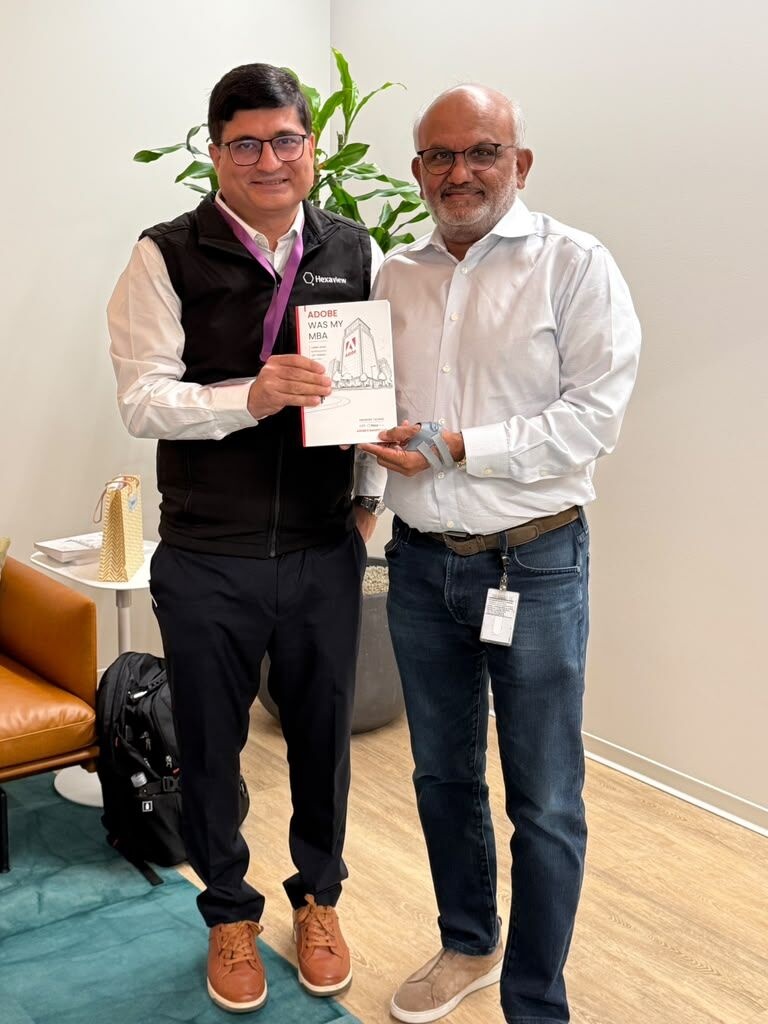
Abhishek Talwar nearly talked himself out of sending the email. He wanted a few minutes with Shantanu Narayen and a chance to hand over a signed book. In his head, the refusal had already arrived. An executive of that stature would surely be too busy. Then Talwar sent it anyway. By his account, the Friday message led to a Monday meeting. The imaginary gatekeeper had been considerably less accommodating than the real person.
The book was called Adobe Was My MBA. Talwar, co-founder and CEO of Hexaview Technologies, had named his account of a working education after his former employer. Now he was presenting it to the leader he had admired from a distance. A book about learning from other people had brought him back to one of them. For a founder who describes himself as an introvert, this was a rather public way to acknowledge a debt.
The offer with the smaller number
His early career offers a less ceremonial scene: a young engineer comparing job offers with his father. Talwar recalls earning ₹2,000 a month at CSIR Labs after college, then moving to a multinational technology firm at ₹15,000 a month. During 2002-03, he says, several much larger offers followed. The choice eventually narrowed to Adobe near Delhi and a better-paid Oracle position in Hyderabad.
His father advised him to consider living costs and proximity to family. Adobe won. Talwar remembers an India operation with fewer than 200 employees, a place where an early employee could become known. The decision looks tidy in retrospect, as career decisions tend to do once somebody has supplied the ending. At the time, it involved an ordinary calculation: which opportunity would leave him better placed after the rent and the distance were accounted for?
A patent begins with the awkward bits
Engineering left a concrete trace. A US patent granted on February 7, 2012 names Talwar as inventor and Adobe Systems as assignee. Filed in May 2007, it concerns synchronizing video captured by multiple cameras using audio. Anyone who has tried to make separate recordings agree about when something happened will appreciate the problem. The camera sees an event; the editor inherits the argument about timing.
Hexaview’s founder biography credits him with two US patents and more than 15 international publications. Those are useful details because his later work in sales and leadership can obscure the technical career underneath. Quality assurance, research and speaking at conferences were part of his professional formation. His business vocabulary arrived after he had spent time with problems that could not be repaired by a persuasive presentation.
Multiple cameras. Shared audio. One synchronized edit.
The queue of customers that failed to form
In 2010, Talwar and Ankit Agarwal started Hexaview. Their engineering reputations helped bring early assignments. Talwar has since described expecting good software to attract a queue of customers; after the first work was delivered, the next work did not obligingly appear. He recalls a period of negative cash flow. Competence had won an opening. Keeping the business supplied with customers required a skill he had underestimated.
He responded with practice. In 2015, the founders pledged to visit their largest market, America, at least three times a year. Talwar researched people before meetings and learned to tell the company’s story. He also credits mentor Jay Singh. The method suited someone who preferred preparation to improvisation. A meeting could begin with homework; conversation did not have to begin with a personality transplant.
A niche, and a partner to share it with
The company’s focus was deliberate. Talwar and Agarwal chose specialized technology work for a specialized market, drawing on their experience in financial technology and targeting US customers. Their 2022 account of the business placed considerable weight on trust: with customers, service providers and staff. Talwar described avoiding complacency as continuing work, even when a relationship had become familiar.
In that conversation, he described entrepreneurship as a marathon requiring stamina, focus, strategy and a partner like Agarwal. It is a practical tribute. Founding partnerships appear in company biographies as paired names; lived over years, they also involve sharing the consequences of decisions. His advice to keep looking ahead and preparing the next attempt has the tone of someone who has stopped expecting the first attempt to settle everything.
“For me, starting out is never a sprint”Abhishek Talwar · 2022
What stays on the wall
Talwar’s office wall makes a small alternative autobiography. In a short video, he points out an early company award and a banner from a software testing conference where he had presented. Around 2016-17, he recalls, he was asked to become a judge. Moving from explaining his work to assessing other people’s work gave the banner a different significance. Office decoration can be surprisingly demanding when asked to account for itself.
Hexaview’s growth has also entered public rankings. Inc. lists the company in its 5000 for five successive years from 2022 through 2026. The positions vary: No. 172 in 2023, No. 469 in 2024 and No. 4,881 in 2026. The latest listing records 20% growth over three years. Read together, the numbers describe a changing business rather than a perfectly ascending line. A long career offers enough material without requiring every year to resemble a victory lap.
The colleagues who would not drop the subject
The book began with other people’s insistence. During a visit to Adobe, friends suggested that Talwar should write one. He listened and largely let the idea pass. On another visit about two months later, the suggestion returned: he already had the material in his LinkedIn posts. A follow-up message from Rahul Vishwaroop finally nudged him into agreeing to try.
Talwar names Vishwaroop, Srijan Sandilya and Subbiah Pillai as the three people who made that difference. They had not all worked in his team or department. Encouragement had travelled across the org chart. Once the book existed, its first three copies went to them. There is a pleasing editorial economy to that choice: the people responsible for commissioning the work, however informally, received their copies before the wider audience.
An education with people in it
On the morning he set out to deliver those copies, Talwar wrote about visiting different Adobe offices in person. He remembered Tower 1, the seventh floor, at the Noida campus in Sector 25. He also said the book contained more than 100 images. This was an account assembled around people and places, with photographs doing some of the remembering. The lesson had an address, a floor number and familiar faces.
Another recollection explains why those relationships endured. Talwar says he repeatedly failed to get ideas through Adobe’s patent process. Rather than telling him to stop, the company brought someone from the US to train him. He learned to improve both the ideas and their presentation. In discussing what he carried into Hexaview, he returns to giving people ownership, inviting ideas and hiring people whose abilities exceed his own. A rejected idea could lead to better instruction instead of a smaller ambition.
AI at work; old friends off duty
Hexaview now describes its work around financial technology, data and AI. In March 2026, it announced an AI-first operating model, a Chief AI Officer role for Kashi KS and a larger place for its HexClaw agent framework. The company said three AI service lines were already serving production customers, including work on legacy documentation and private agent stacks. For Talwar, the next phase of the business is taking shape around how that work gets done.
Yet an Adobe community gathering he co-hosted in the Seattle area offered an amusing house rule: no AI talk. The invitation promised old colleagues, games, food and stories, with no presentations or business pitches. The contrast is easy to enjoy. A technology executive can spend his working life discussing what comes next and still arrange an evening around people who remember what came before. Even the future can wait until after dinner.
The book goes back to school
By October 2026, the book had supplied another return visit. Talwar’s meeting with Narayen brought his former working life and current one into the same photograph: the engineer who left to build a company, carrying a book about the company he left. The published account of the meeting emphasized the leadership principles he had taken with him, from attention to customers to patience and long-term thinking.
His story keeps returning to the usefulness of other people: a father weighing a job offer, a co-founder sharing a risk, colleagues insisting that the scattered stories deserved covers. Talwar has made those connections part of his public account of himself. The CEO title explains where he works now. The book explains why an old workplace still matters to him. Having built a business of his own, he remains willing to name his teachers.