In 1999, Jud Bergman had a proposal his employer did not want. He was running Nuveen's mutual-fund business, with an established career and a view of an emerging customer: the financial adviser leaving a large institution to work independently. The adviser could take experience, relationships and ambition along. The institution's machinery was rather harder to pack.
Bergman wanted to supply that machinery over the internet. Nuveen declined, concerned about its relationships with the large firms whose advisers might become customers. He went ahead outside the company. A decision that looked like a technology bet was also a bet on a particular kind of person: someone who wanted to build a business without asking a large Wall Street firm for permission.
The intended tools were practical. Advisers needed to prepare investment proposals, choose from investment offerings, bill clients and report performance. A small practice needed access to capabilities that a large brokerage could afford to build internally. Bergman's proposition was to make those capabilities available together, without requiring every independent adviser to become a software entrepreneur as well.
The departure had its less philosophical moments. After writing a substantial check for salaries and office space, he saw a magazine cover depicting a winged woman poised above a dangerous drop. He remembered the picture years later, along with the feeling it stirred: “conviction, thrill, and fear”. Payroll has a useful way of editing an entrepreneur's vocabulary.
An internet company learns patience
Envestnet began with a small group that included Bill Crager, Jim Lumberg and Brandon Thomas. Crager remembered a card table and ideas, first in a Chicago law office and later in the Jewelers' Building. He and Bergman had come to know each other through Nuveen's purchase of Rittenhouse Financial Services, where Crager worked. Their partnership would last two decades.
The early years offered plenty of opportunities to reconsider. The dot-com bubble burst. Envestnet acquired Portfolio Management Consultants in 2001, shortly before the September 11 attacks. Later, the financial crisis delayed its planned public offering. The internet had made the business possible; the economy repeatedly made the timing awkward.
Even explaining the product could be work. Bergman recalled having to explain that software hosted online did not require a local installation. Before customers could assess the usefulness of the platform, they sometimes needed a lesson in how it arrived. Envestnet eventually went public in 2010, eleven years after its founding.
There is an unglamorous kind of entrepreneurship in that interval. The underlying customer problem can remain real while the financing climate changes, markets fall and buyers hesitate. Bergman's company had to keep operating through the gap between seeing a need and finding enough people ready to pay for its solution.
- 1999Envestnet founded
- 2001PMC acquired
- 2010Public offering
His favorite colleague was a computer
Bergman loved chess, and colleagues learned to expect it in conversation. At one industry panel, Aaron Klein was warned that Bergman would find a way to introduce the game whatever the question. Within an answer or two, there it was. Some executives have a slide for every occasion. Bergman had a chessboard.
The attraction went beyond a handy metaphor for acquisitions. He drew on Garry Kasparov's thinking about people working with computers. Bergman argued that an expert working with a machine could do better than either working alone. For an adviser worried about automation, that offered a different job description.
Software could perform calculations, support portfolio rebalancing and gather information. The adviser could concentrate on understanding the person whose money was involved. In a 2017 discussion, Bergman described a future with more attention to life transitions, tax matters, estate planning and the behavioral work of helping clients make decisions. A faster calculation mattered because it could make room for a better conversation.
That argument required advisers to change their habits, too. Accepting technology meant handing over activities that had once helped define the profession. Bergman treated that adjustment as an opportunity to develop the human part of the work. The client still needed someone to interpret the situation and help decide what came next.
“Experts plus machines are better than machines alone or experts alone.”
Jud Bergman · 2017
The machine
Calculations
Rebalancing
Information gathering
The adviser
Understanding goals
Guiding decisions
Building relationships
Buying the pieces, connecting the work
Envestnet expanded through acquisitions, including Tamarac and Yodlee. Those businesses brought different capabilities: portfolio and practice tools in one case, financial-data aggregation in the other. The company could serve more of an adviser's working day and see more of the information surrounding a client's finances.
Financial planning became a particular focus. In 2015, the company bought Finance Logix, explaining that advisers wanted planning connected to investment decisions and ongoing management. By 2019, Envestnet had also acquired the maker of MoneyGuide. The direction was clear: a portfolio belonged inside a broader account of someone's goals, obligations and choices.
Bergman was candid about the difficulty of serving everyone. In 2019, he discussed mid-sized advisory firms that wanted a full set of tools but could not afford the subscription paid by a much larger practice. Pricing and product configuration were part of the problem. A platform could be capable and still be the wrong purchase for a particular business.
He also acknowledged gaps, including demand for better customer-relationship tools in the independent-adviser market. That is a useful detail in a founder's story. By then, he could discuss a company with considerable reach and still describe work left to do. His ambitions were broad, but the next task might be something as specific as making a version of software affordable for an office with two or three users.
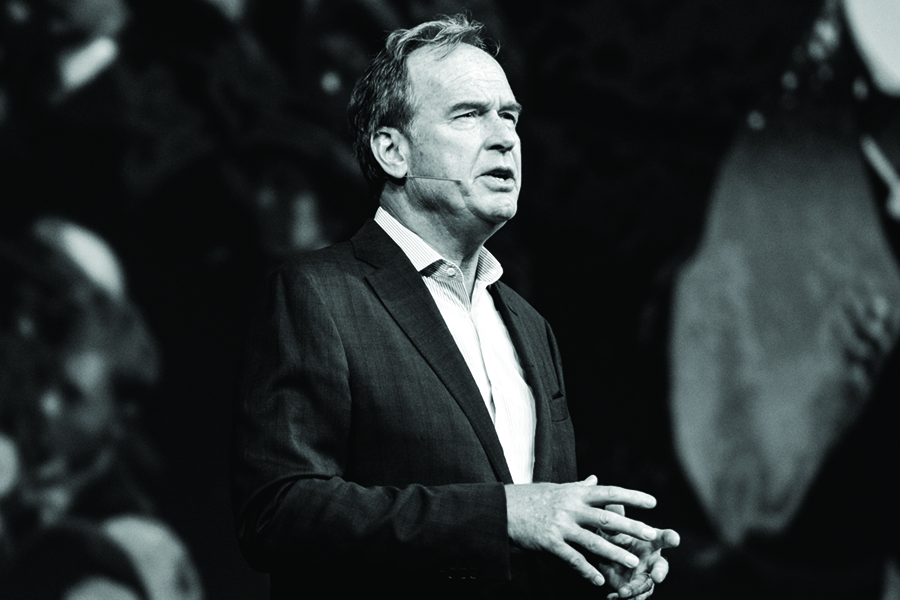
Lincoln, Dylan and the occasional cactus
The breadth of his interests long preceded the company. Born in Crookston, Minnesota, on February 1, 1957, Bergman grew up outside Minneapolis and worked in his family's silo business. He played trombone. At Wheaton College in Illinois, he studied English and played basketball. An MBA from Columbia followed. The humanities survived the change of degree.
He could remember poetry, scripture, Lincoln speeches and the Latin names of plants. Cacti had become a particular interest. He knew a substantial collection of Bob Dylan songs and sometimes adapted them for gatherings of friends and family. A person arriving prepared to discuss investment technology could find himself in a conversation with several unexpected exits.
His children pursued creative work: Elliot in music and visual art, Elise in design and music, Natalie in singing and songwriting, Bennet in poetry. Elliot and Natalie performed as Wild Belle. Bergman supported those choices. His first wife, Susan, was an author; the family's life included books, art and music as ordinary parts of the household.
In 2010 he married Mary Miller, an independent financial adviser who founded Hanover Hill Wealth Advisors. They shared interests in boating, golf, travel and art, and he helped raise her three children. Business was something they could talk about together, among many other things. The household had room for several kinds of ambition.
The conference could end at a blues club
His public presentations often took a historical detour. At the 2019 Envestnet Advisor Summit, he used Winston Churchill to explore leadership during upheaval. Conference regulars had come to expect these excursions into history. The subject might be financial services, but the route there could be pleasantly indirect.
Patricia Farrar-Rivas of Veris Wealth Partners remembered the conversations extending beyond the conference hall, to a favorite blues venue or a Wild Belle performance. She and her colleague Anders Ferguson described an accessible, curious leader who kept the company feeling personal as it grew. Their memories concerned the attention he gave people as much as the businesses he bought.
Bergman also served on the Juvenile Protective Association's board and joined the Field Museum's board. At Christ Church in Lake Forest, he chaired the elder board and occasionally preached. These commitments put him in rooms with purposes and measures of success different from those of a public company's earnings call.
Another venture, measured in barrels
Near the end of his life, another business was taking shape with his daughter Elise and her husband, Collin Moore: Judson & Moore, a Chicago whiskey distillery. It connected family enterprise to Midwestern agriculture and craft. For someone whose early work involved silos, grain was familiar company.
The distillery continued after his death. Elise and Collin began filling barrels in early 2020, and the first whiskey releases followed in 2022. Their space in a former tannery on Chicago's North Side brought production together with a tasting room and live music. Both were musicians themselves, playing in the bluegrass band Big Sadie.
The ingredients gave the venture a regional character: Midwestern grain, Lake Michigan water and Minnesota white oak. It was a different sort of building from a financial-technology platform, with a different timetable. A barrel cannot be persuaded to mature by a promising quarterly forecast. The family's project required the sort of patience Envestnet's early years had already demanded.
A company built to continue
Bergman and Mary died in a car accident in San Francisco on October 3, 2019. He was 62. Before then, Envestnet had been preparing for him to step aside as chief executive in 2020, with Crager succeeding him. That preparation gave the company a direction during an abrupt and personal loss.
The scale of what followed belongs to a later chapter. In November 2024, Bain Capital completed its acquisition of Envestnet in a transaction valued at approximately $4.5 billion. The company then reported more than 111,000 advisers and $6.5 trillion in platform assets. Those assets were held across its platform; they were not Bergman's personal fortune.
His influence also continued through people who had worked with him. In a March 2026 conversation about modernizing Janney Montgomery Scott, former Envestnet executive John Yackel credited Bergman with lessons in integration and unification. The vocabulary had traveled into another firm's daily work.
Bergman's original customer had wanted the freedom to run an independent practice with useful tools close at hand. Years later, that remained a recognizable problem. His answer joined a practical understanding of the work to an expansive curiosity about the people doing it. There was space in that outlook for a portfolio, a poem and a song after dinner.
Approximate transaction value when Bain Capital completed its acquisition of Envestnet.
Continue the conversation
- Envestnet ↗
- Envestnet company profile ↗
- Bergman’s Entrepreneur archive ↗
- 2012 conversation on the early years ↗
- 2017 interview on experts and machines ↗
- 2019 conversation on planning and product decisions ↗
- Family memories and the Chicago beginnings ↗
- Veris colleagues remember Bergman ↗
- Judson & Moore: the family distillery ↗
- The 2024 acquisition announcement ↗
- John Yackel on Bergman’s influence, 2026 ↗