Before John Lunny had a chief executive’s title, he had a government classification that required explanation. He was a GS-1: a civilian Navy employee who had yet to finish high school. His route into the job had involved Fortran, prime numbers and a science fair. The federal bureaucracy had found a place for a boy who liked solving puzzles. It had even assigned him a number.
Decades later, Lunny would run Vestmark, whose software helped financial institutions manage millions of investor accounts. Today he leads LifeCloud, a venture concerned with a more domestic problem: keeping a family’s important information together. Across those settings, an interesting habit recurs. He puts himself where he has something to learn, then pays attention to the people already there.
A summer job with consequences
As a high-school freshman, Lunny took a Fortran class at a community college. His science-fair project subsequently used an IBM 370 to work on prime numbers. Punch cards were part of the arrangement; a monitor was not. The project attracted newspaper attention, and a technical director at a nearby naval base invited him to work there.
He joined the Naval Surface Warfare Center’s user-assistance department, helping other programmers with their code. The work continued through school and into college summers. For a young person interested in computers, the attraction is easy to understand: someone was willing to pay him to spend more time with them.

The people who came with the education
At MIT, where he studied from 1983 to 1987, Lunny earned degrees in electrical engineering and computer science. He also acquired connections that outlasted the timetable. Through his fraternity he met Dave Blundin, who became a friend and repeated business partner. Lunny later counted three companies they started together, including Vestmark.
A research opportunity put his C programming to work with David Clark on Internet protocols. Meanwhile, a conversation with his Navy supervisor about tuition revived a dormant co-op arrangement and helped finance his later college years. His parents, both math teachers, had saved for the first two.
Those experiences informed advice he later offered prospective MIT students as an alumni interviewer: meet people, try unfamiliar activities and ask for help. His education came with collaborators and a practical lesson in admitting that something was beyond his resources. An awkward conversation could be useful. A familiar group could become a company.
Engineers enter the accounting department
Before Vestmark, Lunny co-founded DataSage, an enterprise data-analytics software business. He led its engineering, and the company was acquired by Vignette. At Vignette he became a senior director of engineering, responsible for analysis, personalization and wireless products. Product design and development were already familiar territory when he moved into wealth technology.
Vestmark’s early proposition changed during sales conversations. Lunny and his partners had approached financial firms with an idea for improving trade-settlement workflows. Prospects kept talking about a broader irritation: their accounting systems. The engineers listened and redirected their attention. They also saw the opportunity in separately managed accounts, where individual investors’ holdings required more complicated handling than a shared pool of assets.
They were entering a business whose practitioners knew things they did not. Some early meetings made that plain. Lunny has described the discomfort of being challenged by experienced industry people, and the need to make the next call anyway. Hiring people who understood existing accounting and trading systems helped close the gap. Curiosity needed colleagues with domain knowledge.
The founding team initially chose to bootstrap, drawing on earlier success and support from friends and family. That made independence possible. It also meant accepting responsibility for a product direction that was still being discovered in meetings. The comfortable sequence would have been to learn everything, then begin. His account suggests a messier sequence, with the learning happening while the company was already in motion.
Thirteen years, measured in accounts
On September 18, 2008, Vestmark announced that Lunny would succeed Dave Blundin as chief executive. Blundin remained chairman. The promotion followed Lunny’s work as chief operating officer, building operations, the product and client services. His engineering background had expanded into the less tidy business of keeping an organization working.
The date placed the appointment in the middle of the financial crisis. Years later, accepting recognition from EY, he specifically recalled the company’s pivot during that period. There is no need to decorate that timing with imagined scenes of midnight meetings. The calendar supplies enough drama.
In April 2016, Vestmark announced $30 million in growth financing from Summit Partners, intended for sales, marketing, software development and further opportunities. By August 2018, VestmarkONE had passed $1 trillion in platform assets, across more than 3.4 million accounts. Those figures describe assets supported by the technology; they are not Lunny’s personal wealth.
Assets on VestmarkONE, across more than 3.4 million investor accounts.
The substance underneath the numbers included tools clients could actually use. Vestmark’s investor portal, recognized in a 2018 industry award, gave investors access to performance, holdings and transactions. Advisors could configure the experience. The engineering assignment had become a question of how to give many people a useful view of their own particular account.
In 2019, FTF’s industry-voted awards named Lunny FinTech Person of the Year. By then the company reported more than four million accounts and $1.3 trillion on its platform. An acquisition of Adhesion Wealth had also extended its presence with registered investment advisors. Recognition followed the expansion of a business whose work happened largely behind other financial brands.
A cake, a culture, a competitive streak
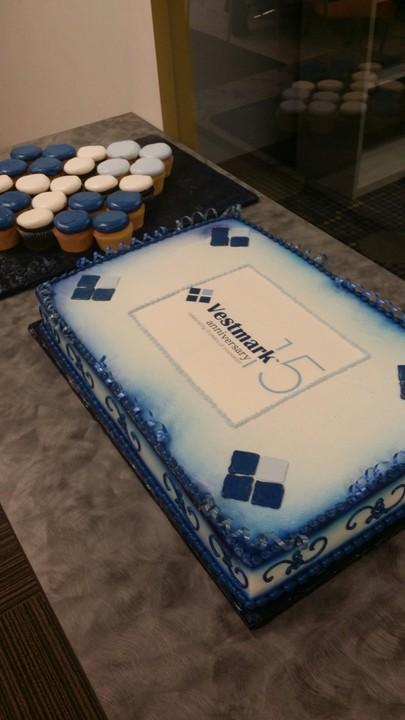
A photograph accompanying Lunny’s post about Vestmark’s fifteenth birthday shows a company cake and matching cupcakes. Software infrastructure has an austere public face. The office party apparently did not.
His pride in the workplace has a more substantial record, too. Vestmark was a Boston Business Journal Best Places to Work honoree in 2017 and again in 2018. The latter selection used employee survey responses, and the company had grown into the large-company category with more than 300 employees. Culture had to survive a change in size as well as win approval.
Lunny received EY’s 2018 New England financial-services Entrepreneur Of The Year award, presented that June. His response returned the attention to the team, its clients and its culture. “It’s really all about the company,” he said. In 2019, hiring chief people officer Nick Thurlow gave the growing organization a dedicated executive responsible for employee engagement and talent development.
There is a competitive streak alongside the collegiality. Lunny played tennis in high school and at MIT. In 2021 he wrote that he played two or three times weekly. He liked matches more than repetitive practice, and doubles supplied a particular education: knowing a partner’s tendencies, noticing frustration and talking through disagreements afterward. He preferred resolving the awkwardness over letting it linger.
“I don’t like to practice - I hate the repetition.”
John Lunny, on tennis, 2021
The admission is appealingly inconvenient for anyone hoping to turn every hobby into a spotless leadership parable. He enjoyed the contest. In golf, too, he liked a friendly wager. Yet his account of doubles also made room for supporting a partner and hearing every member of a team. Competition and consideration could occupy the same court.
Leaving the chair open for someone else
In September 2021, Lunny handed the chief executive role to Michael Blundin in a planned transition and became vice chairman. Michael, who had joined in 2004, had worked across technology, client delivery and relationship management. This was a handover to someone with years inside the organization.
Vestmark then supported more than five million investor accounts and approximately $1.4 trillion in assets. The business was pursuing more personalized investing, including direct indexing. Lunny’s departure from daily leadership came with a continuing board role and an expressed intention to support his successor. ThinkAdvisor also recognized him for executive leadership in its inaugural 2021 Luminaries class.

The next customer was in the family
LifeCloud brought a different unit of organization into focus: a household. Lunny wanted a shared, current view of family assets and a way for his adult children to find his documents, wishes and accounts. Having spent years building systems for financial institutions, he was confronting the ordinary difficulty of keeping personal information accessible to the people who need it.
He publicly introduced the venture in 2023. His announcement described bringing together information otherwise spread across a filing cabinet, laptop and phone. The problem is recognizable without a financial-technology vocabulary. A document can be perfectly safe and still be useless to someone who does not know where to look.
Several colleagues from Vestmark joined the LifeCloud team. Their experience with financial software supplied a shared background for a product intended to organize sensitive family information. Lunny’s stated motivation was refreshingly direct: he needed the service himself.
In June 2026, LifeCloud and ARAG Legal Insurance announced a partnership allowing employers with ARAG coverage to add LifeCloud for employees. The ambition was to reach more families through a channel already concerned with their legal affairs. Meanwhile, in September, Envestnet announced an agreement to acquire Vestmark, with closing expected in the fourth quarter and financial terms undisclosed.
One company had become institutional machinery; another was addressing the contents of a family filing cabinet. Lunny had found another practical puzzle, and another reason to assemble people who knew different parts of the answer.
Keep following the thread
Writing, conversations and the companies along the way.
- LifeCloud / current venture
- LinkedIn / John Lunny
- X / John Lunny
- Fortran, prime numbers and the Navy
- His reflections on MIT
- His account of Vestmark’s beginnings
- Tennis and teamwork
- Finovate podcast / episode 98
- The 2008 CEO appointment
- The 2021 leadership handover
- LifeCloud and ARAG / June 2026
- Vestmark and Envestnet / September 2026
- Vestmark / company profile