Scott Liu’s career contains several dates that look good on a slide: a doctorate in 1991, the co-founding of Shanghai Henlius Biotech in 2010, its Hong Kong listing in 2019, and the founding of HanchorBio in 2020. Put them in a row and the journey seems almost tidily arranged. The years between those dates tell a more interesting story. They contain university teaching, quality laboratories, manufacturing responsibilities and the repeated business of persuading other people to commit.
Liu is HanchorBio’s founder, chairman and CEO. Before that, he held senior positions at United Biomedical, Bristol-Myers Squibb and Amgen. The sequence matters. He arrived at entrepreneurship with experience inside organizations where an attractive idea still had to survive procedures, scrutiny and the practical demands of production. A launch announcement occupies a day. The work that makes an announcement possible can occupy a career.
Read his professional journey through that lens and the familiar founder portrait acquires some useful texture. Here is a scientist whose executive experience includes checking things, documenting things and taking responsibility for things. Those verbs rarely receive their own magazine cover. They do, however, help explain the distance between founding a company and making one function.
A doctorate, then the other side of the laboratory
Liu received his bachelor’s degree in microbiology from Soochow University in Taiwan in June 1984. Seven years later, in May 1991, he earned his Ph.D. in biology at Purdue University. He then completed postdoctoral training at Stanford from August 1991 to August 1993. The route connected Taiwan with two American universities before the corporate titles began to accumulate.
His next position brought him back to Taiwan. From August 1993 to August 1994, he taught in the biology department at National Sun Yat-sen University. Research work followed from 1994 to 1998. Taken together, these early years describe a career with a substantial academic foundation: undergraduate study, doctoral research, postdoctoral training and a university appointment, followed by further research.
It would be easy to rush past this period on the way to the companies. Doing so would flatten the biography. Liu spent years inside scientific institutions before leading businesses. The later founder had already worked through several forms of professional apprenticeship, across different institutions and countries. Entrepreneurship entered a career that had been underway for some time.
Quality was already in the job title
At United Biomedical, Liu served as director of quality operations and regulatory affairs from January 1998 to December 2003. He also held the position of vice president of research and development for Asia from October 1998 to March 2000. Those overlapping responsibilities joined scientific work with the systems used to oversee it. His remit extended beyond the research itself.
In December 2003 he became associate director of biologics quality control at Bristol-Myers Squibb’s technical operations in Syracuse, New York. He remained there until January 2007. In 2006, the company awarded him its Technical Operations Presidential Award. This was recognition earned inside an established organization, before his name became associated with a startup.
Amgen’s Fremont operation came next. From January 2007 to November 2008, Liu directed its quality analytical laboratories. Syracuse and Fremont are useful coordinates in this story. They place him inside operating businesses, carrying responsibilities expressed in remarkably concrete titles. Quality control and analytical laboratories leave relatively little room for a charming ambiguity.
The appeal of this background is its specificity. A founder biography can become a collection of expansive nouns: vision, innovation, disruption. Liu’s earlier titles supply a different vocabulary. Operations. Laboratories. Control. These are evidence of what he was appointed to do, and a reminder that his experience in company building began well before he co-founded a company.
- 1998-2003United Biomedical
Quality operations & regulatory affairs - 2003-2007Bristol-Myers Squibb
Biologics quality control - 2007-2008Amgen, Fremont
Quality analytical laboratories
Shanghai, a co-founder, and a public company
In February 2010, Liu co-founded Shanghai Henlius Biotech with Dr. Wei-Dong Jiang. He served as president and CEO, with responsibility for strategic direction and day-to-day management. The partnership brought two experienced scientific executives into a new organization. Henlius’ early corporate account emphasized their backgrounds in research, manufacturing and quality management.
This part of the story deserves its plural. Companies have co-founders, colleagues and boards; a biography can accidentally crop them out. Jiang belongs in the frame. So does the organization the pair assembled. The company’s development demanded a team whose different responsibilities could fit together, rather than a founder who personally performed every task.
Henlius listed on the Hong Kong Stock Exchange on September 25, 2019. Nine years separated its founding from that listing. A timeline reduces the interval to a short line and a second dot. In organizational terms, it marks the passage from a new venture into a public company, with a different set of reporting duties and expectations.
Liu also served as a global partner of Fosun International. His professional world had expanded to include corporate relationships and capital alongside scientific and operational work. The resulting résumé crosses disciplines, but its sequence remains legible: train as a scientist, take responsibility within established businesses, then help build an organization of your own.
Co-founded with Wei-Dong Jiang
A second venture
When the price changed
One Henlius episode makes that transition particularly clear. During its Series B fundraising, Liu recalled, the board doubled the proposed pre-money valuation from about $650 million to $1.3 billion. Investors resisted the change. Securing a lead investor took him more than four months; the round eventually raised $190 million.
It is a compact story about the distance between a board decision and a completed financing. The price can change in a meeting. Acceptance takes longer. Liu described the effort as “consistent efforts and door-knocking,” and emphasized faith in the board and focused teamwork. The anecdote puts patient execution beside the headline number.
The same interview gives his leadership philosophy a plain test: “Building trust requires time, as team members need to consistently witness alignment between your words and actions.” It is a standard that colleagues can observe. The interesting word is consistently. A persuasive speech lasts minutes; consistency requires the speaker to return to work the next morning.
Starting again in 2020
Liu founded HanchorBio in 2020. A second venture changes the meaning of the first. Experience becomes something to carry into another organization, where familiar credentials meet a new set of colleagues, decisions and obligations. HanchorBio has its headquarters in Taipei and an operating footprint in Shanghai and the San Francisco Bay Area.
That geography connects several places already present in Liu’s career. Taiwan was part of his education and early teaching. California was part of his postdoctoral and corporate experience. Shanghai was where he co-founded Henlius. HanchorBio’s footprint brings those regions into the same business, giving the biography a recurring map rather than a single destination.
The company also gives his current work an institutional setting. Its board comprises eight directors, including three independent directors. Liu chairs a body with members from finance, venture capital, regulation and corporate management. The chairman’s seat sits within a defined governance structure, where oversight is distributed among people with different professional histories.
That arrangement is worth keeping in view whenever a founder’s story threatens to become too solitary. Building a company means creating roles other people can occupy and responsibilities other people can exercise. Liu’s current organization has an executive team and a board, as well as a founder. The photograph may feature one familiar face; the work requires several.
A launch announcement occupies a day. The work that makes an announcement possible can occupy a career.On Liu’s years in research and operations
The meeting after the meeting
In November 2022, Liu received the Chinese-American Biopharmaceutical Society’s K. Fong Award in Life Sciences at its BioPacific conference. Kenneth Fong presented the award, and Liu delivered an acceptance speech. It placed him within a professional community that connected scientific work, entrepreneurship and the industry’s wider network.
By March 2026, another invitation put him in a different position on a conference stage. BIOCHINA invited him to moderate a roundtable in Suzhou and take part in an interview and discussion about business development, competitive positioning and collaboration. Moderation has a different rhythm from a presentation: the job includes making space for other people’s arguments.
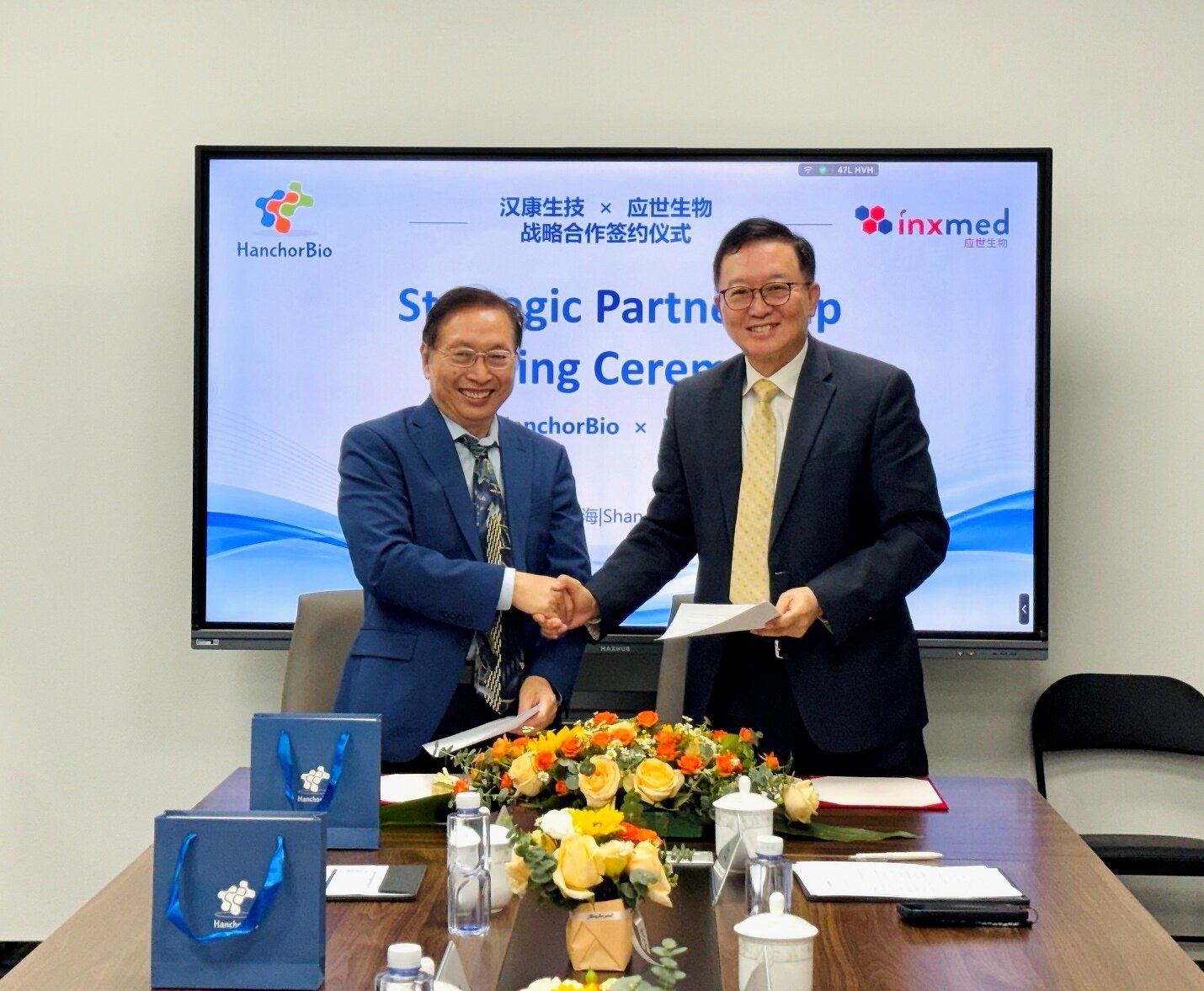
A more tangible encounter followed in July. Liu attended the signing ceremony for a memorandum of understanding between HanchorBio’s subsidiary FBD Biologics and InxMed, whose founder, chairman and CEO is Zaiqi Wang. In the photograph, the two executives shake hands above a table busy with documents, gift bags and flowers. Corporate ceremony has a dependable taste in table decoration.
The document established a research collaboration. Its value in this biography is the visible act of connecting two organizations. Company building involves these negotiated relationships as well as the work conducted inside the company. A handshake makes a convenient photograph; deciding how people will work together supplies the more consequential detail.
Better decisions, another set of doors
In April 2026, HanchorBio selected Bloomberg to support portfolio planning, competitive monitoring, business development and capital-market activity. Liu spoke about “the ability to make better decisions as complexity increases.” The phrase fits the executive portion of his career particularly well. Growing organizations generate more choices, more information and more consequences for each choice.
The following month brought another financing milestone. HanchorBio completed IPO bookbuilding for Taiwan’s Innovation Board at NT$120 per share. The offering introduced OrbiMed as a strategic investor and issued 9.4 million new common shares, with 10 percent reserved for employee subscription. Cathay Securities served as lead underwriter. The announced listing date was May 29, 2026.
These details give the capital-market chapter a human dimension without inventing a private scene. Employees had an allocation. An outside institution became an investor. An underwriter organized the offering. The company entered a transaction through a set of named roles and measured quantities, rather than through a single act of founder confidence.
By October, the calendar had moved on. HanchorBio announced its participation in BioJapan in Yokohama, with more than 15 partnering meetings scheduled. Liu remained chairman and CEO. The latest business update returns the story to a recurring activity: finding counterparts, discussing possibilities and doing the follow-up work that a completed transaction eventually conceals.
The career’s milestones remain useful. Purdue, Stanford, Syracuse, Fremont, Shanghai and Taipei trace a substantial professional journey. Henlius and HanchorBio provide two different chapters of entrepreneurship. But the more revealing thread runs through the responsibilities attached to those names: research, quality, management, governance, financing and relationships.
Liu’s story makes room for the work that rarely earns a dramatic date on a timeline. A valuation needs an investor willing to accept it. A company needs people willing to join it. A partnership needs two organizations willing to proceed. After the announcement, those people still have to work together. For a founder with a long history in quality operations, that is a familiar kind of responsibility.