A Seattle multimodal platform that watches every store at once - so operators stop guessing why last Tuesday was slow.
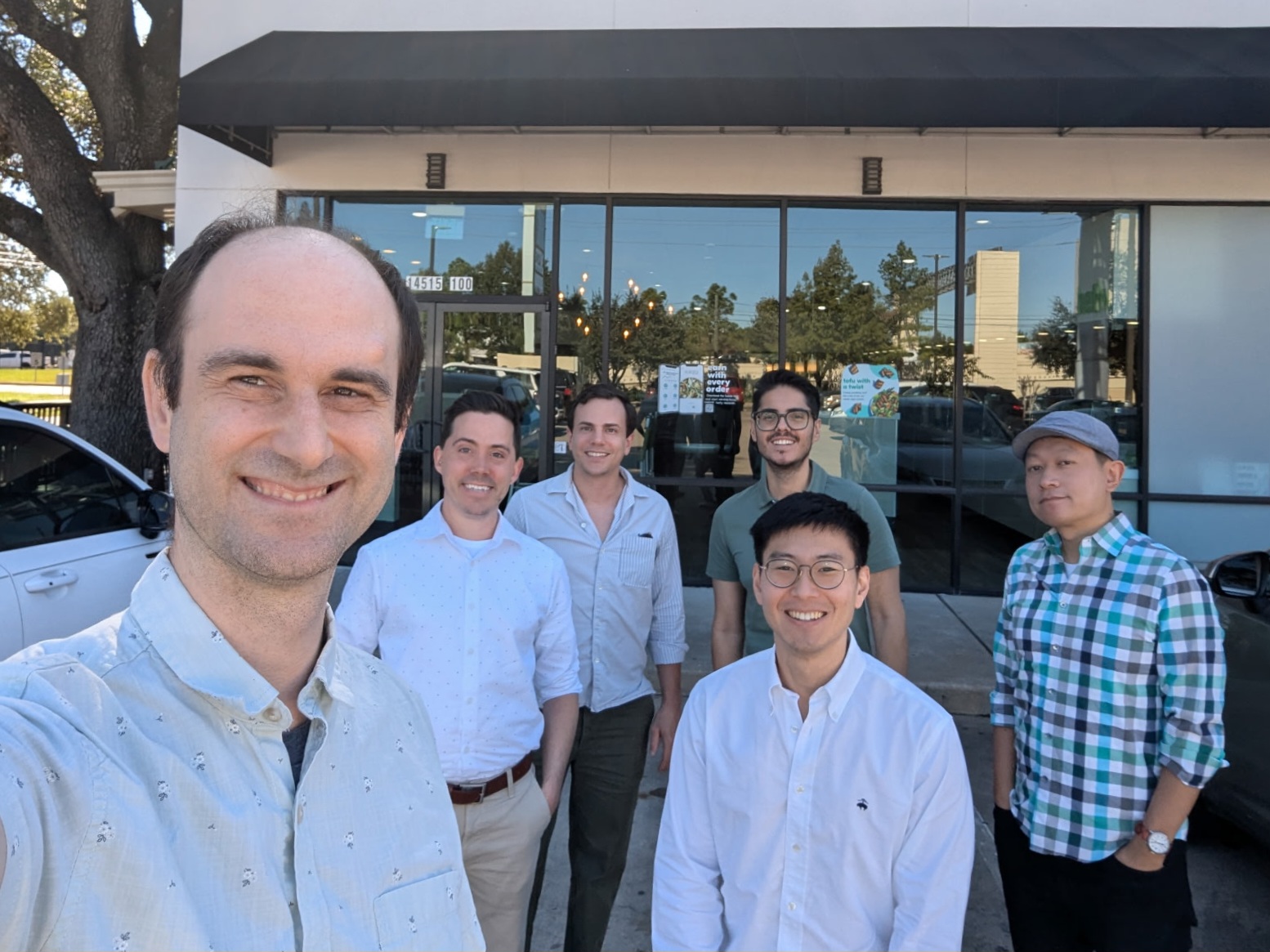
The founding team, standing in a room that will not tell them how their stores are doing - which is precisely the problem they built a company to solve. From left: Dragos Velicanu (CTO), David Chapman (design), Bradley Riley (customer success), Abbas Guvenilir (COO, back), Max Jai Sim (CEO), and Scott Liu (CPO).
There is a very old job in retail called the mystery shopper. Meadow AI's basic insight is that a piece of software can do it continuously, and cheaply, and everywhere at once.
Here is a problem that sounds too simple to be a problem: a company with 40 restaurants often has no idea what is actually happening inside any of them right now. Not the revenue - the revenue shows up in a dashboard. The experience. Was the greeting warm. Was the line too long. Did the upsell happen. Was the store clean at 2pm on a Tuesday. Traditionally you find this out by paying a stranger to walk in, pretend to be a normal customer, and file a report. This is the secret shopper, and it is slow, expensive, and produces roughly a dozen data points a year per location. Which is to say it produces almost nothing.
Meadow AI, a Seattle company that came out of stealth in November 2025, decided the secret shopper should be software. Its platform is what the industry calls "multimodal," which is a fancy way of saying it looks at several kinds of data at the same time: computer vision on video, natural language processing on audio, and structured feeds from the systems a store already runs - point-of-sale, labor, inventory. It fuses these into a continuous read on what customers are experiencing and how employees are performing, and then an AI agent turns that read into recommendations. Do this. Fix that. Move a person here.
The interesting thing about automating the secret shopper is that nobody was defending it. There is no lobby for the manual quarterly audit. It is exactly the kind of expensive, low-frequency, human-intensive task that AI is genuinely good at replacing - and, crucially, one where doing it continuously is not just cheaper but categorically different. A dozen audits a year tells you nothing. A live feed tells you everything.
Meadow is initially aiming at chains with 10 to 300 stores. Big enough to have a real consistency problem across locations, small enough to move fast on a purchase decision. The early customer list is pleasingly strange: national restaurant chains, but also beauty supply stores and, memorably, an arcade-plus-food concept. When your technology works for the arcade, the mainstream is easy.
And the traction is real for a company that hadn't publicly existed: more than $2.5 million in contracted annual recurring revenue at the moment it emerged from stealth. That number is a tell. It means Meadow sold before it built, talked to operators first, and shaped the product around a pain those operators could already name.
Every restaurant owner and brand told us the same thing: their biggest operational challenges could be solved by an AI that automated secret shopper audits and surfaced real-time insights.
One system ingests video, audio, and existing point-of-sale, labor, and inventory data to continuously score customer experience and staff performance across every location.
Replaces the manual secret-shopper visit with a continuous evaluation. Real-world interactions - voice, video, transactions - become scored, comparable, actionable insights.
An AI agent that doesn't just report but prescribes: specific moves aimed at lifting revenue, tightening consistency, and cutting unnecessary labor cost.
Much of the team came out of Modus, the Seattle real-estate startup acquired by Compass in 2020. CEO Max Jai Sim traces the idea to something more personal: his family ran a restaurant business in South Korea, an industry he calls "essential to our daily lives, yet historically underserved by technology."
Previously co-founded Modus (acq. Compass, 2020). Also worked at T-Mobile and Peach.
PhD in Physics, MIT. Former engineer at Dave and Manifold. Leads Meadow's ML infrastructure.
Also co-founded Modus. Runs operations across Meadow's go-to-market and delivery.
Former director of engineering at Modus. Leads product.
| Round | Amount | Date |
|---|---|---|
| Seed | $4.5M | Nov 2025 |
| Prior capital | ~$1.5M | - |
| Total raised | $6M | 2025 |
Seed round co-led by TenOneTen Ventures and Leadout Ventures, with participation from Wedbush Ventures and Redstick Ventures. "Prior capital" reflects the gap between the $4.5M seed and the $6M total reported at launch - approximate.
What they treat as a standalone product is merely a small feature of Meadow's comprehensive platform.
A crowd of AI startups is racing to give physical retailers real-time visibility. Meadow's nearest local comparison is Ethosphere, another Seattle company using AI to analyze retail-worker conversations. Meadow's argument is one of scope: rivals ship a feature; Meadow is trying to be the platform those features live inside.
The other competitor is inertia - the manual mystery-shopping industry that has run this way for decades. Meadow isn't just displacing a vendor; it's arguing the whole audit cadence is wrong.
Watching stores means watching people. Asked about privacy, Meadow's answer was procedural rather than evasive: customers updated their employment agreements and disclosures to cover the platform's use.
It's a small detail that tells you something about the company. The instinct on a hard question was to point at a process, not spin.
The CEO's inspiration comes from his family's restaurant business in South Korea - the origin of a belief that the industry deserves better software.
Three of four co-founders previously built Modus, acquired by Compass in 2020. The fourth, the CTO, has a physics PhD from MIT.
The early customer roster spans national chains, beauty supply stores, and an arcade-plus-food concept.
Meadow essentially turned a centuries-old retail ritual into a continuous, always-on AI service.
Watch & learn
No official Meadow AI video channel was confirmed at publication; links above run a search. Twitter/X, Instagram, and GitHub profiles were not publicly confirmed.