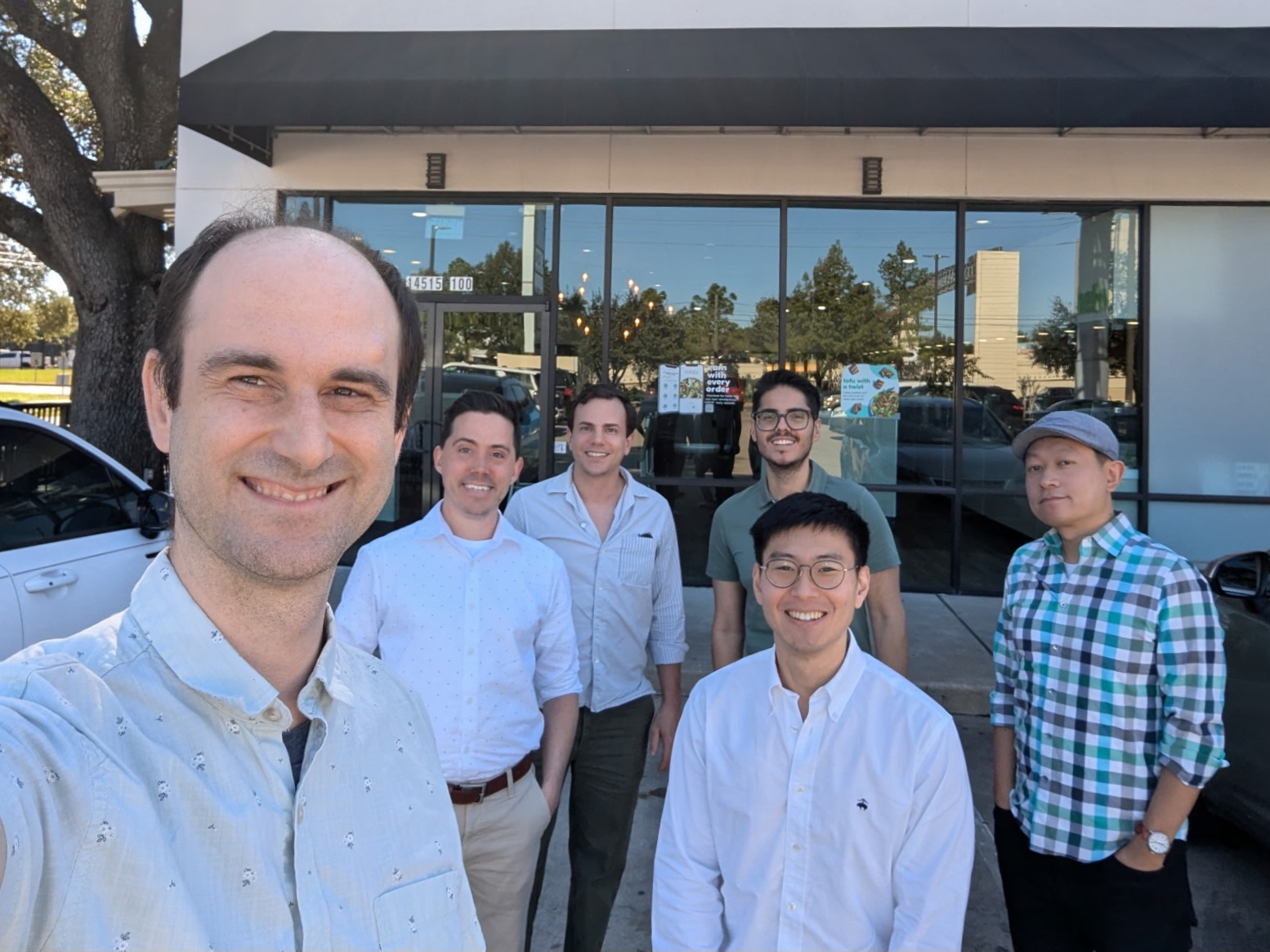
A physicist who decided the most interesting unsolved problem wasn't in a particle, but in a half-stocked soda fountain at 4pm on a Tuesday.
CO-FOUNDER & CEO · MEADOW AI · SEATTLE, WA
Most AI founders in 2025 wanted to write you a poem. Max Jai Sim wanted to tell a regional burrito chain that the lettuce station on Pike Street had been empty for nineteen minutes. That is the whole pitch, and it is a far better business than the poem.
Sim is the co-founder and CEO of Meadow AI, a Seattle company that emerged from stealth in late 2025 with $6 million raised and a deceptively unglamorous mission: give restaurants and retailers a continuous, real-time read on what is actually happening inside their four walls. The product swallows the stuff every operator already has but rarely connects - point-of-sale data, labor schedules, inventory counts, security video, ambient audio - and uses computer vision and natural language to watch the floor the way a tireless district manager would, if a district manager could be in 400 places at once and never needed lunch.
The headline feature has a name that restaurant people flinch at: the secret shopper. For decades, chains paid humans to pose as customers, order a meal, and fill out a clipboard about whether the fries were hot and the bathroom was clean. It was slow, it was sporadic, and it was expensive. Sim's company turns that quarterly ritual into an always-on signal. The audit stops being an event and becomes a heartbeat.
Every restaurant owner and brand told us the same thing: their biggest operational challenges could be solved by an AI that automated secret shopper audits and surfaced real-time insights.
Sim did not arrive in restaurant technology by the usual door. He earned a Ph.D. in Applied Physics at Harvard between 2010 and 2015 - the kind of credential that usually points toward a lab, a national grid, or a quant desk. Instead he wandered toward operations, the part of the economy where things are measured in dropped tickets and out-of-stock SKUs rather than electron volts.
There is a personal thread underneath it all. Part of the inspiration for Meadow comes from his own family's experience running a restaurant business in South Korea. He grew up close enough to the work to know that the gap between how a place is supposed to run and how it actually runs at 7:45 on a Friday is where the money quietly leaks out. A physicist learns to find the signal in the noise. A restaurant kid already knows where the noise lives.
Before Meadow, Sim co-founded Modus, a Seattle startup that digitized the title-and-escrow grind of closing on a home - another deeply unsexy process that, once smoothed, was worth a great deal. Compass, the real estate brokerage, acquired Modus in 2020. Earlier still, he worked at T-Mobile and at Peach, a Seattle lunch-delivery startup. The through-line is unmistakable: he keeps choosing the messy, physical, real-world workflows that software people usually skip because they involve sandwiches, sidewalks, and signatures.
Computer vision reads the room from existing cameras - queue lengths, empty stations, spills, whether the promo display ever made it out of the back.
Natural language and audio turn the front-of-house exchange into a measurable signal: was the upsell offered, was the greeting there, did the experience match the brand.
POS, labor, and inventory data fuse with the video and audio so a single dashboard explains not just what slipped, but why - and at which hour, at which location.
The trick is not any single model. It is the fusion. Plenty of vendors sell a camera. Plenty sell a POS report. Meadow's bet is that the value lives in the seam between them - the place where a dip in sales finally gets explained by a line that was too long, by a worker who was pulled to the drive-through, by a sign that never went up. Multimodal is not a buzzword here; it is the entire point.
Software ate the digital world first because it was easy - the digital world is already made of data. The physical one is harder. A dining room does not emit a clean event log. A retail aisle does not raise an exception when the shelf goes bare. For most of the last decade, the people running those spaces flew on intuition, lagging sales reports, and the occasional clipboard visit. Sim's wager is that the cameras, microphones, and registers already on site are enough to instrument all of it - if someone bothers to wire them together and point a model at the result.
That is a humble idea wearing an ambitious suit. There is no chatbot personality, no promise to replace the chef, no manifesto about superintelligence. There is a number: locations watched, problems caught, dollars not lost. The pitch lands with operators precisely because it refuses to be magical. It just shows up, notices, and tells the truth - the same job the secret shopper had, minus the clipboard and the quarterly delay.
It also explains the customers. A chain does not adopt a stealth-stage startup's camera system on faith; it does so because the alternative - sending a human auditor to a hundred locations and waiting a quarter for a spreadsheet - is both slow and statistically thin. One visit per store per quarter is a snapshot. Meadow offers the movie. For a brand obsessed with consistency, the difference between a snapshot and a movie is the difference between hoping every location is on-brand and knowing.
If you want to understand Max Sim, do not look at the technology - look at what he keeps choosing. Title and escrow. Office lunch logistics. Restaurant floor operations. None of these are the problems that get a founder invited onto a conference main stage to talk about the future of intelligence. All of them are problems where the winner is whoever can make a chaotic, human, physical process behave reliably, day after day, location after location.
That is a specific kind of ambition. It is patient rather than loud. It measures success in error rates and retention rather than in viral moments. A physicist's instinct shows through: define the system, identify what you can actually measure, and refuse to be impressed by anything you cannot quantify. The restaurant kid's instinct shows through too: respect the people doing the work, and aim the technology at helping them rather than scoring them.
The combination is rare. Plenty of technically gifted founders chase whatever is fashionable. Sim's body of work suggests someone who reverse-engineers the question instead - who starts with a real operator's pain, listens until the same complaint repeats back from every direction, and only then reaches for the model. He said as much about Meadow's beginnings: the company did not start with a technology in search of a market. It started with a market telling them, over and over, exactly what to build.
An applied physics doctorate from Harvard is an unusual passport into restaurant tech. Sim treats operations as a measurement problem - which, it turns out, it largely is.
This is at least his second Seattle company. The first, Modus, ended in a Compass acquisition. Founders who finish tend to start again.
The seed of the idea traces to his family's restaurant business in South Korea - lived experience, not a market-sizing slide.
Meadow had $2.5M+ in contracted ARR before it ever left stealth. The press release came after the customers did.