Manfred Ruediger chose a donkey for the photograph. After more than 25 years leading biotech companies, the former CatalYm chief executive was announcing a change in his working life. The setting was outdoors, the companion had long ears, and neither appeared to be preparing for an investor presentation.
His decision was brief: “no more operating roles”. He wanted to concentrate on supervisory boards, advisory mandates and coaching. Beside him stood an animal that supplied a useful joke about firmness. Ruediger recognized something of himself in its reputation for conviction.
There is plenty of conventional executive material in his career: financing rounds, acquisitions, a public listing, scientific credentials. The photograph adds a welcome human scale. Someone who has spent years assembling organizations is now thinking about how to use that experience from a different position.
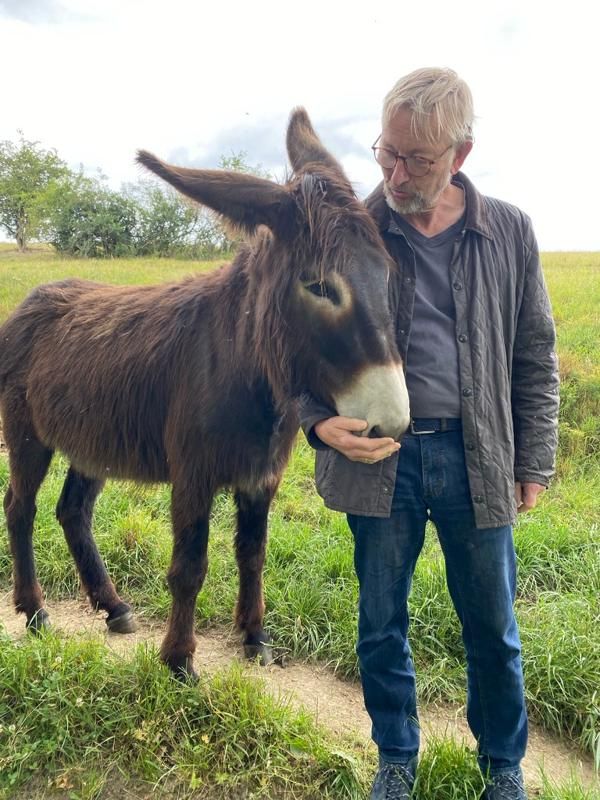
“They just have very stable opinions.”
Manfred Ruediger, on donkeys
Before the balance sheets
Ruediger was born in Mönchengladbach in 1964. His route into business began with biochemistry at the University of Tübingen, where he studied from 1985 to 1991. Organic chemistry and microbiology were part of the course. He then carried out doctoral research at the Max Planck Institute for Biophysical Chemistry in Göttingen.
The doctorate came from Tübingen. Academic work at the Technical University of Braunschweig followed, before he entered industry in 1998. That progression matters to the shape of his career. Research was his starting occupation, rather than a credential added later to a managerial biography.
At Cardion, he served in scientific and executive leadership. In November 2001, the company expanded its executive board and gave its chief scientific officer responsibility across a longer stretch of the research and development process. The job had grown beyond the immediate work of a laboratory.
Igeneon came next. He was its CEO in 2004 and 2005, when it became part of the US company Aphton. His subsequent appointments included Aphton’s chief operating role and leadership of t2cure in Frankfurt. By then, his working vocabulary had acquired another set of nouns: structures, strategy, investors, transactions.
When t2cure announced his appointment in March 2007, co-founder Andreas Zeiher emphasized the task of establishing the necessary company structures and defining its strategy. Those are concrete assignments. A startup can have substantial research behind it and still need someone to organize the enterprise around that work.
Later came venture capital, with Life Sciences Partners in Munich. He was accumulating experience on different sides of the table: explaining a company, evaluating one, and taking responsibility for what happened inside it. Those jobs ask different questions of the same plan.
Amsterdam, 2 July 2015
Kiadis provides a date around which this otherwise mobile career can be pinned. On 2 July 2015, the company listed on Euronext Amsterdam and Brussels. Ruediger was CEO. The initial public offering brought in €34.7 million gross.
The word “gross” deserves its place beside the figure. This was money raised by the company before the relevant deductions, rather than a measure of Ruediger’s personal wealth. A financing milestone is impressive enough as a financing milestone; it does not need to borrow a second meaning.
He had been acting as Kiadis’s CEO since October 2011. The prospectus placed him beside a management team with its own histories, including chief financial officer Robbert van Heekeren. A listing puts the chief executive in view, but the document itself is a reminder of how many responsibilities surround that position.
Public markets also change the company’s audience. Shareholders receive financial reports; dates and accounting periods become part of its public rhythm. Kiadis’s first half-year results after the listing made a careful distinction: the July IPO proceeds fell outside the period ending on 30 June.
That small calendar detail is a useful antidote to the glamour of a stock-market debut. The photographable moment has paperwork on either side. Cash belongs in a particular reporting period. Expectations have to be expressed carefully. A chief executive’s work continues after the shares start trading.
The company between the announcements
CatalYm brought Ruediger back to the work of building a younger organization. A co-founder and later CEO, he worked with a team whose other members included Eugen Leo, Anne Burger and Christine Schuberth-Wagner. The company’s history also rests on the academic work of Joerg Wischhusen.
During Ruediger’s tenure, CatalYm raised more than €56 million. That figure describes a period of company-building, with capital and colleagues moving together. A financing announcement can compress years of preparation into a number that fits comfortably in a headline.
His departure was effective on 28 February 2021. Anne Burger, the chief financial officer, took responsibility as managing director while CatalYm recruited a new CEO. The arrangement was practical: someone named, a responsibility assigned, a search underway.
He thanked the team and investors and said he would follow the company’s progress while turning his attention to new projects. The outgoing supervisory-board chairman, Holger Reithinger, acknowledged his contribution and said he was prepared to remain an advisor.
Here is another way to read a founder’s career. The creation of a company is one event; its ability to proceed through changes of leadership is another. CatalYm’s transition gave the organization a next set of people and responsibilities. Ruediger’s own career continued elsewhere.
Marie Curie, rearranged
Ariceum was founded in 2021. Its name rearranges the letters of Marie Curie, a small piece of wordplay tucked into a corporate identity. Ruediger was a co-founder and its chief executive. The Berlin-based company assembled its beginnings around rights acquired from Ipsen.
In June 2022, Ariceum announced a €25 million Series A. The investor group included EQT Life Sciences, HealthCap and Pureos Bioventures. A further €22.75 million in April 2023 brought that financing to €47.75 million. These were successive company transactions, rather than a single dramatic cheque.
€47.75 million total financing across the original round and extension.
Recruitment accompanied the financing. Serge Sagodira joined as chief business officer in July 2022 after almost a decade at Debiopharm. His background was in licensing and transactions, the business work required when a company intends to grow through agreements with other organizations.
Manufacturing arrangements were another part of the job. Ariceum announced a partnership with AmbioPharm in October 2022. In a May 2023 interview, Ruediger described a company pursuing several tasks in parallel, including manufacturing capacity and a broader set of technologies.
The appealing simplicity of “building a company” disappears once the phrase is unpacked. It means recruiting particular people, securing particular rights, finding particular partners and paying for the work. Ruediger’s Ariceum years contain all four. The company’s name may be a puzzle; its organization required rather less playful attention.
The cost of getting bigger
Ariceum’s 2023 calendar became crowded. The financing extension in April was followed by a strategic research collaboration with UCB in May. In June came the acquisition of UK-based Theragnostics, adding another organization and expanding the company’s US operations.
The acquisition announcement separated the price into two parts: $2.5 million in cash upfront and milestone payments totaling up to $41.5 million. The distinction is worth preserving. A possible later payment and money paid at the start are different financial commitments, even when a headline is tempted to add them together.
The transaction also joined the two leadership teams. For an executive, buying a company brings people into the plan along with its assets. There are new working relationships to establish, and a wider organization to coordinate. The legal completion of a deal supplies a date, rather than finishing that work.
In November 2023, Ariceum’s collaboration with UCB received the Deal of the Year award in the under-€500 million category at the LSX Leaders European Lifestars Awards. Ruediger celebrated alongside Sagodira. The category described the award; it did not disclose the value of the UCB agreement.
His experience with transactions had an earlier chapter at apceth Biopharma. As chairman, he led negotiations during its acquisition by Hitachi in 2019. That assignment belongs beside the Ariceum purchase: his career includes preparing an organization for a new owner as well as bringing another business into one he led.
A chair someone else can occupy
On 26 August 2025, Ariceum appointed David Schilansky as CEO. Previously its chief financial officer, Schilansky thanked Ruediger for bringing him into the company and handing over leadership. Ruediger continued as a strategic advisor.
The announcement made the next arrangement explicit. A successor would run the company. The co-founder would remain available in another capacity. Neither appointment needed to erase the previous years of work for the company to move forward.
Governance has long been part of Ruediger’s working life. He joined 4SC’s supervisory board in August 2005 and serves as its deputy chairman. He also chairs Thermosome’s board. In September 2026, his appointment alongside Ralf Schmid to a:head bio’s supervisory board was reported.
There is a useful difference between accumulating another title and choosing a different assignment. His new emphasis on advice and coaching directs experience toward people currently carrying executive responsibility. It also leaves the operating chair available to them.
The donkey photograph remains an unusually apt accompaniment. It supplies humor without a manufactured anecdote about a childhood destiny or a sudden revelation. Ruediger had taken time away after Ariceum and was ready to describe the work he wanted next. After years of company-building, he was making a decision about his own job.