At 22, Sarah Lane arrived at CarMax with the sort of job title that rarely gets embroidered on a jacket: media planner and analyst. It was 2003. CarMax was still expanding beyond a limited set of markets, search advertising was young enough to require explanation, and the used-car business remained an industry people approached with their shoulders slightly raised. Lane's first advantage was not glamour. It was proximity to the numbers.
She stayed close to them. She also kept moving. Over the next two decades, Lane passed through senior analytics, marketing strategy, consumer insights, store experience, digital transformation and marketing leadership. By 2023, she had become CarMax's Senior Vice President and Chief Marketing Officer. Her public career reads less like a ladder than a tour of the machinery. Every stop answered a different question about how a person decides to buy a car.
There is a tidy corporate phrase for that breadth: cross-functional experience. The lived version is messier and more useful. It means learning why a number changed, what an associate does all day, how a showroom makes a visitor feel, and where a digital handoff breaks. Lane spent 23 years accumulating those views before she put two words and a question mark over the whole thing.
The analyst learns the showroom
Lane has called analytics an exceptional training ground. Business became more data-driven as her career unfolded, and she had already learned to examine what moved the work. Yet one of her defining assignments took her away from a conventional marketing lane. About a dozen years before her CMO promotion, she led a large effort to modernize CarMax stores.
The buildings carried the bones of big-box retail: large, practical warehouses from another shopping era. The redesign introduced warmth. One telling adjustment moved the greeting station farther back. In a traditional dealership, Lane observed, the first hello can feel like an ambush. A few feet of empty floor became a form of hospitality.
That detail contains her broader operating instinct. Marketing does not begin when an advertisement airs. It begins when a customer anticipates friction. The best brand promise is not painted above the door; it is built into the distance between the door and the person waiting behind it.
behavior
the store
digital
the brand
Lane then helped oversee CarMax's digital transformation. Buying a used car is unusually resistant to a neat conversion funnel. A shopper may prequalify on a phone, browse dozens of vehicles, visit a store to sit in two of them, return home to think, finish paperwork later, then arrive for pickup. The journey doubles back because the decision is expensive, tactile and personal. CarMax's task was to make those changes of mind feel like options rather than errors.
This is where Lane's education starts to look almost suspiciously well assembled. At the University of North Carolina at Chapel Hill, she studied music and journalism. Later came an MBA from Duke's Fuqua School of Business. Timing, attention and proof make an agreeable trio for a marketer. One can hear each discipline in the work: a short line that can carry a tune, a story about the customer's agency, and a system of evidence underneath.
The old promise had done its job
For more than 20 years, CarMax used some form of “The way car buying should be.” The line positioned the company as a challenger to the rituals of the traditional dealership: haggling, opacity, the faint theatrical tension of pretending to walk away. It said the category was broken and CarMax had brought a wrench.
By 2025, Lane believed the posture no longer fit. CarMax had become a nationwide retailer with hundreds of stores and an integrated online and in-store experience. The company was no longer merely correcting the old model. Its marketing needed to describe what customers could actively do.
The answer from Lane's team and creative agency 72andSunny Los Angeles was wonderfully compact: “Wanna Drive?” It works literally, as an invitation to try the car. It also works structurally, as permission to control the shopping process. Start online. Visit the store. Switch back. Ask for help. Skip the help. The question can fit on a stadium sign, an app screen or the end of a television spot without requiring a smaller font and a lawyer.
The campaign gave that confidence a house band. The musicians follow customers, singing their choices back to them like a very cheerful Greek chorus. Lane has described the device as a hype squad: memorable, playable across channels and deliberately joyful. Omnichannel retail is useful language in a planning meeting. A band appearing as you prequalify at the park is advertising.
The concision matters because the operational story is long. A customer can only be invited to take control after the systems are ready to surrender it. This is the distinction between a campaign theme and a credible position. Lane did not ask the copy to disguise the business. She asked it to make years of work feel immediate.
Culture, with a calculator nearby
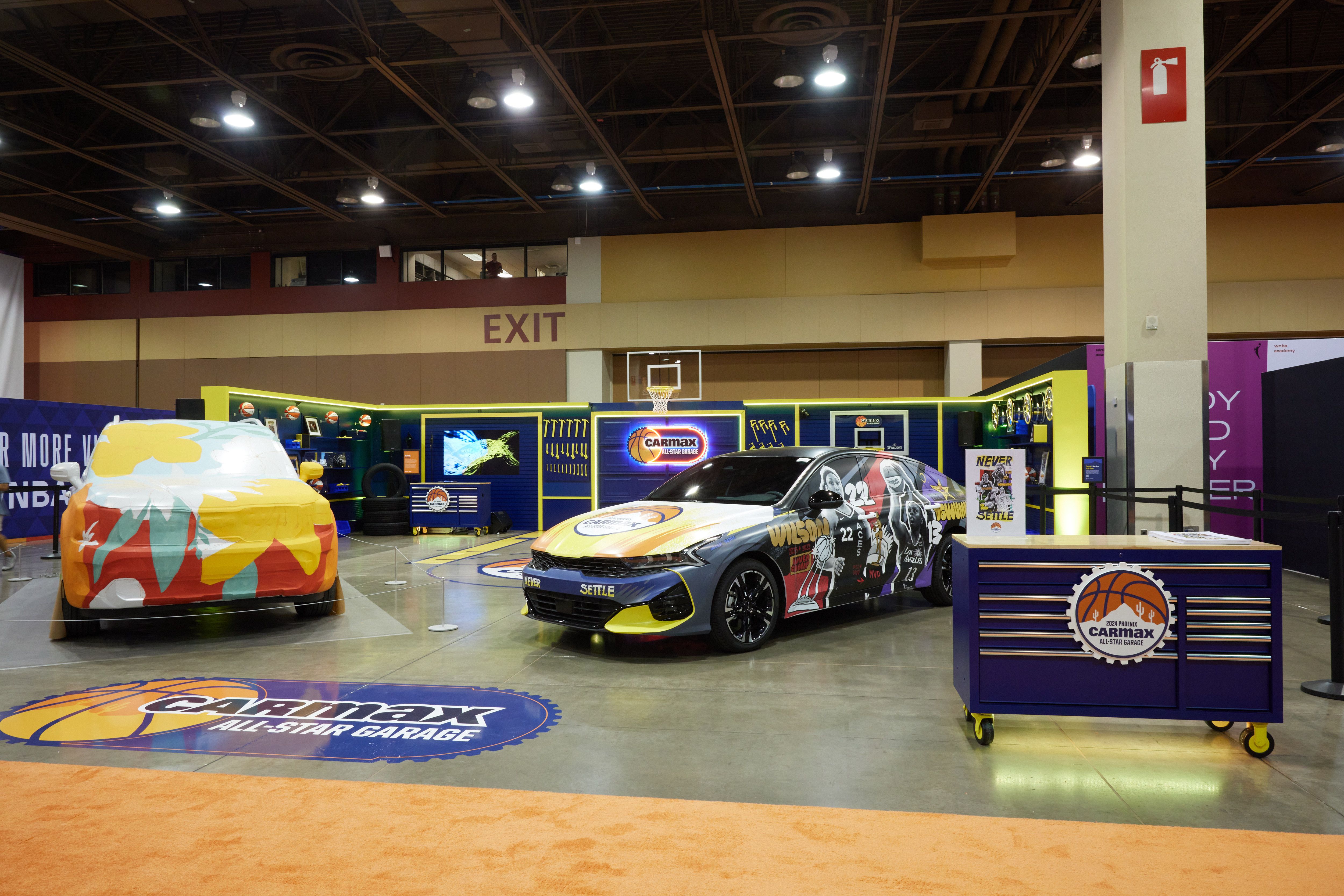
Lane's sports strategy applies the same mixture of conviction and proof. CarMax became the official auto retailer of both the NBA and WNBA in December 2020, before women's basketball attracted today's crowded sponsor interest. Her explanation for activating with WNBA athletes is strikingly unornamented: if the brand was going to work with the NBA, it would work with the women's side too.
CarMax featured Sue Bird and other women athletes in national commercials, became the first official auto retailer of the NWSL, and joined the WNBA Changemakers program in 2023. The work extended beyond buying attention. CarMax participated in media and personal-brand sessions for players, including rookies, and supported storytelling designed to raise athlete visibility.
Lane is equally plain about measurement. “We make sure that the dollars are working for us,” she has said. At the 2024 WNBA All-Star Weekend in Phoenix, at least 5,000 people visited the CarMax space and its All-Star social content produced about 700,000 impressions. CarMax's brand-affinity studies had shown a 20 percent higher lift associated with the WNBA than the NBA.
There is no conflict in her telling between supporting women athletes and interrogating the buy. The discipline is the point. Cultural relevance without commercial accountability becomes a gesture. Measurement without a reason to show up becomes an efficient way to be forgettable. Lane keeps both within reach.
The company lifer who kept changing seats
Long tenure can be mistaken for a lack of motion. Lane's story suggests another possibility: remain in one institution while repeatedly becoming a beginner inside it. Her promotions crossed specialties. Store operations complicated the clean diagrams of marketing. Digital work forced old habits into new systems. Consumer insights turned intuition into a question that could be tested.
She also names the people who made that range possible. Lane has credited former CarMax senior marketing executive Joseph Kunkel as an early sponsor who saw something in her before she felt prepared, placed her in unfamiliar seats and advocated for her. Her own account of staying at CarMax is similarly social. She points to the people and the company's mission, not to a perfectly engineered career map.
In a 2024 reflection on 21 years at the company, Lane wrote that those colleagues and the feel-good mission made it easy to have fun and give her all. The note is revealing because her public comments about work often return to teams. Even the new campaign's hero is not a solitary genius. It is a band.
Lane now serves as executive sponsor of CarMax's Women's Employee Resource Group while leading a brand that wants greater cultural resonance. She has said the company had not permeated culture in the lasting way modern brands seek. Basketball, athlete partnerships and more playful creative are routes toward that aspiration, but the center remains stubbornly practical: clarity, confidence and control.
A young analyst entered CarMax when digital advertising still felt like a specialty. The executive she became now oversees a brand meant to move without seams between screen and store, commerce and culture, calculation and a saxophone. The company changed around her. More interestingly, she kept finding new parts of it to learn.
“Wanna Drive?” is a question addressed to the customer. It also sounds like the question Lane's career kept asking her. Analytics? Store design? Digital transformation? The C-suite? Her answer, seat after seat, was yes.