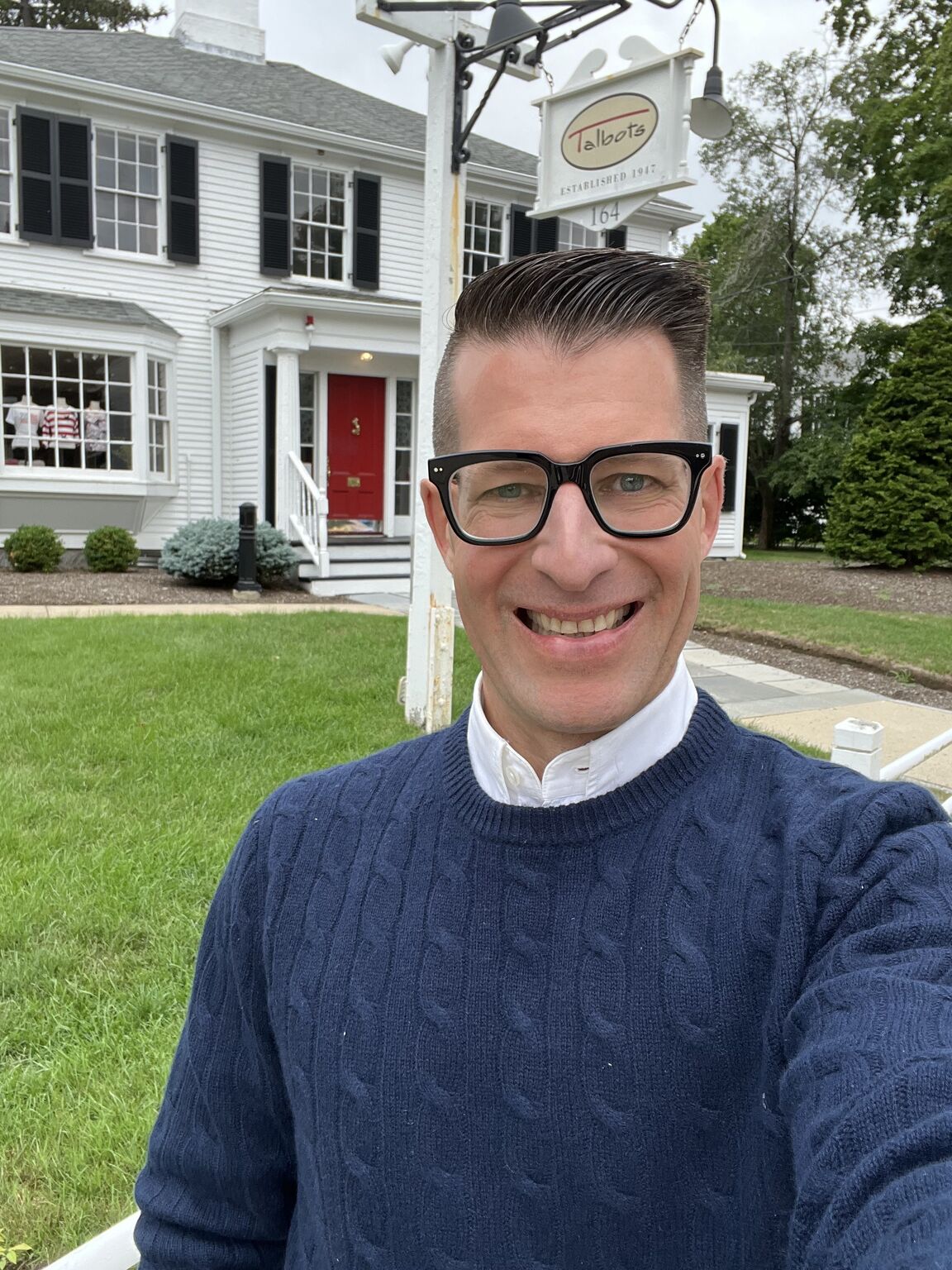
The red door is doing quite a lot of work. It sits on a white clapboard building in Hingham, Massachusetts, where Talbots began in 1947. In the photograph Bobby Ferrario used to announce his arrival as chief marketing officer, the door is behind him, bright and unmistakable. He is smiling in the foreground. The composition is a tidy summary of the assignment: a person with one foot in the next chapter, standing squarely in front of the brand’s memory.
Ferrario joined Talbots in July 2025 after roughly a quarter-century in fashion retail. He did not arrive by way of one narrow marketing lane. His resume moves through corporate finance, brand management, merchandise operations, planning, strategy, growth, investing and general management. This is useful preparation for a job where a campaign is never merely a campaign. It is inventory, timing, stores, screens, product, price, service and the difficult art of making all of them feel like one conversation.
He describes himself in four clipped phrases: customer advocate, brand and community builder, product enthusiast, agile leader. The compression feels intentional. Retail is a business that punishes fog. A garment must fit, a page must load, a promise must survive the walk from an advertisement to a fitting room. Ferrario’s public writing returns repeatedly to the same discipline: notice the large forces changing the market, then make the work concrete enough to ship.
Learning the whole machine
Ferrario studied economics and international relations at Stanford, then added a master’s degree in industrial and organizational psychology. On paper, that combination joins markets, institutions and people. In retail, the three are rarely separable. A pricing choice can be a financial calculation, a signal about brand position and a small drama in the customer’s day, all before lunch.
His first listed professional chapter began at Gap in 2001, in divisional brand management and corporate finance. From there he moved to bebe stores, spending eight years in planning and marketing strategy. At New York & Company, he rose from vice president of corporate planning and merchandise operations to senior vice president of marketing and strategy. The progression matters because it runs from the inner mechanics of retail toward its public voice. Before asking a story to sell, he learned what the organization had to do to keep the story true.
Selected route through retail
Brand + finance
Planning + strategy
Operations + marketing
GM + CMO
Chief marketing officer
New York & Company also put him close to the experiments reshaping apparel. In 2019 he celebrated the growth of NY&Company Closet, a clothing subscription-rental service featured on NBC’s Today. He later served as an investor at CaaStle, whose business centered on clothing-as-a-service technology, while holding executive roles elsewhere. Rental, ecommerce and stores were not abstract futures. They were competing and complementary ways for the same customer to get dressed.
In 2021, Ferrario became executive general manager and chief marketing officer at Orchard Brands. The role, described as a president-equivalent assignment, widened the aperture again. By the time Talbots called, his career had touched the spreadsheet, the assortment, the message and the operating model. A CMO who understands only media is liable to discover that the customer has been having a much larger conversation.
“Careers are built on relationships.”
The essays behind the executive
For a concentrated stretch between October 2019 and June 2020, Ferrario published seven essays. Their titles form a small syllabus: Empathy is Equity, Go for the Growth!, Innovation and Creativity, a yearly book review, a forecast for fashion in the 2020s, an essay on the messy middle and a piece on brands after the pandemic. The subjects are broad, but the method is consistent. He scans technology, economics, culture and consumer behavior, then asks what an operator should do next.
In his fashion forecast, he wrote that fashion constantly reflects who people are while reinventing itself each season. He saw technology making markets more finely grained and more predictive. His candidate for the decade’s successor to “omnichannel” was “omniscient” - retail that knows before the customer knows. Yet the same essay warned against allowing prediction to replace connection. He paired artificial intelligence with Robert Putnam’s work on social isolation, a reminder that a perfectly tuned recommendation can still arrive in a lonely world.
His innovation essay is similarly allergic to magic tricks. Innovation, in his account, is an operating system made from strategic insight and iterative implementation. Curiosity discovers the forces around the business. Execution turns discovery into a loop of tests and learning. The idea has none of the romance of a lightning bolt, which may be why it is useful. Most organizations have more meetings than lightning.
The Ferrario operating loop
There is also evidence of a private habit behind the scanning. Ferrario has said that, beginning in high school, he set a goal to read two or three books each month. The detail explains the easy movement in his essays from resale platforms to telecommunications, social capital and organizational behavior. His education did not end when Stanford handed over the degrees. It acquired a monthly quota.
The relationship is part of the work
When Ferrario announced his Talbots role, he thanked mentors and colleagues and wrote that careers are built on relationships. The comments beneath that announcement supplied an unusually specific example. The spouse of a former team member recalled Ferrario thanking him for the personal time his wife’s demanding work required. More than a decade later, the exchange still shaped how that person thought about leadership.
The anecdote gives “empathy” edges. It is easy to print the word on an office wall. It is harder to notice the person outside the reporting line who also bears the cost of a late night. Ferrario’s essay title, Empathy is Equity, makes the commercial argument in three words. Understanding people compounds. Ignoring them does too, merely in the wrong direction.
His public service adds other rooms to the conversation. He has participated in National Retail Federation CMO and Digital Council activities, volunteered with Stanford alumni and admissions groups, supported development and outreach for the LA28 Olympic and Paralympic Games, and guest lectured at Columbia Business School on retail, fashion, brands, consumers and technology. He also lists volunteer work with the Ali Forney Center. The connective tissue is community, whether the unit is a customer base, an industry council, a university or a city preparing for the Games.
Making the classics travel
The first clear expression of Ferrario’s Talbots chapter arrived with Spring 2026. The campaign, called Art of Coast-to-Coast American Style, placed the collection along Northern California’s Pacific Coast Highway, with Carmel and San Francisco as backdrops. The geography did strategic work. Talbots began on the Atlantic edge of Massachusetts; the campaign let its American vocabulary cross the continent without losing the recognizable color, polish and feminine detail at its center.
The company also introduced More to Explore, its first cinematic digital series. Ferrario framed the goal as continuity across the places a customer meets the brand: immersive, emotional and connected online as well as in a store. His summary is almost severe in its economy: “Product remains at the heart. Storytelling brings it to life.” It is a useful guardrail for a heritage retailer. Story without product becomes costume. Product without story sits quietly on a rack, hoping to be introduced.
Ferrario’s stated aspiration at Talbots is to deepen customer connection while building on classic American style. The phrasing avoids the usual false choice between preservation and change. Heritage is not permission to stand still. Nor is modernization permission to forget why customers cared. The practical task is translation: keep the promise, update the grammar.
“Product remains at the heart. Storytelling brings it to life.”
Perhaps it helps that Ferrario knows something about long distances. He completed the New York City Marathon five times, every year from 2013 through 2017. No responsible profile should turn a race result into a complete theory of character, but the repetition is telling on its own. One marathon may be a dare. Five consecutive finishes look like a practice.
Retail transformation resembles that sort of practice more than a launch party. The work happens through planning cycles, customer signals, store visits, creative revisions and the long middle in which a new idea becomes ordinary enough to operate. Ferrario has written about that middle, managed inside it and kept moving across its changing terrain.
So the red door remains. It should. Recognition is an asset when it still opens. Ferrario’s task is to make sure that, on the other side, Talbots feels connected wherever the customer has entered - from a Hingham shop, a phone in Manhattan or a cinematic drive along the California coast. The future of a heritage brand is not hidden in the attic. It walks in through the door, carrying the past lightly and expecting the experience to fit.