The problem with a résumé is how efficiently it can hide a person. A university name, a previous employer, a familiar city: each offers a quick reason to keep reading. Without them, someone capable can disappear before the conversation begins. Rudradeb Mitra had a Cambridge education himself. He became interested in the people for whom that introduction was unavailable.
He founded Omdena in 2019 around an appealingly practical possibility. Give people a real problem. Let them work together. See what they contribute. The resulting company would bring engineers across borders to build AI projects, while giving newcomers something an online qualification alone struggles to supply: experience with other people depending on the work.
It is an unusual route into a founder’s story. The central character keeps making room for strangers. Yet it explains both Mitra’s impatience with the usual measures of success and the substantial organizational puzzle he chose to take on.
The graduate and the gate
Mitra began his AI research career in 2002. His academic work included ten co-authored papers, and his education took him to the University of Cambridge. He subsequently moved into startups. The sequence matters: he arrived at collaborative AI after years of encountering the technology as research and as something people had to turn into products.
One piece of that research carries the wonderfully academic title Measuring Aboutness of an Entity in a Text. Published in 2006, it lists Mitra alongside Marie-Francine Moens, Patrick Jeuniaux, and Roxana Angheluta. It is a concrete trace of the technical career that preceded Omdena by more than a decade. The later founder was already familiar with a world in which knowledge advances through shared work, named contributions, and the patient business of making a particular problem precise enough to investigate.
His earlier career also included being a founding member of ThinkApps. Later came mentoring with Google for Startups and Seedstars. These roles placed him on both sides of the introduction: building companies, then helping other people work out how to build theirs. A good technical idea had to survive contact with customers, colleagues, and the stubborn details of execution.
His 2018 book, Creating Value with Artificial Intelligence, stayed close to those details. It examined how to choose useful applications, gather data, build systems, and encourage adoption. Even the title keeps its feet on the floor. Value has to turn up somewhere outside the presentation.
In 2017, he had begun stepping back from company building. Travel, talks, and mentoring occupied the following years. That period helped bring the opportunity question into focus. People far from established technology centers could study the same subjects as their better-connected peers. Finding a place to apply that knowledge remained a separate negotiation.
“I do not understand why to compete if we can collaborate.”
Rudradeb Mitra, 2019
Give the work a chance to speak
Omdena offered a way to make skill observable. An organization brought a problem; a distributed group worked on it. Contributors could try approaches, improve data, review one another’s work, and learn in the process. Mitra’s interest was in people demonstrating their ability through participation, with practical projects helping them progress toward professional opportunities.
The distinction between learning projects and paid work is essential. An invitation to participate does not automatically mean a job. In the model described in his interviews, early practical experience could help a contributor establish a record, take on more responsibility, and become eligible for paid projects. The work provided evidence that a short biography could not.
The mechanism fits machine learning’s untidy daily life. Data needs attention. Several possible methods may need testing. Someone has to notice where an assumption has failed. A group can spread that labor and bring different judgments to it. For a learner, there is another benefit: seeing how a more experienced colleague thinks when the answer is still unsettled.
- 01Learn
Build a foundation - 02Contribute
Work on a shared problem - 03Demonstrate
Make ability visible - 04Progress
Earn more responsibility
Illustrative pathway. Paid opportunities depend on performance and availability.
By 2023, Omdena combined the characteristics of a business and a school. That combination creates obligations in two directions. Learners need worthwhile experience and guidance. Organizations need a result they can use. The promise becomes credible when both sides have a reason to return.
A map is a better argument than a slogan
Consider an early Nigerian renewable-energy project. The question was where solar power might be especially useful. The team considered population, darkness at night, distance from the electricity grid, and available sunshine. It was a planning problem with geographical particulars, requiring people to decide which signals deserved attention.
There is a useful modesty in that example. A model can help identify promising locations. Building energy infrastructure involves further decisions, money, and local work. Keeping those stages distinct makes the technical contribution easier to understand. Mitra’s preference for organizations able to use the resulting model gave the exercise a destination beyond a demonstration.
By November 2020, Omdena reported more than 1,500 collaborators from 84 countries working on 31 social challenges in its first 17 months. These were dated measures of participation. They showed how far the invitation had travelled, while leaving the quality and consequences of each individual project to be examined on their own terms.
The human consequence interested him as much as the geographical spread. In a 2019 interview, he described satisfaction in watching people give their spare time to a shared problem. He also acknowledged the task of making the business sustainable. Good intentions still have to find a durable way to pay for the work.
The conversation moves to Bhutan
In February 2024, the Bhutan AI Society shared a photograph of a meal with Mitra. He is seated on the left, plates and a teapot occupying the foreground. The accompanying account described a discussion of AI skills, local projects, and collaboration between communities and international experts. It is a more useful picture of community building than another handshake beneath a conference banner.
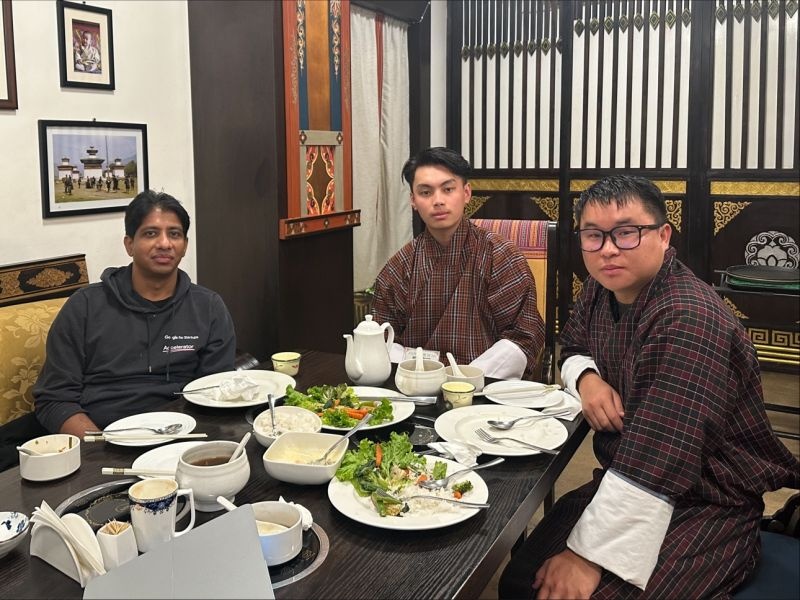
Later that year, Omdena described its Bhutan AI Lab partnership with Druk Holding and Investments and Thimphu TechPark. Mitra also discussed AI in a RIGSS podcast appearance. The setting gave a familiar concern a local expression: technical knowledge can cross borders quickly; the opportunity to turn it into useful work takes more deliberate construction.
A local project changes who gets to ask the opening question. The people learning a technology can also be people who understand the place where it will be used. International expertise then has something specific to meet. The point of the exchange is practical: develop local capability while addressing problems that make sense to the people involved.
After the demonstration, the difficult bit
By February 2025, Omdena was describing a further stage in its development. Its account of building a human-centered AI platform addressed problems inside collaborative delivery: uneven experience, limited visibility into progress, difficulty connecting tasks to code, and a need for continuing feedback. A large community had generated its own management homework.
That admission is part of the story’s substance. Bringing people together opens possibilities. Getting a team to deliver repeatedly requires methods that make responsibility visible. Omdena described tools for matching contributors, reviewing code, following tasks, and identifying bottlenecks. The test was increasingly what happened between the promising experiment and a system somebody could depend on.
The concern continued into a Qorus executive briefing listed for October 22, 2026. Mitra was named as its expert on moving AI proofs of concept into deployment without exhausting the budget. The listed subjects included accountability, skills, governance, and hidden costs. These are less glamorous words than intelligence. They are also words a customer learns to appreciate.
There is continuity here with the author who wrote about value in 2018. A useful system needs a path into ordinary use. A useful opportunity needs a path into meaningful responsibility. In both cases, the attractive first step is followed by a longer stretch of work that someone must organize.
Leave some room for the sea
Mitra’s writing gives the professional biography a less predictable edge. His Medium archive includes arguments for community-first startups and reflections on living with less attachment to elaborate plans. His profile describes him as deeply spiritual. He has made room in a technical career for questions about what a person actually wants that career to serve.
In a 2022 essay, he questioned the attention startup culture gives to raising investment. The objection sits comfortably beside his preference for community-first businesses. A funding announcement is easy to count and easy to applaud. The everyday value of a company to the people working with it demands a longer look. His public writing keeps returning to that choice of emphasis: what a company does, whom it involves, and why the effort is worth making.
His ambitions also include a detail worth rescuing from an older team page: the ThinkApps biography describes a sailing skipper who dreams of crossing an ocean. It is a pleasing addition to a founder’s list of interests. A sailboat has limited sympathy for a five-year forecast.
Read alongside his working life, that aspiration suggests an appealing scale for the story. There are large questions about access to AI and the distribution of opportunity. There is also someone deciding what to do with his days. Mitra’s answer has involved putting other people in a position to contribute, then dealing with what happens when they do.
The résumé remains a tidy document. Omdena makes room for the messier evidence of people solving a problem together. For an engineer waiting to be introduced, that may be the beginning that matters.