Success can arrive before a founder understands it. Money comes in, the team grows, and expansion begins to look like the sensible thing to do. Kazim Qazi has a less comfortable recollection of that sequence. Looking back at KoderLabs, the software company he co-founded, he describes early income that encouraged the business to expand before it had properly identified its strengths. The cash was real. The recipe still needed work.
That admission is more interesting than a tidy account of entrepreneurial foresight. Qazi helped bootstrap a business from three people working in an apartment into an operation of more than 200. Yet the lesson he chooses to discuss is a mistake in timing. A founder can be good enough to win work and still have much to learn about building a company around it. An invoice, for all its charms, is a rather poor strategic adviser.
Today, Qazi leads KoderLabs as chief executive, with teams in Dallas, Dubai and Karachi. His work also connects him to AppVerticals and TechnBrains. Across those businesses, a recurring concern is the distance between having an idea for software and making something useful happen. His own career gives that distance some texture: programming, commercial projects, an apartment-sized beginning, international operations, and repeated attempts to understand what growth should actually accomplish.
“trying to scale before we have figured out our expertise.”
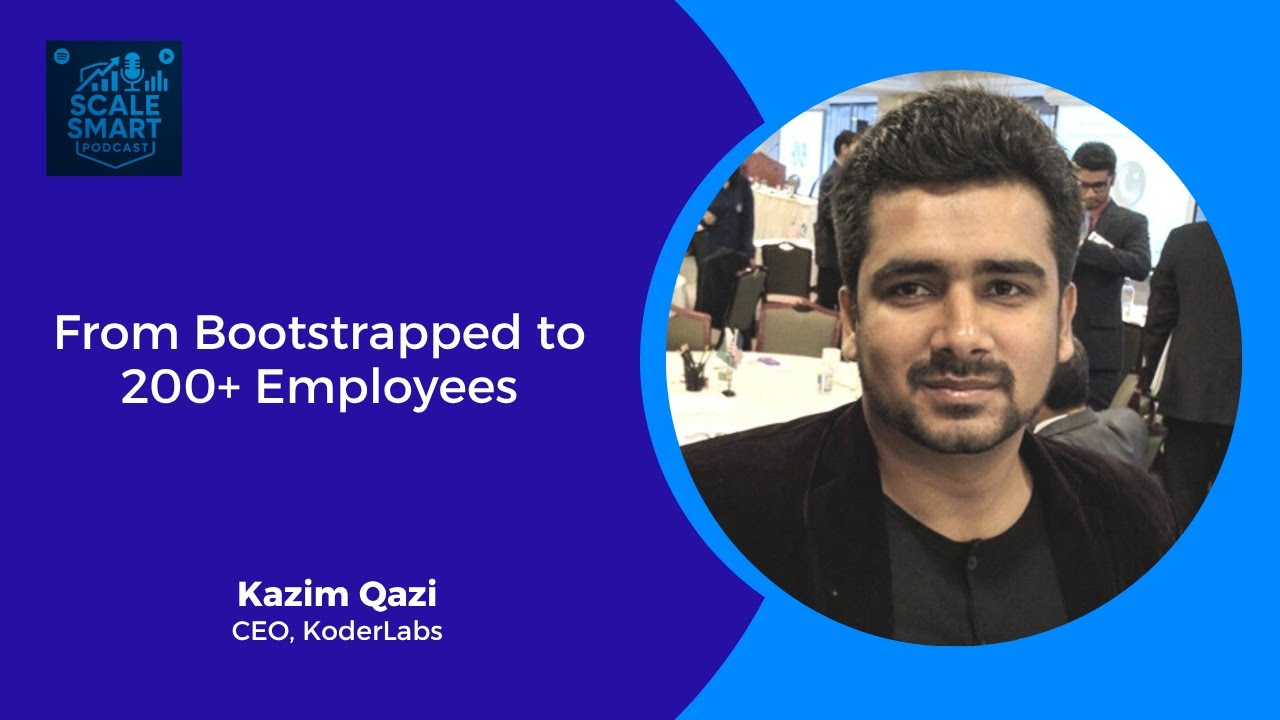
Kazim Qazi, speaking with Jacob Vice
Before the apartment, there was a programmer
Qazi studied at the University of Karachi from 2008 to 2011. His academic record includes first place in both the computer science department and the Faculty of Sciences, recognised with two gold medals in February 2013. He also placed third in speed programming at Procom in 2011. These are unusually concrete details in a business biography: results with subjects, dates and positions attached.
A programming contest and a software company have different ways of keeping score. In a contest, the problem has already been chosen. In business, deciding which problem deserves attention can consume more effort than writing the solution. Qazi's later emphasis on discovering a company's strengths is especially interesting against that background. Technical competence gave him a way to build things. Running a business required decisions about which things to build, for whom, and on what terms.
His early project record is pleasingly practical. There are mobile applications for GasBack, a service concerned with fuel-tax refunds, alongside a reporting application, an e-commerce project, an applicant tracking system and a portal for tracking stone-slab shipments. The dates cluster around 2013 and 2014. This is software amid receipts, recruitment and freight, where a successful result has to survive contact with someone's working day.
Stone slabs are a useful antidote to the more weightless language of technology. They have to get somewhere. Someone needs to know where they are. A portal earns its place by making that job easier. It would be too neat to claim that one early project explains an entire career, but the practical character of those assignments fits the questions Qazi would later return to: what changes for the customer once the software exists?
The trouble with an encouraging invoice
The apartment beginning gives KoderLabs a compact origin: three co-founders, a small space, and a company built without outside funding. Expansion eventually brought a staff of more than 200 and operations spanning the United States, United Arab Emirates and Pakistan. That is the familiar upward line. Qazi's account interrupts it with a question about what the business had learned along the way.
He has explained that some early income came from one-off successes. The company treated those encouraging results as a reason to grow, although its particular strengths still needed to be understood. This is a subtle problem. A customer paying you is evidence that you have done something valuable. Whether you can repeat it, teach it to a larger team and organise a business around it remains a separate question.
In a later conversation with Selvi on Scale Adventure, Qazi also discussed a period in which the company lost nearly all its revenue overnight. The account joins freelance beginnings, difficult hiring decisions and the search for a clearer purpose. There is no need to embellish it with an invented crisis-room scene. A business that has experienced that sort of reversal has ample reason to examine how much confidence any single revenue stream deserves.
His conversations about leadership return to team structure and hiring as well. On Work Cultured, he discussed adapting the organisation through rapid expansion, embracing new technology and building a culture centred on people. Put together, these concerns make growth sound more administrative than glamorous. Someone must decide how work is assigned, which skills are missing, and whether the people joining the company can succeed in the roles awaiting them.
A customer needs more than a finished application
The commercial problem that drew Qazi toward entrepreneurship was straightforward: people with business ideas often lacked the technical expertise to turn them into software and assess the quality of the help they were buying. KoderLabs and AppVerticals grew around serving those customers. The appeal of that work lies partly in translation. A founder describes an ambition; an engineering team needs decisions precise enough to implement.
His account of KoderLabs' development includes a move toward longer relationships as a technology partner. That changes the questions around a project. Delivering an agreed application is one milestone. Understanding whether it serves the customer's business, and what needs to happen after launch, makes the relationship more demanding. A finished checklist can look splendid while leaving its owner with an awkward problem.
Qazi's writing about user analytics brings this concern down to the scale of a shopping page. He discusses click patterns, scrolling, recordings of user sessions and the points at which customers abandon a purchase. These are small observations with commercial consequences. A visitor hesitating at a form gives a team something specific to investigate. A redesign based on taste alone offers a more expensive kind of guessing.
There is a connection here with his account of premature expansion. In both cases, visible activity invites an optimistic interpretation. A growing team looks successful. A busy website looks popular. The harder work is deciding what the activity tells you. His analytics advice asks businesses to choose measures tied to their goals and investigate where users encounter friction. That is a modest discipline, which is part of its appeal.
What happens when writing code gets easier?
Artificial intelligence has given Qazi another reason to revisit the value of a software business. In his Scale Smart conversation, he discussed repetitive development work being automated and the increasing importance of understanding a customer's field. His prediction gives specialists a larger role in the next wave of technology companies. If software becomes easier to produce, knowledge of the problem can become a more consequential advantage.
It is an interesting position for someone whose early achievements include competitive programming. The skill that helped establish his credentials now operates in a changing market. His argument leaves plenty of work for engineers, but asks more of them than producing code. They must understand what the code is supposed to achieve. A faster answer is helpful only after someone has asked a useful question.
What does the customer need to accomplish?
His thinking about technological change has a history. In December 2022, he wrote about the uncertainty of running a technology company while its tools and markets kept shifting. He described regular discussions with his team, examining changes and deciding what to adopt. That account is useful because it presents adaptation as an ongoing management task, with meetings and evaluation, rather than a flash of intuition bestowed on the chief executive.
The newer question is how AI might let each employee contribute more without the company simply increasing headcount. Coming from a founder who has already questioned the timing of expansion, that idea has a particular consistency. The business can reconsider what scale means. More people is one possible result; greater usefulness from the people already there is another subject worth his attention.
An ambition with some working instructions
Qazi has spoken of an eventual Fortune 500 ambition for AppVerticals. KoderLabs' appearance at number 2,151 on the 2022 Inc. 5000 provides a concrete milestone in the company's growth. He is also a member of the Forbes Business Council. These are distinct markers: a growth ranking, a professional membership and a long-term aspiration each say something different about where the business stands and where he hopes to take it.
The details around those markers are what make him worth following. His university results establish a technical beginning. His early projects show the ordinary commercial work behind the software. His interviews supply the correction to a smooth success story: revenue can flatter, expansion can outrun understanding, and hiring requires more care than an upward graph suggests.
One of his short public statements asks people to take ownership and contribute even when nobody is watching. That is a useful place to leave an entrepreneur whose work involves so many activities a customer never sees. Software depends on choices made between demonstrations: reviewing a requirement, checking an assumption, helping a colleague, admitting that a promising result needs another test.
The apartment has long since given way to a larger operation. The question Qazi brought out of it remains surprisingly small and exacting: what are we good at, and can we do it again? A company can spend years learning to answer that honestly. His willingness to discuss the question makes the growth more interesting than the number alone.
Keep the conversation going
Interviews, writing and the businesses behind the story.