A bus is a useful corrective to entrepreneurial grandeur. It has a route, passengers and a habit of making people wonder where it has got to. Before Jorge Carlos Campos Berny was helping run a software company across borders, a university project addressed that particular uncertainty: tracking the transport serving Anáhuac Mayab in Mérida. The question was small enough to understand immediately. The business that followed would require considerably more explanation.
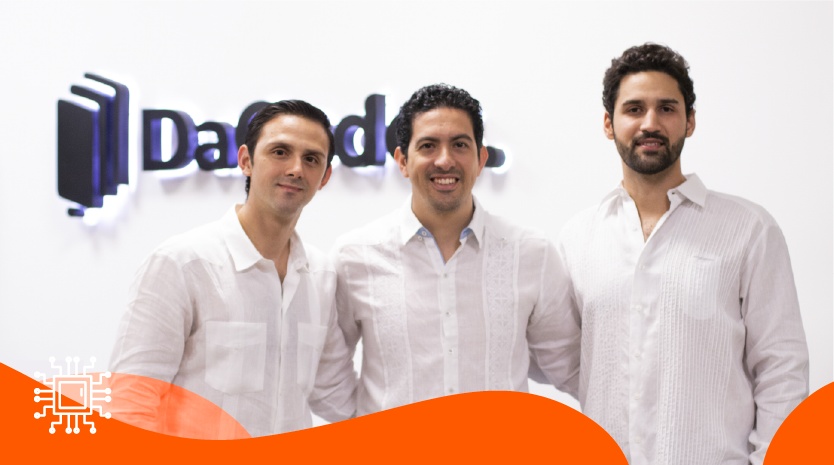
Campos, usually identified professionally as Jorge Campos, co-founded DaCodes with Carlos Vela Canul and Mauricio Moreno Jure-Cejin in 2014. Their shared university years supplied the connection. The bus project supplied an example of what software could do. Neither supplied a ready-made instruction manual for persuading strangers to pay them. That part would have to be learned while running the company.
A timetable before a business plan
Campos graduated in industrial engineering from Anáhuac Mayab in 2013. His background matters because DaCodes’ beginnings were also an education in unfamiliar work. The founders were engineers learning how to turn a technological idea into a service someone would buy. They used courses and videos, sought out people who knew more, and gradually found their way into the market for mobile applications.
The university transport project, Mayabús, concerned routes, location and schedules. It is an appealing origin because usefulness needs so little decoration here. A student wants to know where the bus is. An application can make that information available. There is no need to invent a new human desire; getting somewhere on time has an established constituency.
Early progress was uneven. The founders’ first idea did not achieve much success, and the company initially focused on startups needing apps. By July 2017, DaCodes had a team of 15 and ambitions to work in the United States and Europe. A campus problem had opened a door. Finding a repeatable business on the other side took longer.
The awkward business of being unknown
Campos’ account of the first customers is refreshingly practical. In January 2020, he recalled the difficulty of getting work before anyone knew the company or could recommend it. He also described unfamiliar responsibilities around hiring, employee rights and payment arrangements. An engineering qualification was useful preparation for some problems. Becoming an employer brought another syllabus.
“Al principio nadie te conoce,” he said: at the beginning, nobody knows you. It is a compact description of a founder’s credibility problem. Customers want evidence that a supplier can deliver. A new supplier needs customers to produce that evidence. No amount of enthusiasm makes that circle disappear, though enthusiasm can keep people working through it.
The tecniA technology park helped with branding, consulting, office access and university interns. That support gives the story a recognizable setting: a young company growing within an institution, with people and practical assistance nearby. Campos’ beginnings belong to that network of relationships as much as to the familiar portrait of an entrepreneur with an idea.
From the bus stop to the restaurant table
DaCodes’ early work moved through ordinary activities with surprisingly complicated information behind them. In 2017, it presented Degusta Yucatán with tecniA: a restaurant guide intended to help people discover places to eat and interact with them. Restaurant photography, user profiles and comments were part of the proposition. Choosing lunch had acquired a software layer.
The company was also developing applications around purchases, customer rewards and internal communication. These projects reveal the commercial territory Campos and his partners were entering. Businesses already had customers, documents and processes. Software offered a way to connect those activities, make them easier to manage or give customers another way to participate.
There was variety beyond consumer apps. In 2019, DaCodes was involved in the technology behind Sunwise, a business serving companies selling solar installations. That project placed the firm behind another entrepreneur’s product. The work could be visible as an app on a phone or operate inside somebody else’s business. Either way, a client’s particular task shaped the brief.
The sales pitch hidden in the clock
By 2018, Campos was discussing an advantage that required no new invention: overlapping working hours. His partner Vela had returned from a Boston business gathering with observations about American companies using distant development teams. Campos pointed to communication, English and the convenience of working while the customer was awake. The clock had become part of the sales argument.
He also wanted development work to remain in Yucatán, where he saw talent and opportunity. Expansion abroad did not require treating Mérida as somewhere to escape. The proposition was to serve a wider market from a place the founders already knew. Geography could support the business rather than simply describe its limitations.
There was a complication, which Campos acknowledged. More technology companies arriving in the region could offer higher salaries and make recruitment harder for local firms. The same attention that brings customers also brings competitors for employees. His view of growth already included that trade-off. A busy local industry can be good news and an expensive hiring environment at once.
- 2014DaCodes founded
- 201715-person team
- 2019Fifth anniversary
- 2025Leading across LATAM
A party, then a different kind of scale
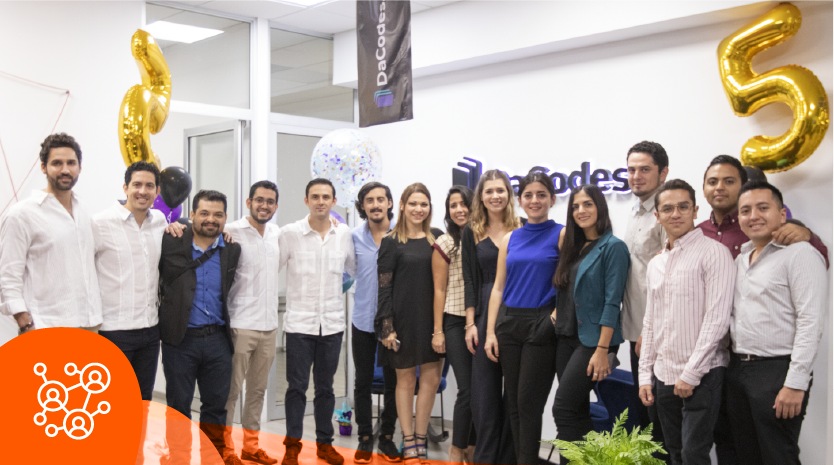
On November 22, 2019, the founders marked DaCodes’ fifth anniversary at tecniA. There were new offices, a ribbon cutting, relatives, friends and acknowledgments of the people who had helped. The company had served more than 200 clients in its first five years. Discovery Channel, Interceramic, Decathlon, Bepensa and Palace Resorts were among the names associated with that period.
The photograph of the team celebrating has the reassuring specificity of an actual office party: people arranged together, a company sign, a large gold five. Businesses are often described through their next target. An anniversary briefly insists on the time already spent, and on the colleagues who were there for it.
By 2023, the business included finding and managing technology teams that complemented clients’ own departments. Customers were principally in Mexico and the United States. This model places considerable weight on people: who joins a team, how they communicate, and whether they can work effectively inside another organization. For Campos, selling capability and organizing talent had become closely connected work.
Three things that do not fit neatly on a CV
Today, Campos’ responsibilities include sales, talent augmentation strategy and general administration. It is a combination that joins the promise made to a customer with the people and organization needed to keep it. His entrepreneurship education includes Babson Build at Babson College, alongside the industrial engineering foundation he brought into the business.
His hiring preferences offer a more personal view of how he thinks a team should work. In a public post, he listed continuing curiosity, ownership over ego and a team-first outlook as three qualities he seeks in developers. Technical skill earns consideration; his emphasis is on the habits that determine what happens after someone joins.
That is a demanding set of preferences in miniature. Curiosity means accepting that there is more to learn. Ownership means staying with a problem. Working for the team means other people’s progress matters too. For a company selling collaborative work, those qualities have a clear purpose. A résumé can list technologies; it is less accommodating about how someone behaves when the project gets difficult.
When the office crosses borders
In April 2025, Campos wrote about leading colleagues across Latin America. His account included differences between countries, bilingual communication, remote relationships and the deliberate work of keeping people aligned. He described giving local leaders real ownership. A company could share its direction while allowing decisions to reflect the people and circumstances in each place.
“You can’t assume one leadership style fits all.”
Jorge Carlos Campos Berny, April 2025
His practical responses included regular video calls, clear documentation and opportunities for colleagues to connect. These are modest instruments for an ambitious task. The lesson he described was to keep adapting, listening and learning rather than expect a single management style to travel unchanged. The founder’s job had acquired another layer: helping people who did not share an office feel part of the same undertaking.
The next question comes before the technology
Artificial intelligence now features prominently in Campos’ public work. In September 2025, he joined Moreno and entrepreneur Juan Javier Ibarra for a CANACO Mérida discussion about business efficiency. His more recent posts return to operational questions: how a process works, where time or money is being lost, and what improvement a business needs to see.
He has also described companies with expensive enterprise systems still relying on outdated spreadsheets for decisions. His argument is that information needs to be connected and dependable before automation can do useful work. In that telling, a new tool does not relieve a company of understanding its own operation. Faster confusion remains a rather awkward product to sell.
There is continuity with the bus project in that approach. The technology changes; the starting point remains a situation somebody wants to improve. Campos’ career has carried him from the practicalities of a campus service to customers and colleagues across countries. The question that makes the work intelligible is still a human one: what information, connection or piece of help would make the next step easier?
Follow the route
More from Jorge and the people around DaCodes.
- DaCodes - company and leadership
- Jorge Carlos Campos Berny on LinkedIn
- Read Jorge’s essay on leadership across Latin America
- The founders on their university beginnings
- DaCodes’ early development work - Milenio, 2017
- The US expansion conversation - El Financiero, 2018
- Watch DaCodes on YouTube - company channel