On March 14, 2025, the South Florida Education Center put a very large subject into a very particular room. In LA 331, the program for its AI V.I.B.E. event included “AI for Start-Ups and Entrepreneurs.” Vic Narang, founder of TechRev and GDKN, was on the session’s roster. The title contained a useful constraint. Whatever artificial intelligence might become, this conversation had to make sense to somebody trying to run a business.
For Narang, that was familiar territory. He has been GDKN’s CEO and president since 1993. Alongside that staffing and technology business, he became the founder and chief executive of TechRev, a software development company. His public work has moved among recruiting people, building applications, and bringing business owners together. There is considerable distance between a candidate interview and an AI discussion. An employer with an unfinished project may see them as neighboring problems.
That is the interesting part of Narang’s career: the recurring attention to how an organization actually gets something done. A good idea needs people. People need working systems. Systems need somebody to notice where the process has become awkward. The glamorous announcement usually gets the photograph. The awkward process gets Monday morning.
A career measured in assignments
GDKN’s 1993 starting point gives Narang’s story a long time horizon. By 2018, the company was described as serving Fortune 500 customers across 40 American states and five Canadian provinces. A 2019 company announcement put that reach at all 50 states and seven provinces. These are dated snapshots of its service footprint, but they show an enterprise that had traveled well beyond a single Florida market.
The company’s work includes temporary staffing, direct hiring, and recruitment process outsourcing. Those services answer different questions. An employer may need extra capacity for an assignment, a permanent colleague, or assistance running the search itself. Narang’s business sits where the employer’s requirements have to become a workable employment arrangement.
The distinction matters to the people involved. A temporary assignment has a beginning, a location, a compensation agreement, and an eventual ending. GDKN describes structured onboarding and offboarding, along with communication during an engagement. Its offering follows the worker through the assignment. Seen that way, the placement is one event inside a longer relationship.
There is a temptation to tell a founder’s story exclusively through expansion. Narang’s also rewards attention to duration. The same executive title appears across decades in which the tools available to employers changed. The underlying transaction remained personal: somebody needed help, and somebody else needed to understand the job well enough to provide it.
- 1993GDKN leadership begins
- 2016Municipal agreement signed
- 2021Low-code discussion announced
- 2025AI session for entrepreneurs
His name at the bottom of the page
A municipal agreement supplies a less theatrical image of entrepreneurship. In a City of Fort Lauderdale contract, Vic Narang signs as GDKN’s president in November 2016. Jay Narang appears as vice president. The signature page records GDKN as an Ohio corporation authorized to transact business in Florida.
There is no product-launch lighting on a contract signature. Yet it captures a consequential part of a chief executive’s job. A proposal becomes a commitment. The organization puts its name to an agreement, and an individual signs for it. The public buyer and the private supplier now have a shared document to return to.
This detail anchors Narang’s career in the work of an operating company. The founder is present in the commercial paperwork as well as the leadership directory. Government contracting also places the business in a setting where formal agreements matter alongside the initial sales conversation. A signature is brief. The obligations that follow tend to take longer.
The software has a day job
GDKN’s technology catalog brings the same working world into view. It includes systems for recruitment, payroll, leave, references, appraisals, and time and expense management. The names are admirably resistant to romance. Nobody has ever needed a smoke machine to unveil a leave-request form.
One product, TEEMS, describes a timesheet moving through three levels of supervisor approval. Another tracks recruiting from an initial client proposal through offer acceptance. The catalog is organized around the records that let a business continue from one step to the next. Its subjects are ordinary because the work is ordinary, and ordinary work still has to be done correctly.
For a profile of Narang, the significance lies in the proximity of these activities. The company he leads works with people and with the applications used to administer work. That combination offers a useful reading of his business interests without requiring a grand theory about his private motivations.
GDKN’s custom development approach begins with requirements and prototypes, followed by design, building, testing, rollout, and support. It also offers maintenance and application monitoring. The sequence gives the software a life after delivery. A functioning application has to survive contact with the organization that ordered it, including the colleagues who will inherit it after the project meeting ends.
A good idea needs people. People need working systems.The work between the big ideas
A tool for the people building tools
TechRev adds another dimension. Narang is identified as its founder and CEO, while its services include web and mobile application development. Here the customer may be a startup trying to turn an idea into a product, or an existing organization trying to make a process work better.
The company has also offered DEW, its application development workbench. The product places tools for building software inside a software platform. That is a different commercial proposition from supplying a developer for an assignment, although both address the capacity needed to finish a technical project.
A DEW trademark application was filed in December 2016, and the mark was registered in March 2019. The listed service was software as a service for developing other software. Narang appears as the correspondence contact. The record gives the product a concrete chronology, extending the story beyond a general description of technology services.
In 2021, TechRev announced Narang’s invitation to IT Palooza by TechLauderdale for a discussion of low-code approaches to digital transformation. The topic fits the workbench: how to reduce the effort required to build an application. It also places him in a public conversation about who gets to create software and how much assistance they need along the way.
An MBA, and a room full of business owners
Narang’s education crossed two institutions. He earned a bachelor’s degree at VRCE in Nagpur, India, and an MBA at the University of Detroit Mercy. Those qualifications sit comfortably beside his overlapping responsibilities in technology and business. They establish his educational path without turning it into a prediction of everything that followed.
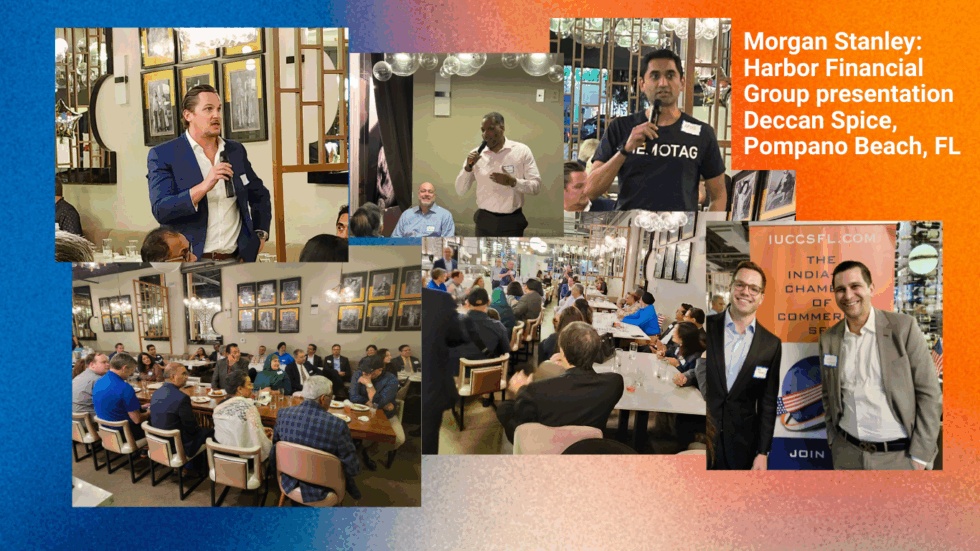
His activities in South Florida have also included the India-US Chamber of Commerce. A 2024 convention publication listed him as the chamber’s president. The current leadership directory lists him on its board, with business and finance as his area. The distinction between those two descriptions preserves the chronology of a role that has changed.
The chamber serves business communities across Miami, Fort Lauderdale, and Palm Beach. Its events offer a more local scale than GDKN’s cross-border assignments. Narang’s professional world includes both: the broad geography of delivering services and the smaller geography of people meeting one another in South Florida.
In 2022, an Indo-American Chamber of Commerce delegation report listed him among representatives presenting during a Miami business visit. The agenda concerned opportunities and doing business in the region. In that setting, his role was part of a group connecting visiting businesses with local institutions. Entrepreneurship acquires a different texture when the next useful introduction is across a table.
The conversation moves from low-code to AI
The 2025 AI event brings those strands together. Its program paired Narang’s business perspective with speakers including Cinthya Lavin of the Better Business Bureau and Mehran Basiratmand of Florida Atlantic University. The session title addressed startups and entrepreneurs directly. It placed technology inside the decisions facing people responsible for a company.
The progression from low-code discussion to AI discussion is visible in the subjects of his public appearances. Both concern tools that promise to change how businesses produce work. The practical questions are persistent: what needs building, who will use it, and how much effort will it take to make it useful?
Narang’s background gives those questions a particular setting. GDKN supplies and supports workers. TechRev develops applications. His chamber work places him among business owners and professionals. The AI conversation arrives within that existing set of activities, with employers and entrepreneurs already in view.
There is no need to treat every new technology as a fresh origin story. A founder can encounter a new tool with decades of organizational experience behind him. In Narang’s case, the continuity is legible in the work itself: staffing assignments, application development, a workbench for developers, and a session aimed at people starting businesses.
What happens after the idea
A founder profile often wants a single moment that explains everything. Narang’s public career is more cumulative. There is the company led since 1993, the municipal signature, the software product, the low-code invitation, and the entrepreneur session. Each places him at a different point between a business intention and its execution.
The most revealing image may be the least dramatic one: a person accepting responsibility for the next step. In a staffing business, that step might concern an assignment. In software, it might concern requirements or support. In a chamber, it might be an introduction that lets a conversation begin.
That reading leaves room for the human scale of the enterprise. A company can operate across borders while its work still depends on individual people understanding one another. Narang’s career follows that tension from the staffing desk to the software discussion. The big idea gets everyone interested. Then someone has to make the arrangements.