There is a moment in hiring when the difficult part appears to be over. Someone accepts the offer. The manager exhales. Then come the reference checks, the onboarding forms, the timesheet, the approval, and the payroll question. A vacancy has become an employment relationship. The work has changed shape.
GDKN has built a business around that larger shape. Its menu includes temporary staffing, permanent recruitment, and recruitment process outsourcing. Beside those sit custom software, HR systems, application support, and call centers. The combination invites a useful question: how much of a hiring problem is actually a coordination problem?
- Recruit people for temporary assignments or permanent roles.
- Handle the administration around a workforce, including payrolling.
- Build and support software for the work between departments.
A timesheet tells the story
Start with a small detail in GDKN’s product catalog. Its Time Entry and Expense Management System, TEEMS, describes a timesheet passing through three levels of supervisor approval. Only after the third approval is it updated in the system. Pending, approved, and rejected entries trigger notifications.
Three approvals sound like an unusually dull place to begin a company profile. Yet they reveal the customer’s world. An employee has worked. A supervisor must confirm it. Other people need a record they can use. Every handoff creates another opportunity for a delay, a correction, or a small mystery about whose inbox contains the answer.
GDKN’s catalog follows that administrative trail. A recruitment system tracks candidates and requirements from the initial client proposal through offer acceptance. Other tools cover payroll, leave, references, quality issues, and appraisals. The company is selling ways to keep the record moving after the recruiter’s conversation ends.
- 01Source
- 02Validate
- 03Onboard
- 04Approve time
- 05Payroll
One employment relationship. Several handoffs. Diagram is an editorial synthesis of GDKN’s described services.
The brief gets very specific
A job listing makes the recruiting side tangible. On January 27, 2026, GDKN advertised for a manufacturing recruiter in Milwaukee. The applicant had to speak Canadian French and English, possess at least three years of manufacturing recruiting experience, and manage recruitment from posting through offer acceptance. Workday experience was a plus.
The listed pay was $30.37 an hour. That is the worker’s advertised pay, rather than the price a client pays GDKN. The distinction matters when evaluating staffing economics: a pay rate answers one question about a role, while the commercial agreement has to answer questions about the service surrounding it.
This is also a reminder that “talent” becomes useful only when translated into requirements. Languages, industry experience, software familiarity, and location narrow the search. GDKN’s job here is to turn a particular operating need into a person who can meet it.
Factories, utilities, and the public buyer
GDKN names Honeywell, Cargill, Humana, UPS, Lockheed Martin, and Schneider Electric among its customers. Its stated industry coverage includes manufacturing, engineering, utilities, healthcare, technology, retail, and finance. Those names establish the kinds of organizations it targets; they do not tell us the size or current status of individual accounts.
Government work forms another part of the business. Its public-sector page lists local governments, public agencies, and staffing and technology services. A City of Fort Lauderdale contract record also identifies GDKN, with Vic Narang signing as president in 2016. Public procurement gives the story a paper trail beyond a customer-logo gallery.
For buyers, the practical attraction of this service mix is administrative capacity. GDKN describes payrolling arrangements in which a client identifies the consultant and GDKN handles employment functions. That arrangement separates finding someone from administering the assignment, allowing a buyer to purchase the part it actually needs.
“Matches profiles, not words”GDKN’s description of its data-mining approach
The software follows the paperwork
The IT business extends the same logic into applications. GDKN describes custom development for processes that commercial software does not fully cover, alongside integration, testing, maintenance, and help-desk support. Its published development approach begins with requirements and prototypes, then moves through building, testing, rollout, and support.
Its HRMS offering brings payroll, daily activity, performance appraisal, and management reporting into the workforce conversation. The separate work-management product focuses on tasks, priorities, deadlines, and progress. Read together, these offerings suggest a company interested in the information that surrounds work as much as the initial placement.
The purchasing implication is straightforward. A staffing assignment, a custom development project, and a software deployment each need their own scope. Putting them on one supplier’s menu creates a possibility for coordination. Buyers still have to establish who owns each record, approval, integration, and support request.
A company built around people, including its own
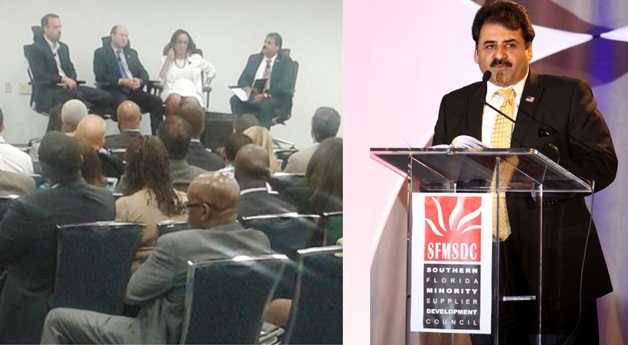
Founder Vic Narang has led GDKN since 1993, according to a Memorial Healthcare System announcement. GDKN’s corporate citizenship page also identifies Jay Narang as a co-founder and describes his involvement in minority-supplier organizations. The company’s recognition gallery includes supplier awards and a 2014 Florida Companies to Watch recognition.
Its team directory supplies a quieter organizational portrait: sourcing specialists, recruiters, payroll administrators, onboarding staff, HR, and finance. GDKN describes continual learning as part of employee development. The job titles make its operating model visible: the candidate search is supported by several other kinds of expertise.
The clock is part of the service
Even the call-center offering follows an operational argument. GDKN promotes near-shore, English-speaking support in the same time zone, with phone, email, chat, and 24/7 service options. Its stated rationale connects working schedules with staff continuity and retraining costs. That is a service-design proposition buyers can examine against their own coverage requirements.
The useful lesson to borrow is modest: map the whole workflow before choosing the supplier. Define the role, the checks, the onboarding owner, the timesheet approver, and the support arrangement. A vague brief or incompatible systems can leave the handoffs unresolved. GDKN’s broad menu is most useful when a buyer knows exactly which of those handoffs it wants help managing.