In August 2007, Codesoft needed somebody in Phoenix. The assignment was precise: a .NET architect, available immediately, for nine to twelve months. The candidate needed at least eight years of experience. A companion opening sought a senior developer for six to nine months. The advertised rate was simply “Open.” These were the particulars in a recruiting message, and particulars are where a technology business becomes interesting.
Consider the asymmetry. A project lasting less than a year called for knowledge accumulated over most of a decade. The customer was seeking temporary access to long experience. Read that way, an ordinary vacancy becomes a miniature portrait of the services economy: the expertise takes years to acquire, but a business may need it for only one difficult stretch.
- Codesoft’s stated offer combines IT advice, implementation resources, and staff augmentation.
- Oracle and SAP are named ERP specialties; application development also appears in its business profile.
- The buying decision is about scope: do you need a plan, a delivered project, or a particular person?
- Its historical staffing record offers a practical lesson: specify experience, duration, and responsibility before comparing proposals.
01 / THE BUSINESS INSIDE THE REQUIREMENTEight years of knowledge, nine months of work
The architect’s requirements included presentation, business, and data layers, along with modeling and object-oriented concepts. The developer opening mentioned web services, security, scalability, and interaction between tiers. The post asked for a résumé, an hourly rate, and availability. It offers evidence of recruitment for contract assignments; it does not tell us whether either position was filled. The useful detail is the shape of the purchase: skill, time, place, and a start date.
ARCHITECT REQUIREMENT
PHOENIX / AUGUST 2007
As an interpretation of that record, Codesoft’s role was to connect a defined technical need with a suitably experienced professional. A buyer could understand the offer without a slogan about transformation. There was a task, there was a gap in capability, and there was a proposed period during which someone would close it.
That specificity is something a reader can copy. Before commissioning outside help, write the requirement in ordinary language. Which decision cannot your team make? Which system cannot it implement? Which skill will it need for six months but probably not for six years? A service provider can respond more usefully to a defined problem than to an ambition with a fashionable name.
02 / ADVICE MEETS IMPLEMENTATIONThe gap after the software purchase
Codesoft’s company description pairs strategic consulting with implementation resources and full-life-cycle professional services for commercial and government organizations. It lists IT staff augmentation, ERP implementation, Oracle, and SAP among its specialties. Its stated purpose is expressed in five words: “Linking Technology with People.” Its public profile gives 1989 as the founding year.
“Linking Technology with People.”CODESOFT / PUBLIC COMPANY DESCRIPTION
There is a sensible way to read that pairing. Consulting helps a customer decide what to do. Implementation supplies work to carry out the decision. Staffing supplies particular expertise inside a team the customer already directs. Those are different purchases, even when one supplier offers all three. Confusing them is an excellent way to produce a proposal nobody can quite accept.
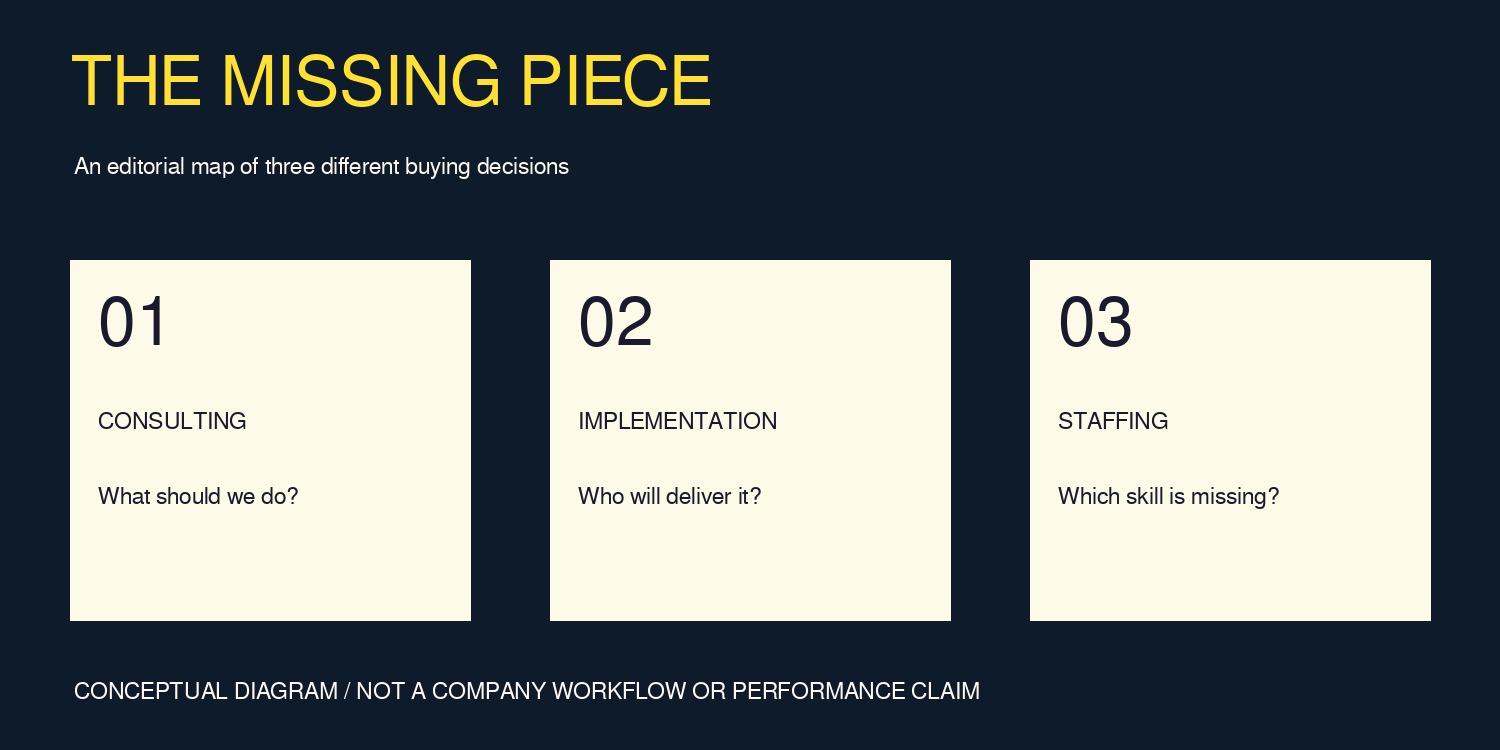
For a hypothetical ERP buyer, the distinction matters immediately. Hiring an adviser to define requirements differs from hiring a team to configure a system. Adding a specialist to an internal project differs again. A useful brief says who owns the business decisions, who owns delivery, and who will accept the result. That is a purchasing framework suggested by Codesoft’s service mix, rather than a claim about how every Codesoft engagement operates.
03 / A SERVICES COMPANY’S PLACEA business built around other businesses
Codesoft sits on the services side of enterprise technology. A business profile describes technology consulting, application development, and recruitment. The common thread is work commissioned around a customer’s needs. A consultancy selling expertise faces a different buying conversation from a software publisher selling access to the same product to many subscribers.
Its combined offering suggests a potential convenience: a customer can discuss the plan and the resources required to execute it with the same organization. Whether that produces better results depends on the actual team, the assignment, and the contract. Breadth of services is a reason to ask more precise questions, not a substitute for asking them.
The alternatives follow the requirement. An ERP implementation specialist may suit a tightly defined platform project. A technical staffing agency may suit a company that already has capable project leadership. A custom development firm may suit a business seeking a delivered application. An internal hire may suit a need that will persist for years. These are purchasing alternatives, not a ranking of providers.
The most useful comparison therefore starts with ownership. If the customer manages daily work, evaluates individual performance, and supplies the project plan, staffing may be the appropriate frame. If the supplier is expected to deliver an agreed result, the proposal should describe that result and how it will be tested. Calling both arrangements “IT services” saves words and loses meaning.
04 / THE PRICE IN THE WRITINGA contract lesson with a dollar sign
A separate public record gives the story a less comfortable dimension. An October 2023 court decision names Codesoft International Inc., Katalyst Technologies Inc., and Rahul D. Shah as defendants in a financing dispute. It describes an October 2021 agreement in which Spin Capital purchased $2.798 million in future receivables for $2 million. The plaintiff asserted that remittances stopped in February 2022.
Shah argued that a representative had made assurances about when his guarantee would be enforced. The court relied on the written agreement’s merger and modification provisions, granted the plaintiff’s summary-judgment motion, and denied the discovery cross-motion as moot. The decision records that dispute and ruling; it does not establish why remittances stopped or what happened afterward.
For a buyer reading this profile, the transferable lesson is modest and practical: write down the terms that matter. In an IT engagement, that means scope, payment milestones, responsibility for delays, and acceptance criteria. A reassuring conversation cannot do the administrative work of a clear agreement. Neither can a beautiful presentation, however splendid its diagrams.
05 / THE REQUIREMENT IS THE STARTHire for the gap you actually have
Codesoft’s public proposition makes most sense when the customer can name a missing capability. Its staffing archive shows how concrete such a need can be. Its company description connects that work to consulting and enterprise implementation. Together they give a useful picture of a provider selling professional expertise around business technology.
The approach has limits. If a team has no agreed objective, adding a specialist may leave the argument intact. If nobody can approve business requirements, implementation resources may wait on decisions. If a standard application already meets the need, commissioning custom software may add work the buyer did not need to own. These are conditions to consider when evaluating the service model, not reported failures of Codesoft projects.
Return to Phoenix. The interesting thing about that old vacancy is how little ornament it required. Experience. Duration. Availability. An hourly rate. Anyone assessing a consultancy can borrow that discipline: make the need legible, assign responsibility, and define completion. The missing piece becomes easier to hire once somebody has taken the trouble to describe its shape.