The first problem with buying IT support is that almost everyone appears to sell it. A cloud specialist sells it. A cybersecurity firm sells it. A software developer may sell something with a remarkably similar description. Before a business can choose a supplier, it has to decide what kind of supplier it needs. IT Companies Network has made that preliminary confusion its business.
- A directory for finding IT providers, from managed support to software development.
- Search routes include location, service, technology, and client industry.
- Free provider profiles feed the directory; premium listings sell extra visibility.
The useful question is what happens between typing “IT company” and having three firms worth calling. A directory earns its place in that interval. Its contribution is organization: turning a broad request into a smaller set of plausible conversations. That sounds modest. Anyone who has compared three proposals describing three different jobs will recognize the appeal.
The search before the search
IT Companies Network, founded in 2020 and based in Dallas, operates ITCompanies.net. Its homepage reports coverage across 84 countries and more than 3,600 companies. Those are directory figures, reported by the platform. They describe the size of the shelf, rather than the number of successful buying decisions made from it.
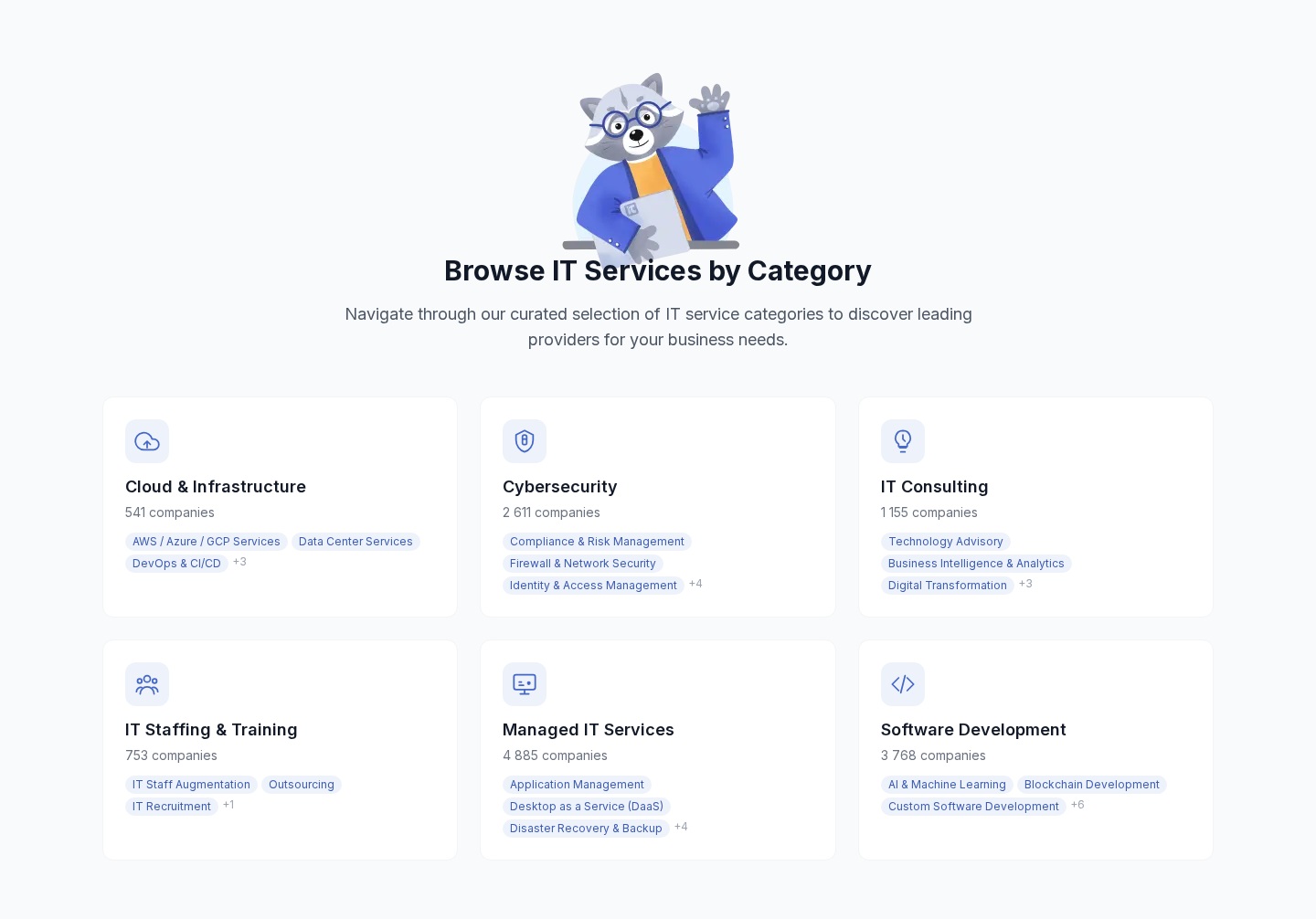
The shelf has six broad divisions: cloud infrastructure, cybersecurity, IT consulting, staffing and training, managed IT, and software development. Within cybersecurity, incident response and penetration testing have separate entries. Within managed IT, backup and helpdesk support have their own places. These distinctions matter because “keep us running” and “test our defenses” describe different assignments.
The more revealing routes are technology and industry. A buyer can browse Microsoft 365 or Python specialists, then investigate providers serving healthcare or manufacturing. Consider a hypothetical clinic replacing its support firm. Familiarity with its existing systems and sector could make a candidate more relevant than a general claim to digital expertise. The directory gives that investigation a starting point.
Seven steps on the other side
For providers, the visible onboarding sequence has seven stages: company information, services, location, description, logo, account, and choosing a plan. It is an instructive little inventory. A useful supplier profile requires structured information before it requires a persuasive slogan. The business needs to be discoverable under the words a buyer actually uses.
The company offers free profiles and says premium listings provide additional visibility in target markets. That establishes the commercial exchange: suppliers get a place to describe themselves, while some pay to be seen more prominently. Buyers supply the reason that visibility has value. A supplier wants attention from somebody already looking for its kind of work.
For a small IT firm, that is a different marketing proposition from publishing another broad article about technology. The potential reader has arrived with a procurement task. Whether the listing produces a worthwhile lead still depends on the fit between the buyer’s problem and the supplier’s capabilities. Being discovered is the opening event.
“Our goal is to bring IT experts and business owners together.”Joseph Harisson, founder, in his public professional biography
Read the small labels
One live managed-services listing displays both “Verified” and “Sponsored.” The pairing is worth pausing over. Verification concerns the platform’s assessment of a provider; sponsorship concerns visibility. Neither label, by itself, answers whether that provider can migrate your particular system, work to your timetable, or support your staff when something goes wrong.
The results also contain ratings displayed alongside zero review counts. A careful buyer should read those elements together before interpreting a score as customer evidence. Ask for references. Open the provider’s own site. Ask which comparable assignment it has completed. A directory can collect signals; the buyer still has to decide how much weight each signal deserves.
Clutch and Goodfirms occupy adjacent territory, with IT company profiles, reviews, and commercial visibility products. IT Companies Network’s emphasis is the IT services search itself, organized through specific service families and technology labels. The practical comparison is which platform helps you assemble a relevant, inspectable shortlist for the job in front of you.
- 01Define
the service - 02Narrow
the context - 03Inspect
the evidence - 04Compare
the proposals
The price comes after the brief
There are two costs here: appearing in a directory and delivering IT work. A free company profile has a stated entry price. The work itself needs a proposal. Treating those as separate purchases prevents a directory’s invitation to request quotes from becoming an assumption about what the eventual project will cost.
Harisson’s October 2023 network-support guide reported a broad global hourly range of $25 to $300, using the platform’s internal data. That historical range is useful mainly as a warning against buying from a single headline number. The guide discusses geography, infrastructure size, compliance needs, and support frequency as variables. A rate without those conditions leaves the important arithmetic unfinished.
Borrow the method
The approach readers can copy is straightforward. Write a short brief before browsing: systems involved, locations served, required hours, security expectations, deadline, and the person responsible for approval. Use the directory’s categories to identify candidates. Send the same brief to three plausible firms. Ask each to price the same scope and state its exclusions.
This approach works best when the buyer can define the assignment and allow time for comparison. During an active outage, a directory search may be slower than an existing support relationship. For a highly specialized environment, a listed category may be too broad to establish competence. In either case, access to a name is only one part of getting help.
The quiet lesson of IT Companies Network is that procurement starts with vocabulary. Name the work precisely, and the search becomes more useful. Then ask for evidence, compare the commitments, and make the call. The shortlist is the product. What you do with it determines its value.