Half a million resumes ought to be an advantage. At RapidBrains, HashRoot’s talent business, they had become a queue. Applications arrived by email, through the website and in database uploads. Recruiters spent hours opening files and checking qualifications. A request for an unusual technical skill could send them back through the pile. The company had plenty of candidates. Finding the right ones was consuming the working day.
- The job: HashRoot runs cloud infrastructure, technical support and security operations, and builds software and AI systems.
- The buyers: Hosting companies, SaaS businesses, enterprises and other IT service providers.
- The revealing detail: Its recruiting AI improved after engineers fixed document handling and listened to recruiters.
HashRoot built Lens to search that collection. Its account of the project contains something more interesting than a victory lap: a week lost to troublesome documents, early results that missed the point, and a decision to change the economics of the models doing the work. Here is a company explaining itself through a backlog.
First, teach it to read
The initial difficulty was wonderfully ordinary. Resumes came in different formats. Some were scanned PDFs. Long documents parsed slowly. HashRoot says mixed-format parsing delayed the project by a week, until optical character recognition and fallback handling became dependable. Before anyone could ask a clever question, the system had to read the file.
Then came relevance. Early recruiter tests returned unsuitable matches. Engineers revised how resumes were divided into chunks and embedded individual sections. They paired semantic retrieval in ChromaDB with structured queries in PostgreSQL, combining the meaning of a request with filters such as location and experience. Recruiters could approve or reject results in a dashboard.
Cost changed the design too. HashRoot says OpenAI was accurate but expensive at scale, so it used LLaMA through Groq, retaining OpenAI for difficult queries. Caching frequent questions also helped. The case study reports a 40% reduction in inference costs, 70% less time spent manually filtering, and roughly 40% better shortlist relevance, based on recruiter feedback. These are company-reported results from this deployment.
The cloud still needs a crew
Lens makes more sense when placed beside HashRoot’s older work. The company manages servers and data centers, migrates applications, builds deployment pipelines and staffs support desks. Its cloud services cover AWS, Microsoft Azure and Google Cloud. Security work includes penetration testing, threat monitoring and security operations centers. Software engineering and AI development extend that operational toolkit.
Customers buy help with the continuing obligations of technology: upgrades, incidents, backups, capacity and releases. A hosting provider needs support while its customers sleep. A software vendor needs each new customer’s environment configured correctly. HashRoot can supply white-label support, answering behind the customer’s brand. The operator may be invisible to the person opening the ticket.
For advertising-software business iMarketleaders, HashRoot describes moving a product from a non-cloud data center to AWS and automating deployment. Auto scaling and DNS had been obstacles. The resulting dashboard let the client configure customer URLs, Nginx settings and scaling groups, with automated code updates. An operational chore became a repeatable action. That is a concrete reason a SaaS company might hire it.
One invoice, a lot of responsibility
The commercial proposition mixes implementation projects, ongoing managed services and dedicated teams. HashRoot’s partner page lists relationships with AWS, Microsoft, IONOS and Red Hat. These place it alongside the platforms customers already use. Its pitch is the breadth of work it can take responsibility for across those environments.
One case concerns a Chicago-headquartered data center business with 14 facilities. The requested scope ran from technical tickets and server administration to software development, sales support and design. HashRoot reports payroll savings of up to 70% after outsourcing. That figure belongs to this engagement’s staffing bill; it should not become a blanket forecast for a buyer’s entire technology budget.
Clutch lists an indicative $10,000 minimum project and hourly rates of $50-$99. Actual scope matters: a migration, continuous security monitoring and a dedicated engineering team consume different resources. The sensible comparison includes the management time a buyer must still contribute, alongside the vendor’s fee.
The person answering the ticket may be invisible. The responsibility cannot be.
HashRoot’s own culture pages emphasize training, employee participation and recognition, including a “Best Helping Hand” award. For a service business, that last category has practical charm. A colleague willing to explain a stubborn problem is part of the delivery system.
From server rooms to global teams
HashRoot dates its beginnings to 2008. Its UK company was incorporated in August 2015. The current leadership page names Anees T as founder and Febina K V as Director and CEO. Its LinkedIn profile reports more than 1,500 customers across over 80 countries, spanning work beyond any single office.
The newer Nexus offering connects technology operations with setting up and managing global capability centers. HashRoot argues that its existing infrastructure, talent and managed-service businesses give that offering a foundation it already operates. Buyers considering an overseas team are also buying questions about access, governance, payroll and who makes decisions.

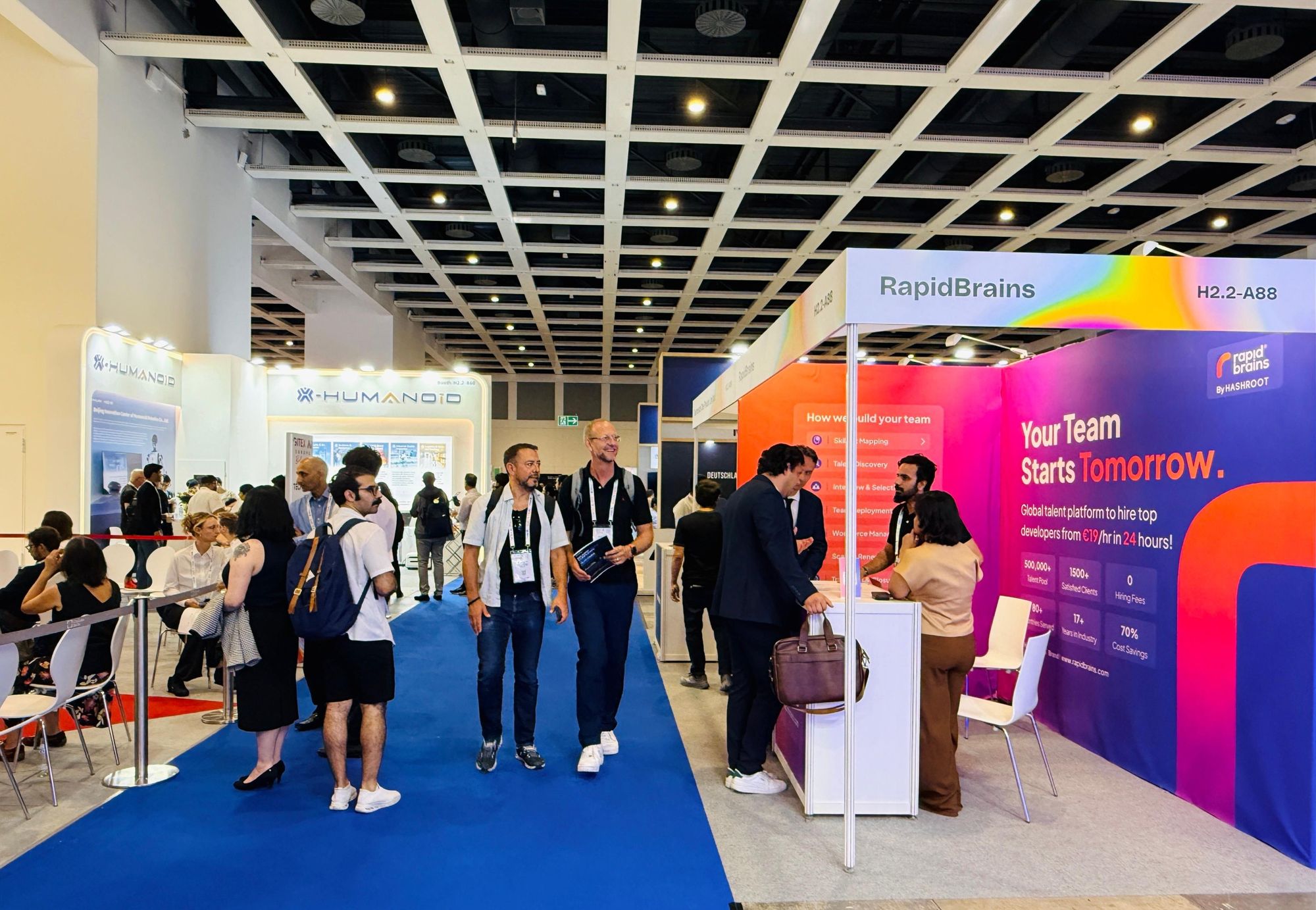
In December 2025, HashRoot announced a strategic investment in Worksent, a white-label MSP support business. The companies described plans to expand network and security operations, AI automation, and their U.S. and European presence. In 2026, HashRoot also reported RapidBrains’ appearances at GITEX AI Europe and Düsseldorf Future Tech Fest. Infrastructure and talent now share the same expansion story.
Copy the feedback loop
The useful lesson from Lens is an operational one: choose a recurring task, make its inputs readable, combine search methods, and let the people doing the job judge the output. Measure time, relevance and cost separately. A sub-minute query is not the same measurement as hours spent screening during a day.
That approach depends on usable records, accurate filters and people willing to correct the system. An outsourcing engagement likewise needs clear scope, escalation rights and an accountable owner inside the customer’s business. HashRoot’s most persuasive work starts where those responsibilities become specific. The backlog gives the engineering somewhere useful to begin.