The first thing CACI sold was help. In 1962, Herb Karr and Harry Markowitz saw an opportunity around SIMSCRIPT, a computer simulation language that people could obtain but struggled to use. The technology existed. The instruction, support, and community around it needed work. The two founders put $1,000 apiece into a mailing advertising a seminar.
- CACI pairs government expertise with software, sensors, and communications hardware.
- Price pressure pushed it toward selling technology outcomes.
- Its expansion into space and electronic warfare comes with acquisition costs and dependence on federal budgets.
There is something delightfully unglamorous about this beginning. The company’s celebrated first office was a park bench and a telephone booth. Its opening insight was practical: a sophisticated tool creates demand for people who can make it useful. That idea helps explain a company whose work now spans hostile drones, satellite links, and federal computer systems.
A business in the instruction manual
An early Navy contract paid $17,330 to simulate inventory operations. In 1964, IBM paid $30,000 for a new SIMSCRIPT version. CACI called the resulting product SIMSCRIPT I.5. Customer work helped finance reusable technology. The consulting assignment could become the beginning of a product.
Today, CACI builds national security technology and supplies specialized expertise. Government customers buy secure networks, intelligence analysis, software development, electronic warfare capabilities, and engineering support. A commercial buyer can also encounter its international subsidiaries through data and software services. The connecting problem is getting information into a form that somebody can act on.
When the hourly rate became the problem
The original model had a weakness. In a 2024 interview, chief executive John Mengucci described government buying that increasingly rewarded price over past performance. Experience became harder to monetize when a procurement treated suppliers as interchangeable hours. CACI responded by shifting the mix toward technology and becoming more selective about the work it pursued.
“If we have time, we’ll invest. When we don’t have time, we’ll acquire.”
John Mengucci · July 2024 interview
That change places CACI among government integrators such as Leidos, SAIC, and Booz Allen Hamilton, while some products compete in specialist defense markets. Its particular proposition combines access to difficult customer problems with technology it can develop, buy, and integrate. That combination is a positioning argument; it does not mean competitors lack either ingredient.

The signal is the product
Consider SkyValor, CACI’s drone defense system. Finding a small aircraft requires more than spotting a dot. The system combines radio-frequency sensing, radar, optical and infrared cameras, and cellular sensing. Different sensors supply different evidence. Software helps assemble it, while non-kinetic effects provide ways to disrupt the threat. CACI offers trailer, truck, and fixed-site configurations.
The earlier SkyTracker family established a related approach: detect and locate drones, including their operators, and integrate with other defense systems. BEAM 3.0 puts electronic attack capabilities into a backpackable format. These products address customers protecting troops, facilities, and infrastructure. Their usefulness depends on the threat, deployment environment, integration, and authority to employ the available effects.
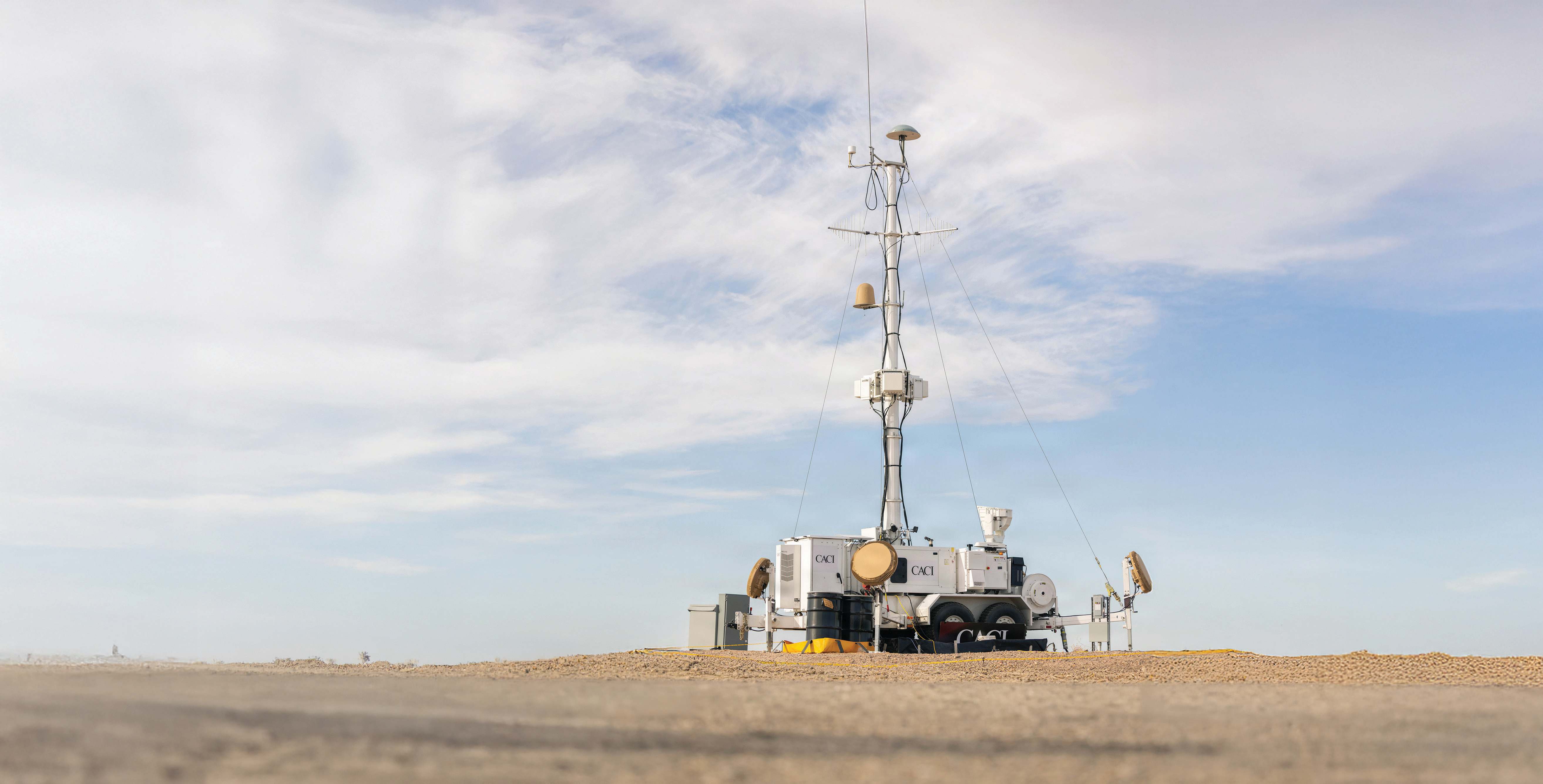
Space creates another information problem: moving data between distant assets. CACI manufactures optical communications terminals, including CrossBeam for low Earth orbit crosslinks. Its Orlando production and testing facility opened in 2022. Here, software expertise meets flight hardware, manufacturing discipline, and the inconvenient fact that a deployed satellite is difficult to service.
DarkBlue brings the same emphasis on usable information to investigators. Its intelligence suite supports analysis and collection across the open, deep, and dark web, alongside training. The training matters: access to more material does not automatically produce a better investigation. Analysts still need to decide what the evidence means.
For a prospective customer, the useful starting point is a mission requirement: what must be detected, connected, protected, or modernized? A government team can seek an integrated delivery program; an investigative team can explore DarkBlue and its training. These are different purchases. Treating the entire portfolio as one product obscures the engineering, procurement, and operator skills each assignment needs.
Buying the missing pieces
CACI’s strategy has a price tag. It completed the Azure Summit acquisition in October 2024, announcing a $1.275 billion cash deal for radio-frequency technology and engineering. In March 2026, it completed the acquisition of ARKA for an announced $2.6 billion. ARKA added electro-optical, infrared, and hyperspectral imaging, plus AI-based geospatial intelligence software. Those purchases broaden what CACI can deliver, while adding integration and financing demands.
Partnerships supply another route. A 2023 AWS agreement targeted government cloud adoption, edge computing, and analytics. CACI also joined Oracle’s federal human resources modernization effort. Customers need systems that connect with existing infrastructure, so an integrator’s partner relationships can matter alongside its own inventions.
The customer still holds the pen
CACI reported $9.568 billion in fiscal 2026 revenue. Its latest quarter, reported October 21, 2026, brought $2.475 billion in revenue, up 8.2%; organic growth was 2.1%. Awards totaled $4.8 billion. Awards, contract ceilings, and revenue describe different things: work still needs authorization, funding, and delivery before an announcement becomes earned sales.
A buyer can borrow a simple discipline from this story: specify the result before choosing the parts. Ask how a proposed system will connect to the tools already in service, what operators must learn, and how performance will be demonstrated. A collection of capable components still needs a coherent plan for daily use.
The concentration is substantial: U.S. government contracts supplied 95.6% of fiscal 2026 revenue. Fixed-price work exposes CACI to overruns; acquisitions require successful integration. Within the workforce, the company reports 39% veteran employees and received its sixth consecutive USA TODAY Top Workplaces award in 2026. Mission familiarity is a resource the business actively cultivates.
Public accountability also belongs in this picture. In November 2024, a jury awarded three Iraqi plaintiffs $42 million in the Abu Ghraib case involving CACI’s interrogation subsidiary. CACI disputed liability. After initially affirming the verdict, the appeals court reversed course in August 2026 following a Supreme Court decision and remanded for dismissal. The legal outcome and the underlying allegations deserve separate attention.
For another business, the useful lesson is specific: learn where a customer’s work gets stuck, then build something repeatable around that knowledge. It requires access, expertise, and patience. Without those conditions, buying technology can leave a company with expensive parts and no convincing reason they belong together.