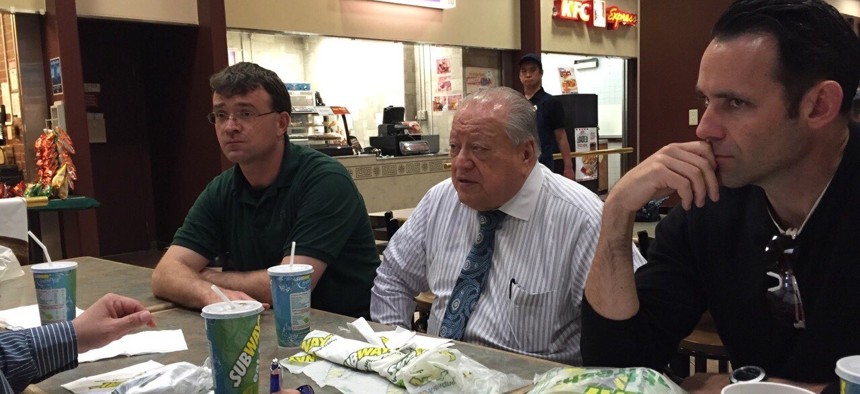
The photograph could almost pass for a family lunch. Sandwich wrappers cover the table. Paper cups stand beside a stack of documents. At the center sits Fernando Galaviz, wearing a tie in a food court. He founded THE CENTECH GROUP in 1988. The setting is a useful introduction to a company whose work happens far from the technology industry’s usual stage: inside government security offices, military communications systems, and the networks people expect to work every morning.
- SecurityManager automates federal personnel and physical security casework.
- Network, cybersecurity, telecom, and service-desk teams keep agency systems operating.
- A 2020 ownership change followed a contraction; a 2023 team award shows subsequent delivery work.
Galaviz had worked in the federal government before becoming CENTECH’s founder. His career included positions at the Commerce and Transportation departments, and years advocating for minority businesses. He understood that selling technology to Washington involves understanding the machinery that buys it. A useful application still needs a contract, a delivery team, and somebody responsible when the application stops behaving.
The founder leaves. The work remains.
That machinery can become vulnerable when too much of it depends on one person. In a 2022 remembrance, former federal procurement chief Steve Kelman described CENTECH’s decline after Galaviz suffered a stroke: business development slowed, and employment fell from 350 to 50. Kelman reported a sale price of $4 million. Galaviz’s obituary dates the sale and his retirement to 2020.
The distinction matters. The failure Kelman described began in winning new work. A contractor can retain useful software and experienced people while losing the capacity to replenish its contracts. That is the uncomfortable business question inside this company’s history: how do you preserve institutional expertise when the institution’s central figure steps away?
CENTECH’s current website names Prathiba Ramadoss and Selva Jayaraman as its owners and Johnnie Rankin as CEO. The business they describe combines specialized software with teams that operate and support government technology. Read together, the history and the current offering suggest a rebuilding effort around capabilities that survived the founder’s exit.
“Trust • Quality • Service • Value
CENTECH’s stated principles
The clearance file has a workflow
Consider personnel security. Before an agency can move a case forward, information must reach the right people under the right rules. CENTECH’s SecurityManager turns that administrative work into configurable software. In use since 2008, it provides integrated case management for personnel and physical security. CENTECH lists deployments supporting Health and Human Services, Homeland Security, Commerce, Education, and Transportation.
Rules-based workflows and role-based access controls address two practical questions: what happens next, and who gets to do it? CENTECH also offers custom development and Salesforce-based approaches with coalition member Business Integra. Its stated starting point is an assessment of the customer’s requirements and regulations. The platform decision follows that assessment.
There is a lesson here for anyone buying enterprise software. Describe the handoffs before choosing the screens. A tool built for a specific security operation earns its place by fitting that operation. The advantage of a specialist is familiarity with those requirements; the trade-off is the effort and expense of tailoring the system.
What the software actually costs
The published GSA schedule makes that expense tangible. A price list current through September 18, 2023 lists SecurityManager Version 4, including the first ten users and personnel-security and contract modules, at $348,311.50. Annual maintenance for those users is listed separately at $103,553.40. Those are dated schedule prices, rather than a quote for a deployment today.
The same catalog separates additional users, optional modules, training, and professional services. CENTECH’s business therefore includes software licensing and maintenance alongside paid technical work. The useful buyer’s question is about the complete configuration and its continuing support. A base license alone cannot describe the cost of integrating an agency’s working environment.
Somebody still has to fix the phones
The software sits beside a decidedly physical services business. CENTECH supports base telecommunications, including analog and internet-based telephone systems, E911 updates, cabling records, and equipment maintenance. Its explanation of the job is refreshingly concrete: customers must maintain older environments with limited funding, while replacement components become harder to obtain.
The company says it keeps overhead low to support competitive compensation and retain existing staff. That is an operating proposition worth examining. On a military installation, people who know the equipment and its history can be part of the service being purchased. Replacing them introduces another transition into a system already managing obsolete hardware.
Elsewhere, CENTECH describes firewall and endpoint management, continuity planning, incident response, and cloud-readiness assessments. One network case study describes an Army Reserve-directed consolidation completed within 18 months. Another account details introducing government-provided ServiceNow software at Vandenberg, then adding dashboards and self-help tools. These are examples of implementation work: configuring, moving, maintaining, and teaching systems to fit their users.
A contract is a route to the customer
This puts CENTECH in the federal systems-integration and managed-services market. Agencies buy delivery capacity and domain knowledge as well as code. Its GSA Multiple Award Schedule provides a purchasing route for software and IT services. Larger integrators and other specialist contractors offer alternatives; within a particular project, another contractor may also become a teammate.
In August 2023, CENTECH announced its participation on a Centuria-led team awarded a $63 million base IT task order at Hanscom Air Force Base. That figure describes the team’s award, not CENTECH’s revenue. The distinction keeps the announcement useful: it shows a place on a delivery team, without pretending to measure the company’s financial recovery.
The part worth copying
CENTECH’s stated principles include understanding the customer’s mission and continuously improving performance. Its careers page puts education assistance and professional certification among employee benefits. Those commitments fit a business where expertise must remain useful across changing systems, requirements, and contracts.
Another piece of the operating history surfaced in January 2026. Bloomberg Law reported that CENTECH and the Air Force settled a dispute over communications infrastructure at Vandenberg. The case concerned the agency’s refusal to accept materials purchased by a subcontractor. Even in a business organized around software and services, purchased equipment and contractual responsibility can become consequential issues.
The approach suits organizations that need tailored workflows, operational support, and a contractor familiar with federal delivery. It is a heavier fit for a small team seeking an inexpensive application it can activate unaided. The transferable idea is specific: assess the workflow, preserve the people who understand it, and budget for the years after installation. In government IT, tomorrow morning is part of the product.