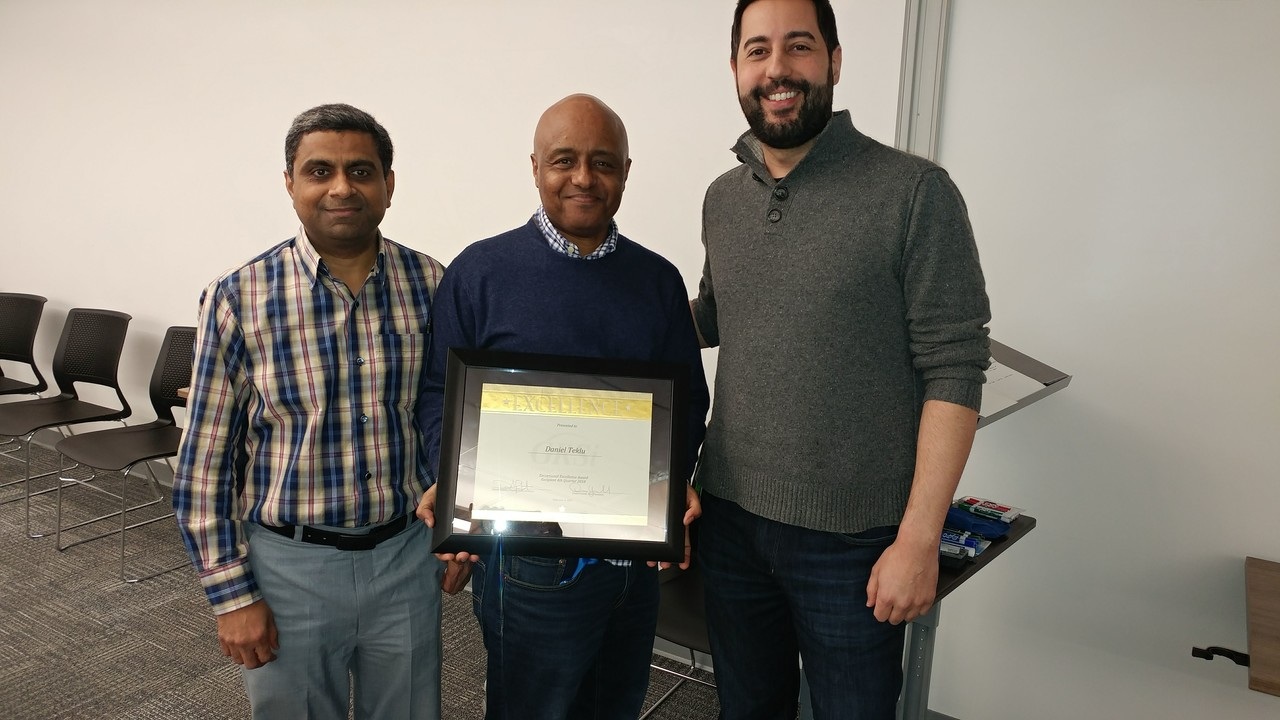
In March 2019, GRSi held a small ceremony for a man responsible for storage and backup. The photograph is wonderfully ordinary: three colleagues, a framed certificate, a meeting room. Daniel Teklu stands in the middle. There is no product launch in sight. Yet the picture gets remarkably close to explaining this company. Before a researcher can do something interesting with data, somebody has to make sure the data is there tomorrow.
- GRSi builds and runs technology for federal research and defense customers.
- Its work combines daily IT support with cloud, software and security engineering.
- DLH bought the business for $185 million in December 2022.
A garage, then a place inside the mission
GRSi began in 2000. Its founder was Deborah Grove. A Frederick County economic development account places the early headquarters in a former garage at her home. In 2011, the headquarters team, then 15 people, moved to Westview Drive. By the county’s 2015 account, the wider company employed more than 200 people, with clients including NIH, the FBI and Walter Reed.
Garage stories usually invite us to imagine an invention. Here, the more useful thing to imagine is accumulated knowledge: which systems people depend on, how they get access, where a change might interrupt their work. That is an interpretation of GRSi’s trajectory, but its later contracts give it substance. The company grew around organizations whose technology had to keep serving people while engineers changed it.
Hundreds of applications. One working day.
Consider the assignment GRSi announced in August 2021 for the NIH Director’s Office. The three-year contract, worth more than $32 million, covered hundreds of applications and tens of thousands of support incidents. Its scope ran from application development and DevOps to service management, storage, infrastructure and cybersecurity. A support ticket and a software release belonged to the same operating picture.
That range explains the offering better than a cloud of fashionable technology terms. GRSi sells teams and engineering services that help an institution function. For an agency buyer, the practical benefit is being able to commission development, infrastructure support and security work around a shared mission. For the scientist at the other end, the benefit may be a functioning application and fewer interruptions.
Infrastructure
Cloud platforms
Data controls
Connected responsibilities, not a one-way project plan.
The cloud work became more specific in September 2022. GRSi won a two-year assignment supporting NIH’s STRIDES program. The announced scope included shared cloud architecture, governance, engineering and operations, plus integrating Microsoft Azure as a centrally managed platform alongside existing AWS and Google Cloud services. It was a plan for making several cloud environments usable within one research institution.
GRSi also worked beyond health research. A four-year, $32 million Marine Corps software engineering contract announced in April 2022 covered development, testing, security posture and post-deployment support for the Technical Control Analysis Center family of systems. The setting changes. The engineering requirement remains recognizable: maintain existing capabilities while introducing new ones.
The price of knowing the customer
When DLH announced its acquisition that December, GRSi had approximately 700 employees. The buyer wanted more cloud modernization and cybersecurity capability, along with greater scale. GRSi’s then president and CEO, David Affeldt, pointed to the fit:
“From culture and values, to market presence and capabilities”
David Affeldt on the DLH combination, December 2022
The announced $185 million price comprised $178 million in cash and $7 million in equity. DLH financed the purchase through an amended credit facility. This was an acquisition of an operating business. Calling the amount venture funding would tell a different story.
The revenue figures require similar care. In February 2023, DLH said GRSi had produced approximately $120 million of revenue in 2022. The earlier acquisition announcement had projected roughly $140 million in annualized revenue going forward. One describes past activity; the other was an expectation. Neither should pass for a current standalone sales figure.
Another number arrived in 2023: $1.7 billion. GRSi was among eight awardees on a five-year National Cancer Institute IT blanket purchase agreement. That amount was the aggregate ceiling across the agreement. Individual call orders still had to be competed and awarded. The position gave GRSi access to potential work, with a customer it had supported through desktop management and user support since 2018.
Access also helps explain BroadTech, GRSi’s mentor-protégé joint venture with DeltaStrac. In March 2022, BroadTech received a prime position on STARS III, a government IT contracting vehicle. In this market, the route by which a customer can buy the work is part of the business model.
The SPARC contracting page supplies a useful glimpse of how much surrounding work that involves. It describes GRSi assignments ranging from $1 million to more than $45 million, with services spanning requirements, design, testing, maintenance and help desks. Those stages matter to a buyer responsible for the entire system. A clever implementation still needs a defined requirement, a way to test it and someone to maintain it afterward.
The next contract is another contest
Experience does not secure every renewal. In August 2026, GAO denied DLH, LLC’s challenge to an urgent NIH IT bridge order awarded to Dynanet. DLH had been the incumbent. Its task order expired while a longer procurement went through protests and corrective action. The decision concerns purchasing and continuity; it does not establish a technical failure by GRSi.
Other work continued inside the parent. In September 2026, DLH announced an NHLBI follow-on worth up to $43.7 million over two and a half years, including options, supporting approximately 2,000 people. In October, it announced a separate $2 million NIH data governance pilot. Those are DLH awards, and they show the current company working where research, operations and data controls meet.
The practical lesson is modest enough to use: understand the operating dependencies before proposing the transformation. Ask who uses the application, who answers when it breaks, and who can approve access. An organization seeking an instant software subscription will need a different buying process. GRSi’s business grew around the slower, more demanding job of making technology fit an institution. The certificate in that meeting room suddenly makes sense.