On December 15, 2025, the Army retired a piece of software that had served it for more than 27 years. The Standard Procurement System for the Army had helped people buy things for a generation. Its replacement, the Army Contract Writing System, carried a surprising family resemblance: it began with software already working for the Air Force. One of the companies helping turn that inheritance into usable infrastructure was Synergy.
- Reuse the foundation. Adapt proven software to another agency’s work.
- Connect the machinery. Contracts must talk to financial systems.
- Stay for the handover. Migration, training, and support determine whether people can use it.
This is a revealing introduction to a company whose name could otherwise disappear into a directory of IT contractors. Synergy works on the processes that let government function: writing contracts, handling cases, sharing information. Its appeal rests on knowing both the technology and the bureaucratic machinery around it.
The government’s hand-me-down
Founded in 2005, Synergy was built by Sam Sarkar and Chandan Mukhopadhyay. Sarkar’s background includes consulting for Freddie Mac, Fannie Mae, and Deloitte. Mukhopadhyay worked in engineering and architecture at webMethods and Informix. Their biographies describe careers spent making enterprise systems work, a useful preparation for institutions where replacing one application means negotiating with several others.
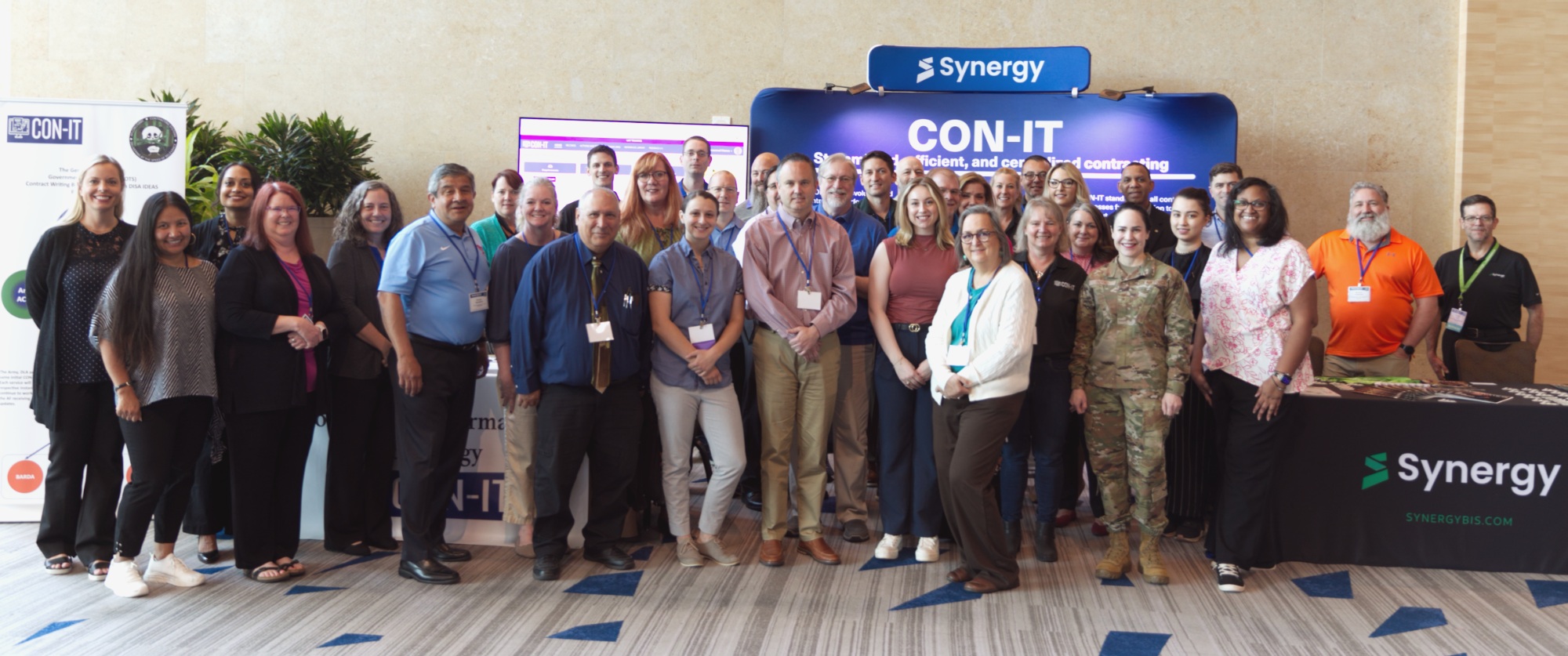
The Army’s earlier procurement tools had aging architectures. Its modernization efforts stretched back to at least 1999. In 2022, officials chose to start with the Air Force’s CON-IT baseline. The Army’s account of the rollout describes an incremental approach: release useful capabilities while developers continue building. The shift was from waiting for a finished suite to improving a working one.
Appian supplies the low-code platform beneath these systems. USDA’s Enterprise Application Services helped provide the delivery route. Appian identifies Synergy as the USDA support contractor adding CON-IT capabilities and hosting and developing ACWS. The accomplishment belongs to a network of agencies, platform suppliers, and implementers. Synergy’s place is in the implementation.
The hard part starts after launch
Consider the trajectory. The Army reported 95 ACWS contract actions in fiscal 2023, then 3,022 in 2024 and 45,324 in 2025. That expansion created demands beyond adding features. Its November 2025 account describes architecture changes for surges, interface improvements, training, and service-desk attention. A working system has to become a supportable one.
From first use to daily work.
The same Army report puts the Tier 3 incident backlog at 808 in February 2025 and 133 in September. That detail is more instructive than a launch announcement. Adoption brings friction; reducing it requires people who understand both the application and the work interrupted by a problem.
“Modernization is not a rip-and-replace effort”
Gregory Youmans · ACWS functional sponsor · January 2026
An interface can determine which users can move. In October 2024, the Army announced integration between ACWS and the Corps of Engineers’ financial management system, with deployment planned in waves. The connection allowed contract status, funding, and expenditure data to stay aligned. For a buyer evaluating an IT contractor, this suggests a better question than how quickly a screen can be built: which other systems must exchange information before the new workflow is useful? Synergy’s emphasis on integration addresses that kind of dependency. A demonstration becomes more persuasive when it includes the handoffs.
What the contract buys
Synergy sells development, integration, hosting, and continuing support through government contracts. Its published vehicles include GSA’s Multiple Award Schedule and Coast Guard application services. Buyers are acquiring the labor and delivery capability needed to make software useful inside an agency.
Published ceiling for the Coast Guard APLES II contract. A ceiling sets ordering capacity; it is not guaranteed spending or company revenue.
The APLES II description covers engineering, operation, maintenance, and enhancement across 35 business systems and 90 applications. It illustrates the economics: the relationship can extend well beyond an initial build. Costs follow the work ordered, while a contract’s headline ceiling describes its permitted scale.
The portfolio also includes Salesforce case management and support, cloud migration, and software delivery pipelines. Synergy says it supports dozens of USDA Salesforce applications and delivered a Coast Guard court case management system using its 100-day minimum viable product approach. Its emerging technologies practice describes Python, Snowflake, and language-model work at the Department of Labor.
A map, a phone, a stalled project
The same integration problem looks different on the water. In its account of preparations around Super Bowl LIX, Synergy says it inherited a stalled Coast Guard Team Awareness Kit project and delivered a functioning server within two months. The government-provided platform lets teams share an operational picture. Synergy deployed it and trained users.
The company also tested iTAK, the version for Apple devices. Its explanation contains a wonderfully ordinary detail: Coast Guard teams already used iOS equipment. Familiar hardware reduced another obstacle to adoption. This is a company-reported case study, but the practical lesson travels: start by understanding what people already carry and use.
Training belongs in the budget
Synergy’s approach to its own workforce offers another concrete detail. The SLIC immersion program pays a salary from day one. Its published sequence runs from training through certification and practical projects to deployment, typically over three to four months. Tracks include Appian, Salesforce, cloud engineering, and DevSecOps.
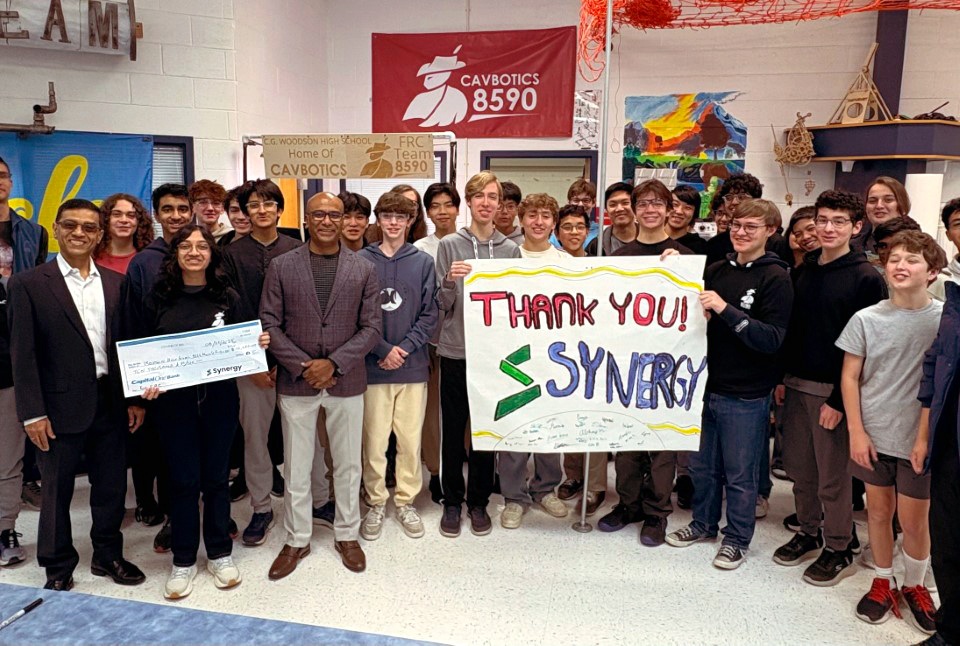
There is a community counterpart. In January 2026, Synergy announced support for Woodson High School’s Cavbotics robotics team. The contribution helps cover materials, tools, registration, and travel. Alongside the formal training program, it gives the company’s talk about developing people a tangible expression.
The useful thing to borrow
For an agency choosing between implementation partners, Synergy’s documented acquisition work and platform expertise are relevant credentials. Appian named it its 2023 Public Sector Emerging Partner of the Year. Synergy also announced CMMC Level 2 certification after an independent assessment in December 2025. Those credentials help establish suitability; individual requirements still decide the fit.
The reusable idea requires discipline. A borrowed baseline must fit the new mission. Financial interfaces, data migration, security requirements, and user training still need attention. Organizations unable to support incremental releases will struggle to reproduce the approach. The attractive shortcut is the existing foundation. Everything built around it still has to work.