Keisuke Tomida had acquired an inconvenient thing for someone with a successful legal career: a fairly clear picture of his future. He knew the work. He liked the arguments. Clients relied on him. Continuing along that road made sense. The trouble, as he later explained, was that he could already imagine where it went.
His next chapter would involve a different kind of brief. Instead of representing employers in labor matters, he would help build opportunities for children to meet people from other countries. Some encounters would happen through classroom screens. Others would happen in a host family’s home, without anyone boarding an international flight.
Tomida is the co-founder and co-CEO of HelloWorld, based in Okinawa. The company’s ambition is disarmingly conversational: make it normal to have a friend in every country. There is a lot of organizational work tucked inside that friendly sentence. His route into it begins with a profession he had spent years learning, and a decision to stop treating that investment as instructions for the rest of his life.
A future with the ending already written
Born in Mie Prefecture, Tomida studied at Keio University. He graduated from the university in 2007 and its law school in 2009. In 2011, he began working as a lawyer specializing in employer-side labor and employment matters. At Dai-ichi Fuyo Law Office, his professional territory included the difficult business of relationships at work.
In the summer of 2018, he moved to Berkeley as a visiting scholar at the University of California. He wanted time to consider how to spend the next thirty years. Around him were entrepreneurs, researchers and engineers whose work suggested other possible futures. The change of scene became a change of direction.
He left his law firm on December 31, 2019. In his account of that decision, published the following January, he expressed affection and gratitude for the colleagues he was leaving. He described being well suited to employment law. The departure came from wanting a different future, rather than needing to disown the earlier one.
The university years also contain a less formal expedition: he cycled around Hokkaido. A bicycle circuit and a career change belong to different scales of decision, of course. Still, the trip is a pleasing detail in the biography of someone whose later work would make a habit of questioning how far people need to travel to encounter something unfamiliar.
- 2011Employment law
Japan - 2018Visiting scholar
Berkeley - 2020HelloWorld
Okinawa
Two founders, different kinds of momentum
Before HelloWorld, Tomida was developing Paike, an app intended to help people make connections across countries. Hikari Nonaka was working on Machinaka Ryugaku, a study-abroad experience built around local encounters. Their projects approached a similar ambition from different directions: one through an app, the other through a nearby front door.
They met at a startup pitch event in Fukuoka in 2018. Nonaka approached Tomida first. By October 2020, they had established HelloWorld together. Its founding announcement presented the combination of Paike, local cultural exchange and World Classroom as a route toward their shared goal.
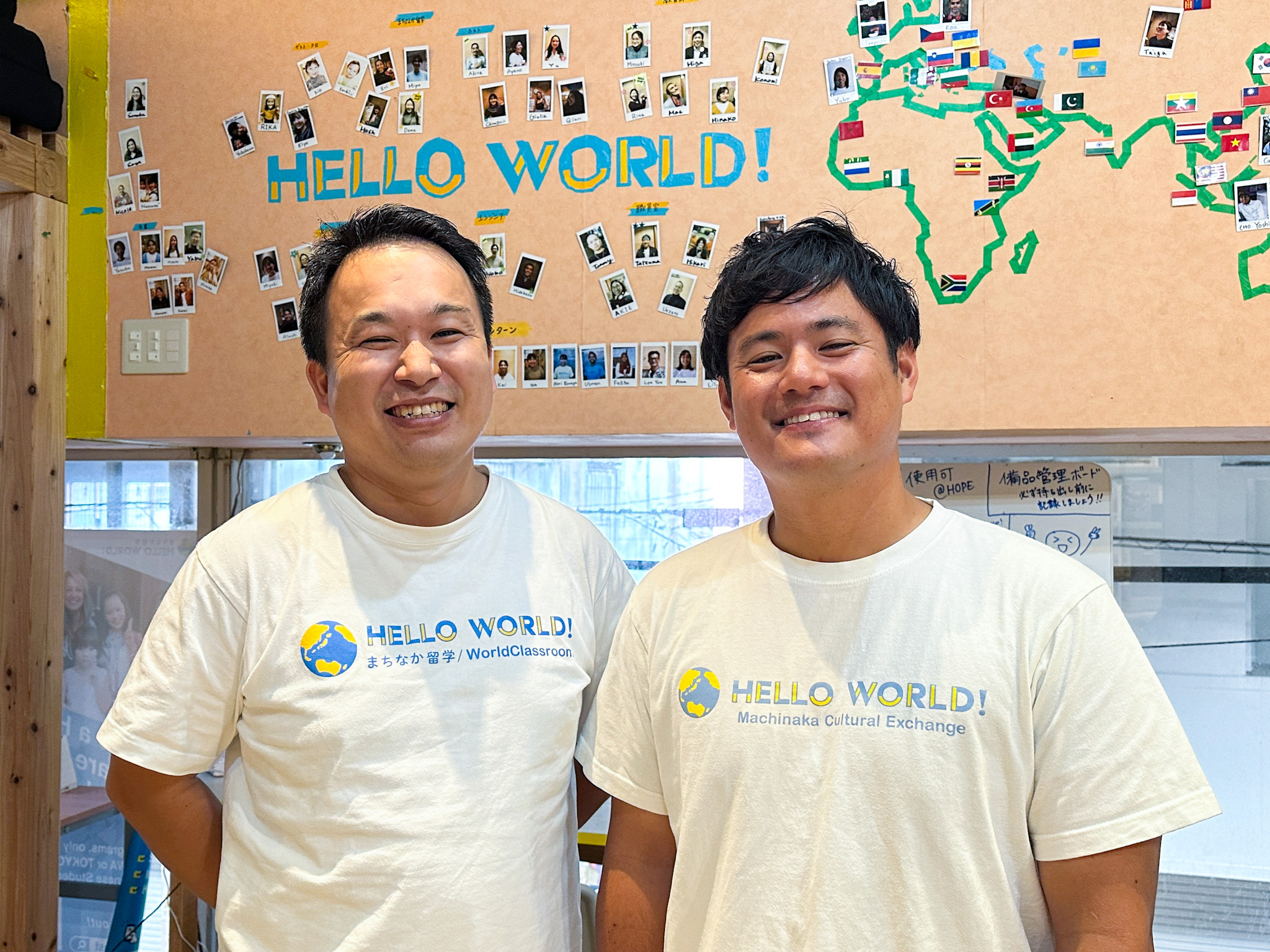
Nonaka has described their division of strengths with useful candor. He is comfortable with the initial leap and drastic decisions. Tomida thinks about rationality, feasibility and systems that can work repeatedly. Their differences help explain the partnership: an appetite for beginning sits beside an appetite for making the beginning reproducible.
Okinawa gave the venture a setting that suited its purpose. Tomida first visited Koza for a workcation in 2020 and was drawn to its mixture of older shopping streets and international influences. He decided to relocate. HelloWorld’s global ambition had found a very particular neighborhood.
The passport can stay in the drawer
Machinaka Ryugaku takes a straightforward fact seriously: people from other countries already live in Japan. Participants can stay with international residents and experience a different household’s language and customs locally. A journey across cultures can begin with a journey across town.
For a child, that changes the size of the first step. A short local experience asks for a different commitment from a long overseas stay. The program brings the encounter closer to ordinary family life, where conversation has a purpose beyond completing an exercise. Someone has to understand someone else.
WorldClassroom brings that purpose into school. Launched in 2021, it connects classrooms internationally and supports English practice. In February 2024, HelloWorld reported approximately 55,000 users across 80 schools. The significance for Tomida’s ambition is the setting: opportunities to encounter another country can arrive within the school day.
Another program, Machinaka ENGLISH QUEST, uses shared tasks to get people communicating. HelloWorld and the railway-company consortium JTOS announced an event for Shinjuku Chuo Park in June 2024. Japanese and international children would use English to complete quests together. A task supplies an excellent antidote to the awkwardness of being told simply to mingle.
A nearby home
Machinaka Ryugaku
Meet an international host family in Japan.
A classroom screen
WorldClassroom
Connect with students in another country.
A shared challenge
ENGLISH QUEST
Use a common task to begin a conversation.
The programs place communication in situations where there is a reason to try. English becomes something that helps a relationship or an activity proceed. That emphasis runs through the company’s work, from a household visit to a connection between groups of students.
Who gets a place at the table?
Bringing an experience closer does not automatically make it available to everyone. Families still have different resources. For a founder who wants international friendship to become ordinary, the cost of participation belongs inside the problem he is trying to solve.
In January 2023, HelloWorld provided a free three-day cultural exchange opportunity in Tokyo to students supported by Ashinaga, with help from Odakyu Electric Railway. Tomida’s comment on the project emphasized the importance of giving children opportunities that family circumstances could otherwise put beyond reach.
The collaboration continued in January 2024, expanding to both Kanto and Kansai. Mitsubishi UFJ Financial Group sponsored the initiative, with Odakyu again providing support. The expansion made the access question tangible: more partners and more locations could create opportunities for more children.
HelloWorld also operates the Machinaka Ryugaku fund to support participation for children whose families cannot afford it. The fund sits beside its paid services. Building a business and widening access are tasks the organization has chosen to carry together.
This part of Tomida’s story has less glamour than a departure for California. It involves coordination, institutional relationships and money allocated to participation. It also brings his ambition down to a question a family can actually answer: can our child join?
A lawyer walks into a pitch show
In November 2024, Tomida described preparing for HORIE ONE × MAKE MONEY SURVIVE, a program featuring entrepreneur Takafumi Horie. He expected sharp questioning and was ready, he wrote, to return to his lawyerly instincts if defending HelloWorld required an argument. Old professional habits can be remarkably portable.
His account ended on a warmer note. After the pitch and questions, he felt the company’s intentions had been understood. He had arrived prepared for a contest and left pleased with the response. The story also exposed a concern he had before appearing: how would a venture built around social impact fare in a show centered on investment?
Earlier that year, HelloWorld had announced ¥184 million in long-term borrowing from Okinawa Bank, MUFG Bank and the Okinawa Development Finance Corporation. The company said the financing required neither collateral nor guarantees and involved no dilution.
Long-term debt financing announced by HelloWorld.
No collateral, guarantees or equity dilution.
Tomida and Nonaka explained their preference in terms of time. They wanted long-term growth toward a wider social role, and had focused on generating revenue and profit before rushing into equity financing. The choice connects their mission to the structure of the company carrying it.
In the same personal essay, Tomida offered a smaller picture of organizational life. Colleagues sometimes looked after one another’s children. He called the culture HelloWorld Family. It is an unusually domestic detail in an account that also discusses funding and growth, and a fitting one for a business whose work often begins with hospitality.
Make it ordinary
Tomida’s educational work has also taken him into school governance. In April 2024, HelloWorld announced his appointment as a director of PST Academy, which operates the high-school division of Okinawa International School. The company had been involved in planning and running the school’s summer program since 2022.
His description of work is concise: “The means to make an impact on society.” His stated working rules are more operational. Consider social impact. Follow ideas through. Build systems that can be repeated, with a team whose members help one another accomplish more. There is the former lawyer’s attention to what will actually function.
“The means to make an impact on society.”
Keisuke Tomida, on what work means to him
The tools continue to change. In April 2025, HelloWorld announced an AI English conversation beta for WorldClassroom and a planned trial involving about 70 schools and 13,000 students. By February 2026, its Tokyo work included partnerships with local governments and companies as the organization explored how to reproduce its approach in different settings.
A September 2026 announcement listed Tomida for an October public-education panel at IMPACT STARTUP SUMMIT, alongside government and education leaders. The topic fits the direction of his work: how an educational encounter becomes something institutions can provide more widely.
The distance from employment law to a child’s first international conversation looks considerable on a résumé. Tomida has spent the intervening years working on the arrangements that make such a conversation possible. A school connection, a willing host, a partner paying for a place: modest pieces of an ambition with a very large map.
He once left a future because he could see its ending. At HelloWorld, the desired ending is clear enough: friendships across countries become ordinary. The unfinished part is getting the next introduction to happen.
Follow the conversation
Tomida’s writing, HelloWorld’s work and conversations worth watching.