Before Sherry Coutu built a website for investors, she had to discover that building a company was something she might do. There was no family business waiting for her, no obvious apprenticeship in being a founder. There were, however, people who noticed her. A teacher expected more. A case study revealed an unfamiliar working life. A mentor recognised an entrepreneur before she recognised one herself. Much of her subsequent career has involved arranging versions of that encounter for other people.
It is an unusual thread through a career usually introduced with a list of institutions: interactive investor, Pearson, Raspberry Pi, the ScaleUp Institute. The list suggests someone who belongs in boardrooms. The story is more interesting when you ask how she got through the first door, and why she keeps finding ways to hold others open.
Someone had to point out the door
Coutu was born in New Westminster, British Columbia, and grew up in Canada before making her career in Britain. University took her to the University of British Columbia, then economics at the London School of Economics, and eventually an MBA at Harvard Business School, completed in 1993. On a CV, these look like orderly steps. Discovering what to do with them took other people.
She still names Mrs Cousins, her grade-five teacher, among her inspirations. The teacher told her she could do better. Later, a university case study about Dame Stephanie Shirley showed her a route into entrepreneurship and innovation that she had never imagined. A person on a page could expand the available choices. A person in a classroom could make her take those choices seriously.
Richard Caruso became another important influence. Coutu credits him with a lesson in deciding: waiting for perfect information could become its own obstacle. She also remembers receiving the opposite advice early in her working life, when a senior colleague recommended keeping quiet in meetings and fitting in. It is difficult to reconcile that instruction with the career that followed. One suspects the meetings would have been quieter, if considerably less useful.
The mortgage paperwork had a competitor
Interactive investor emerged from a problem with an impatient customer attached: Coutu herself. Looking into buying a house, she found the paper information about mortgages frustratingly out of date. She had worked at ISI Emerging Markets, where financial information was being delivered online to institutional users. Ordinary people had financial decisions to make too. Why should they have to work with yesterday’s paperwork?
The business launched in 1995. Its early service covered mutual funds and expanded into other financial products. This was the web before online investing became an everyday assumption. The opportunity depended on making useful information available to people who had previously faced more friction getting it. The internet supplied a new way to distribute it; the customer’s problem supplied a reason to bother.
Coutu served as chief executive and chair. Interactive Investor International floated in 2000 and was acquired by AMP in 2001. Those dates are the neat version of the adventure. Inside a growing company, the work was less tidy: recruiting quickly enough, learning to lead, keeping track of the money and listening to what customers actually wanted. Demand could be encouraging and awkward at the same time.
- 1995interactive investor launches
- 2000The business goes public
- 2014The Scale-Up Report
- 2015The ScaleUp Institute launches
- 2024Raspberry Pi Holdings board appointment
The company also gave her a lasting education in the people around a board table. Investors can bring different priorities, and a founder must live with those differences after the agreement is signed. It helps explain why her later advice gives financing and experienced guidance so much attention. Money arrives with relationships. The relationships remain after the celebratory announcement has been filed away.
A country full of growing pains
After interactive investor, Coutu became an angel investor, backing businesses including Zoopla and LoveFilm. The transition placed her alongside other founders wrestling with questions she recognised. A company could have customers and ambition and still struggle to find the people, leadership or knowledge required for its next stage. Experience had value beyond the company where it had been acquired.
Her investment interests have included consumer internet, information services and education. Ask what attracts her to a founder and the answer turns towards the problem being solved. Curiosity matters. So does wanting to fix something that needs fixing at the moment a solution becomes possible. A polished pitch has its uses, but it cannot make an unnecessary product necessary.
In 2014 she brought that interest in growth into public policy with the Scale-Up Report on UK Economic Growth. Its recommendations addressed the practical obstacles facing growing businesses, including skills, leadership, finance, access to customers and infrastructure. These are the concerns that appear after an idea starts working, when enthusiasm needs to become an organisation capable of delivering.
The following year, Coutu and LinkedIn co-founder Reid Hoffman launched the ScaleUp Institute. The organisation gave the subject an institutional home: researching barriers and encouraging the support businesses need to expand. It was a continuation of her operating experience at a different level. A country needs to understand what prevents an existing company from employing more people or reaching another market.
“You’re either growing or shrinking.”
Sherry Coutu, 2016
That is her brisk objection to treating the label “small and medium-sized enterprises” as a sufficient description. Size captures a moment. Direction tells you something else. She argued for using better data to see which companies were growing and where support could help. A snapshot is convenient. It does rather miss the movement.
Put a working life in the classroom
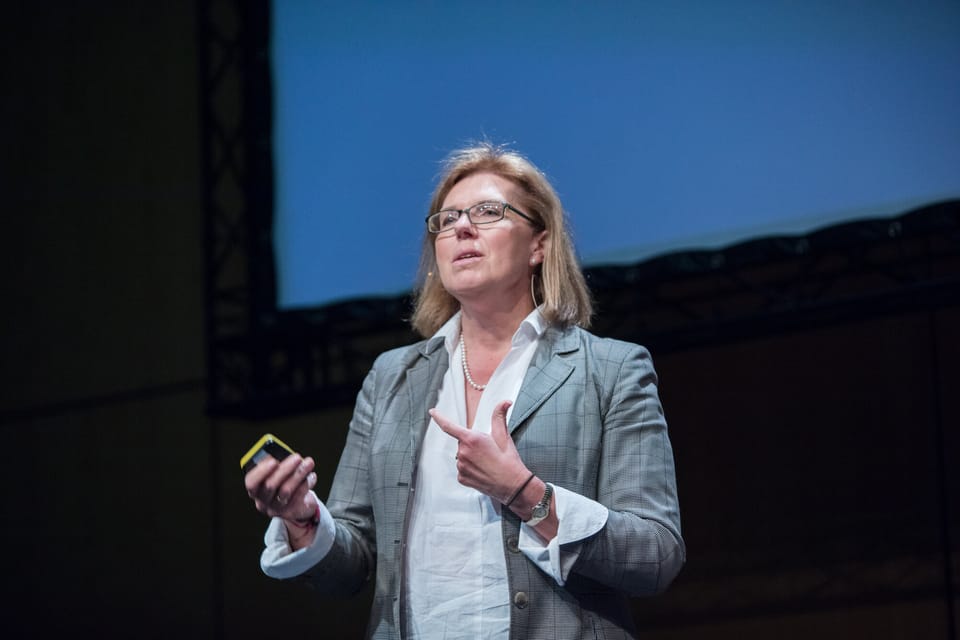
Founders4Schools carries the same concern into an earlier part of life. A business looking for talent and a pupil choosing subjects might seem far apart. Coutu saw a connection. Students need a clearer view of working life; employers will eventually need people with the skills to take part in it. An encounter between them can make the relationship less abstract.
Her own examples had included a teacher and a case study. Founders4Schools lets educators find business people who can bring careers and classroom subjects into the same conversation. A child can ask how someone’s job actually works. A volunteer can explain a route that rarely appears in a textbook. The useful detail may be something as ordinary as what a person does on a Tuesday.
By 2018, Coutu was discussing both Founders4Schools and the ScaleUp Institute as projects she particularly valued. Preparing people for future work fitted with the skills shortages growing businesses were facing. The charity’s work made the connection tangible: real people explaining what they do, rather than an employer’s future requirements remaining somebody else’s distant policy problem.
Maths4Girls adds a particular focus. It brings girls into contact with role models who use mathematics in their working lives. When Coutu discussed it in 2023, she was concerned with the distance between learning a subject and recognising where it could lead. Sometimes a lesson needs a visitor who can explain why they still use it after leaving school.
An hour you can borrow
Digital Boost extends that approach to small organisations. It is a subsidiary of Founders4Schools, offering access to volunteer mentoring and practical support. A person running a small business may need help with a website, sales or a new digital tool. Generic training can be hard to translate into the immediate problem sitting on the desk.
The service connects those organisations with experienced people willing to share what they know. Its public figures describe a community of more than 5,000 volunteers and support for over 36,000 businesses. These are Digital Boost’s cumulative figures, rather than a count of companies Coutu has personally mentored. The distinction matters: the point of building a platform is that useful work can happen beyond its founder’s diary.
Organisation-reported totals, accessed October 2026. The two counts measure different things.
There is a modesty to the unit of help: an hour, a question, a conversation. The arrangement makes a larger claim about who should have access to expertise. Knowing someone with the right experience need not depend entirely on where you went to school or which people happen to be in your address book.
The questions that survive the meeting
Coutu’s current board work spans education, computing and long-term savings. She is a non-executive director at Pearson and Standard Life, and senior independent non-executive director at Raspberry Pi Holdings. She chairs remuneration committees across those companies. These are formal responsibilities inside established organisations, alongside her work creating ways for people outside such organisations to find help.
Her advice to growing companies remains practical. In recommendations shared through Cambridge ideaSpace in 2024, she urged founders to keep listening to customers, recruit people with experience of the stage ahead and build systems that can accommodate growth. She encouraged founders to investigate prospective investors by speaking to people they have already funded. The questions can be asked before the money arrives.
She has also described a working style with little appetite for an aimless appointment: “I don’t just do coffee.” Away from that diary, she likes climbing mountains and taking long walks. In 2023 she had returned from her third trip up Indonesia’s Rinjani volcano and was preparing for a fourth Kilimanjaro ascent. Apparently, reaching the top once does not exhaust the subject.
The connecting idea in her career is simple enough to recognise in daily life. Someone knows a route that someone else cannot yet see. Coutu has been the pupil, the founder asking for help, the investor, the visiting businessperson and the person building the booking system. The work continues whenever an introduction turns an unfamiliar possibility into a next step someone can actually take.