Before you can kill a mosquito, it helps to know where it might be born. For Zzapp Malaria, that meant finding likely pools of stagnant water across large areas. Omdena assembled 40 collaborators to combine satellite imagery, topography, population density and other data into an algorithm that could prioritize the search. The output was a more useful place to send a person.
- The offer: custom AI engineering, talent and practical training.
- The method: distributed specialists, shared experiments and structured review.
- The catch: useful data and clear ownership still do the heavy lifting.
That small distinction explains much about Omdena. The company works on the distance between an interesting prediction and somebody doing something with it. Its customers include startups, NGOs and enterprises that have a problem, but lack the complete engineering team to solve it.
A map before a mosquito
Zzapp’s challenge used data from Ghana and Ethiopia’s Amhara region, arriving in batches as surveying continued. The task was to identify areas likely to contain water bodies before the wet season made mosquito breeding more urgent. Here, AI offered a way to direct limited attention across an inconveniently large landscape.
Zzapp later won the $3 million grand prize in the 2021 IBM Watson AI XPRIZE. The competition’s total purse was $5 million. Omdena contributed to model development; Zzapp won the award. The distinction matters because a collaboration, an operational business and a prize-winning system are different things.
The larger lesson is practical. A map has value when a field team can use it. UNDP’s description of Zzapp includes on-the-ground management, training and quality control alongside software. The algorithm is part of an operation with boots, schedules and responsibilities.
The opportunity the courses missed
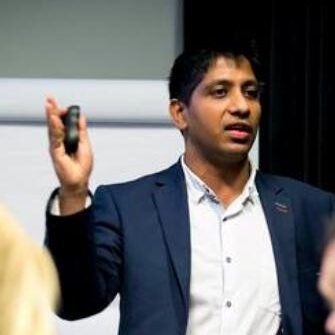
Rudradeb Mitra founded Omdena in May 2019 after noticing an awkward mismatch. People far from major technology centers could access AI education, yet the projects that would prove their abilities remained harder to reach. Organizations tackling social problems, meanwhile, struggled to afford the people they needed.
The early format brought selected engineers and enthusiasts together for roughly two months. Participants collaborated on a shared problem, with peer review providing a check on quality. In his 2019 AI Time Journal interview, Mitra put the organizing principle plainly.
“I do not understand why to compete if we can collaborate.”
Rudradeb Mitra · AI Time Journal, 2019
His proposition differed from a leaderboard competition: let people compare approaches while contributing to the same result. Collaboration, compassion, inclusivity and innovation remain Omdena’s stated values. Its mission connects access to engineering opportunity with access to useful AI.
A model small enough for a tree
The Dryad Networks project supplied a wonderfully unromantic constraint. A forest sensor runs on limited power and computing capacity. An impressive model that cannot fit on that device is of little help to a forest.
Omdena says 50 engineers worked for eight weeks on fire detection, model optimization and a training pipeline. Teams explored alternatives, and quantization reduced the numerical precision of model parameters to make inference smaller and faster. The job involved deciding what the hardware could afford.
Dryad challenge figures reported by Omdena. The model had to work within the sensor’s limits.
MyCover.ai presented a different bottleneck. Before assessing car damage, the team had to validate vehicle images, standardize dimensions and check annotations. Its workflow combined number-plate detection and text recognition with image comparison and damage assessment. Omdena reports completing the project in under three months.
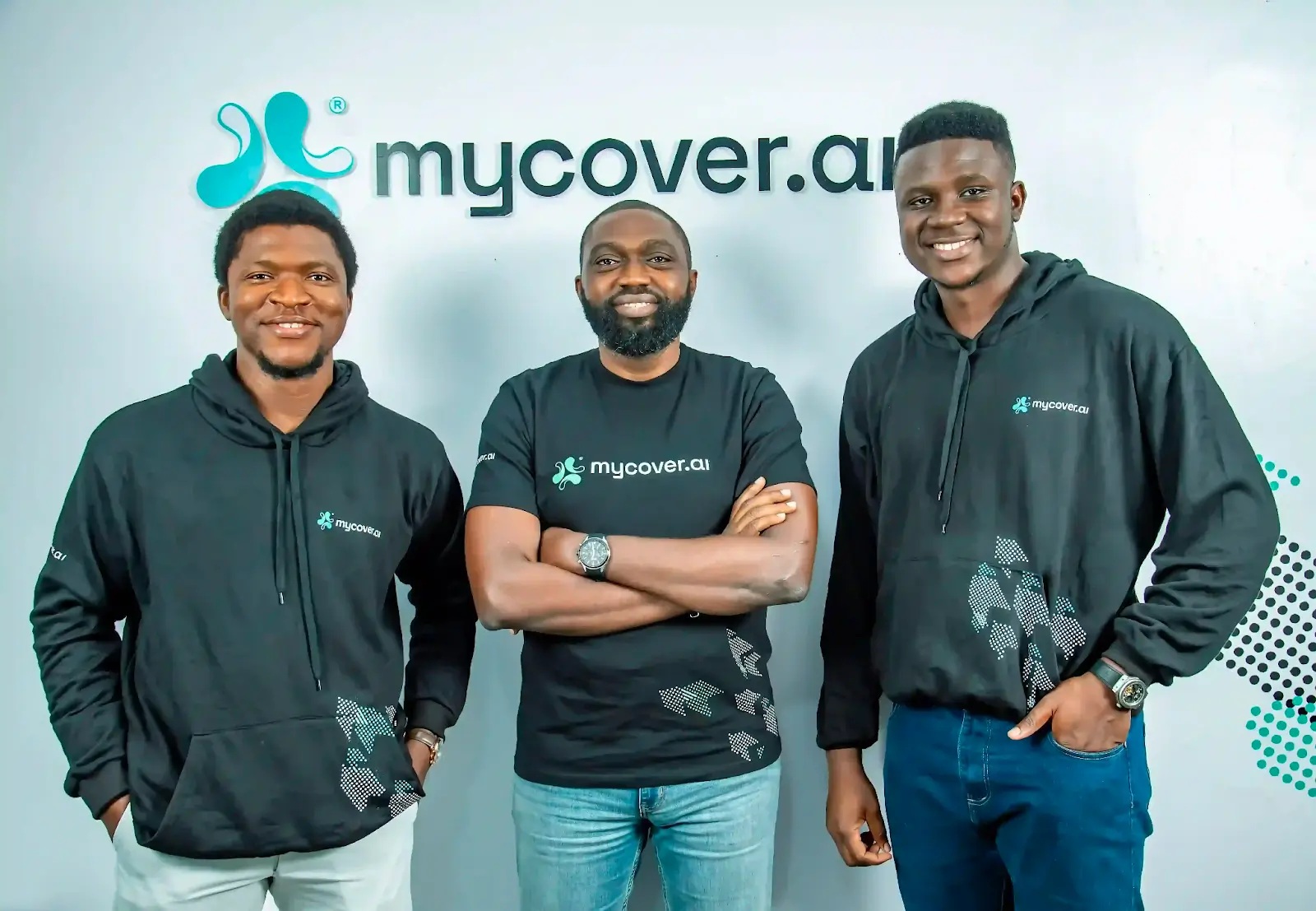
In both accounts, the documented obstacles appear before the glamorous output: limited hardware in one, inconsistent inputs in the other. The transferable habit is to test those constraints early. More collaborators cannot compensate for a training set that misrepresents the job.
The bill comes after the demo
Omdena now sells end-to-end development, embedded AI engineers, research, datasets, data engineering and capacity building. Its technical range includes language models, computer vision, geospatial analysis, predictive systems and deployment. Training programs use real projects and mentorship so capability can stay with the client.
For a buyer, the choice begins with what is missing. A team with its own product leadership may need an embedded specialist. An organization starting from an idea may need scoping, data work and a complete delivery squad. A client hoping to keep developing independently may benefit from training alongside implementation. These are different purchases, even when the underlying technical skills overlap.
That places it between a specialist AI consultancy, a talent network and a practical learning community. Buyers can alternatively hire internally or engage another engineering firm. People seeking experience can consider competitive platforms or social-impact communities, though those choices serve different purposes.
Its May 2026 cost guide, updated in June, puts organization-wide AI delivery at an indicative $12,000-$30,000 in a comparison table. Those are Omdena’s estimates, not independently established savings or a fixed quote. Integrations, security, evaluation and ongoing usage change the economics. Monitoring and maintenance keep costing money after a demonstration works.
The network also grew beyond a single project room. An ITU AI for Good biography recorded more than 1,500 collaborators from 84 countries working on 31 challenges in Omdena’s first 17 months. That early record gives the community story some substance. It also suggests the operational question that follows any growing distributed effort: how do people with different experience and expectations inspect one another’s work?
Who checks the collaborators?
Today’s answer includes Umaku, Omdena’s delivery platform. The company describes four automated reviewers that inspect code changes for scope completion, code quality, DevOps practices and bugs. Boards, documentation and QA reporting sit alongside them. The promise is that a buyer can inspect progress and the evidence behind it.
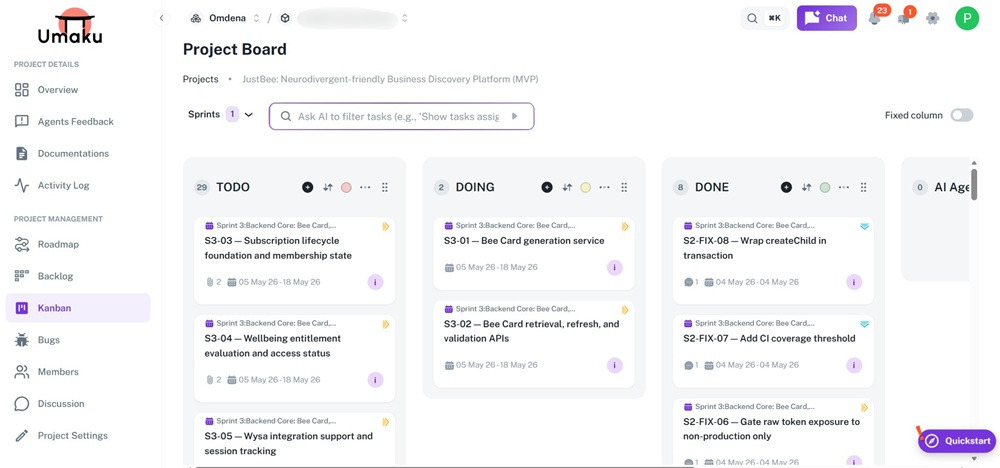
- 01 Define scope
- 02 Build + commit
- 03 Four AI reviews
- 04 QA + handover
Company-described workflow, simplified.
Read beside the early emphasis on self-organization, this suggests a more explicit system of accountability. It does not establish why any individual changed their mind. It shows what the company now asks customers to buy: a coordinated delivery process as well as access to engineers.
Start with the next decision
A sensible way to borrow the method is to choose one decision, establish what data supports it and compare approaches against an agreed test. Assign someone to own the result after handover. Omdena’s public GitHub projects offer code to inspect before commissioning something new.
Distributed collaboration needs a bounded task, available evidence and someone able to act on the output. Where data is inaccessible or ownership is vague, adding engineers adds coordination work. Back at the mosquito map, the useful question remains wonderfully specific: where should the field team go next?