The first clue that Sam Witteveen took an unusual road into artificial intelligence is his degree. It is in music. Long before tutorials on language models, notebooks on GitHub, or conversations about enterprise agents, he studied at La Trobe University in Australia and graduated with a Bachelor of Arts in music. One account of his career describes a period as a pop songwriter. The record gives few details about the songs, but the detail changes the shape of the story. Here is someone whose working life began with composition, then came to revolve around systems that compose, classify, and generate.
Witteveen did not go straight from a studio to a research paper. Between those chapters stood Family Play, an educational games business he founded and led in the 2010s. Its apps were made for children learning through play. That venture offered a different sort of lesson from a university course: software has to meet its audience where they are. It has to do something when a person taps it. A clever idea that stays on a whiteboard is just a clever idea on a whiteboard.
That practical instinct appears across his later work. Today he is co-founder and CEO of Red Dragon AI, a Singapore company launched in 2017 with researcher Martin Andrews. He is also a Google Developer Expert in machine learning, an organizer of Machine Learning Singapore, a video teacher, and a VentureBeat writer and podcast host. The job titles multiply. The recurring action is simpler: take a technical shift, try it, and show others what happened.
A founder who learned to explain
The founding year matters. In 2017, machine learning had an audience of curious developers, but most businesses were still far from speaking fluently about models. Red Dragon AI positioned itself around both custom AI work and training. Its public description covers model development, large language models, agents, and programs for technical teams and management. Witteveen and Andrews put research and instruction under the same roof. The arrangement makes sense when the technology changes quickly: a client needs a working system, and the people responsible for it need to understand the decisions inside it.
The same year, Witteveen became one of the first 12 Google Developer Experts appointed in machine learning, according to his speaker biography. The designation gave him a public platform; it did not write the lessons for him. He still had to stand in front of developers, decide which concepts deserved an example, and make the example run. His speaking record later spread across events in Asia and the United States, including Google events and TensorFlow World. In 2020 he also became an anchor mentor for Google for Startups.
His technical partnership with Andrews has produced papers as well as presentations. One 2019 project examined question answering with a small model. Another explored how a language model might help generate explanations. A 2021 shared-task paper dealt with multi-hop inference: the difficult business of linking several pieces of evidence into a coherent answer. In 2022 the pair investigated prompts for diffusion models. These are different questions, but they orbit a common concern. How do we get useful behavior from systems whose workings are often more complicated than the polished output suggests?
A model can make a sentence look effortless. The work is in finding out whether the sentence earns that confidence.On the questions running through Witteveen’s public work
The meetup as a working room
Machine Learning Singapore offers a more immediate view of his teaching. The group says its aim is to help people create and deploy their own deep learning models with tools including TensorFlow, PyTorch, and JAX. It promises material for beginners and intermediate developers, along with presentations about recent papers and techniques. Its public listing names Witteveen among the organizers and records more than 7,500 members. The number is impressive; the promise underneath it is more interesting. Attendees are meant to leave with models and code they can play with.
That wording fits a city where a research talk can be followed quickly by a product question. Singapore is both the base for Red Dragon AI and the setting for the meetup. Witteveen’s own public posts show him joining developer workshops there, including a 2024 Build with AI session and a Gemini masterclass with Andrews at DevFest Singapore. The co-founder reappears as fellow teacher. Their shared stage is another reminder that a technical field grows through conversations in rooms, not only through announcements online.
The route, in five stops
The lesson travels
A meetup holds a room. YouTube sends the room outward. Witteveen’s channel, launched in 2022, has become a running syllabus of machine learning and generative AI. By late September 2026, Social Blade counted about 133,000 subscribers and 370 videos. The catalog includes language models, agents, local models, and tools from several competing companies. The format is familiar to anyone who has tried to learn fast-moving software: watch a demonstration, pause, copy the code, discover a snag, and go back to see what the presenter did.
He leaves another door open through GitHub. Repositories under the name samwit include LangChain tutorials, LLM tutorials, agent examples, Ollama exercises, and older TensorFlow talks. Some repository descriptions explicitly say they accompany the YouTube channel. The notebooks are useful evidence of the teaching style. They let a viewer inspect the machinery behind a smooth explanation and, when a library changes, see exactly where a once-working lesson needs repair.
A public technical teacher has a difficult relationship with time. An explanation can be careful on Monday and obsolete after the next release. Witteveen responds by returning to the tools: testing new models, showing current APIs, and revisiting the agent frameworks that keep moving beneath developers’ feet. His LinkedIn posts in 2026 read less like declarations than field notes. In one, he compared the cost of agent runtimes using the same model and asked readers to notice how much the surrounding system matters. In another, he described testing a speech diarization model on a long podcast. He closed with a question about what people might build with better speaker attribution.
“The harness, not the model, is often what’s driving your agent costs.”Sam Witteveen, LinkedIn
After the pilot, the questions get harder
The VentureBeat work extends that habit into journalism. Witteveen writes about enterprise AI, often looking past a launch headline to the practical implications of licenses, hardware, costs, and deployment. His 2026 articles addressed Google’s chips and models, Nvidia’s agent platform, and Tencent’s open model strategy. A reader does not have to agree with each assessment to see the method. He wants to know what a release changes for the people who must choose a system and live with it.
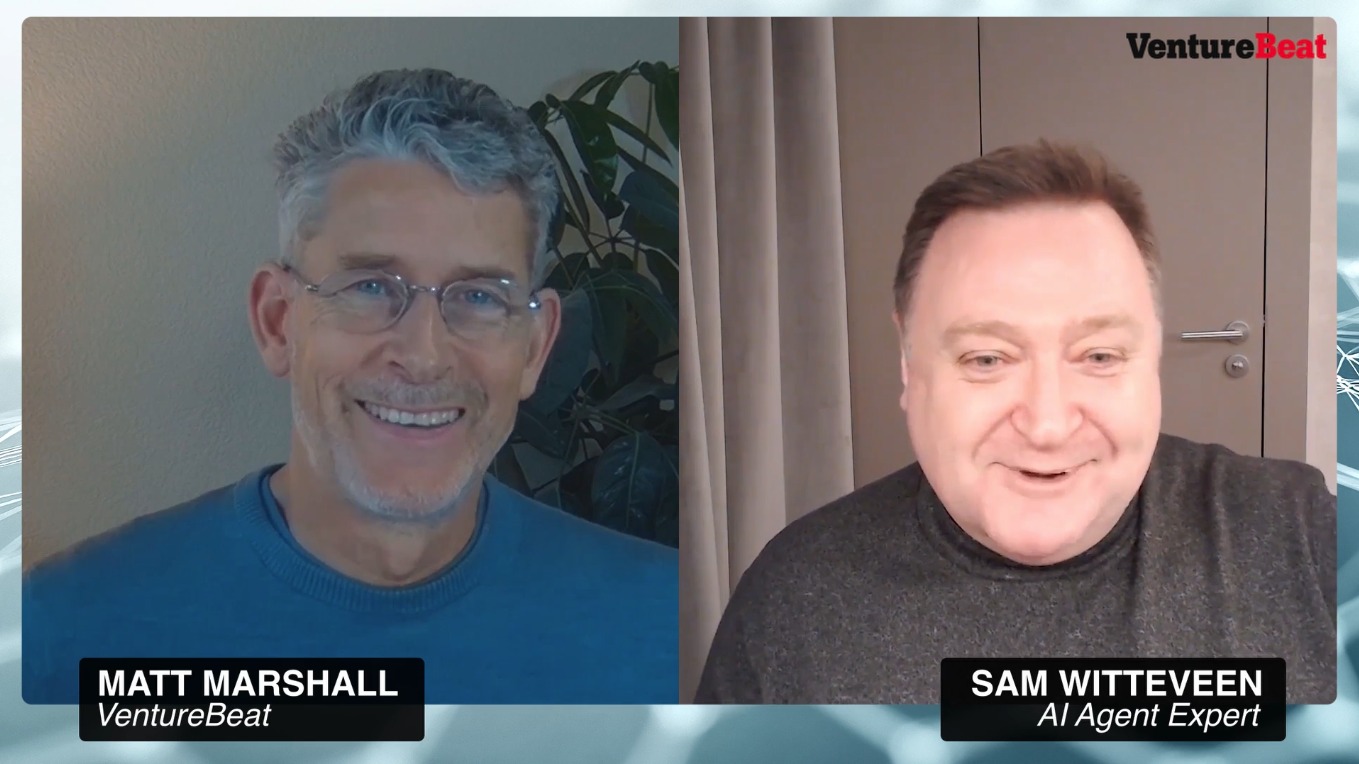
In November 2025, VentureBeat launched Beyond the Pilot, co-hosted by Witteveen and editor Matt Marshall. The title is a whole editorial position in four words. The show asks enterprise leaders what happened after a proof of concept, when an agent met infrastructure, budgets, governance, and the ordinary friction of an organization. It is a natural next venue for someone who has built a company around applied AI. The podcast gives him a different kind of classroom: instead of explaining code to a developer, he invites practitioners to explain their decisions to listeners.
His public output now crosses several audiences. Researchers can find his papers. Developers can run his notebooks and watch his videos. Meetup members can ask questions in person. Company leaders can read his reporting or hear the podcast. Those audiences do not always need the same level of detail, but they benefit from the same discipline: put claims next to the conditions under which they hold. A benchmark has a setup. A low-cost agent has an architecture. A tutorial has dependencies. The lively part of Witteveen’s career is how often he is willing to walk through those details in public.
Watch and listen
See Witteveen discuss model evolution in a Two Voice Devs conversation, or browse the latest tutorials on his channel.
An old skill in a new field
It is tempting to draw a neat line from songwriting to generative AI. The verified facts support a more modest and more human account. Witteveen studied music. He built games. He founded an AI company with a research partner. He has spent years teaching people how changing tools work. Those stages did not arrive with a single master plan attached. They show a person repeatedly making something for an audience, then learning what the audience needed next.
The music degree makes a good opening because it reminds us how many kinds of attention technical work can demand. A tutorial needs sequence. A talk needs pacing. A demonstration needs a moment when the abstract becomes audible or visible. It would be too easy to claim that music caused his later career. What can be seen is that Witteveen has made communication part of the job, from the meetup room to the video frame and the newsroom. He has chosen a field in which the score is rewritten every few weeks.
For the developer watching a new model appear, that may be the most useful thing about his work. He rarely asks for faith in a label. He opens the notebook, measures the result, and asks what the tool is good for. The lesson ends where the next experiment begins.