At a developer conference in 2025, Cole Medin asked for a show of hands. Who had used an AI coding assistant? Most of the room. Who used one for nearly all their development? Far fewer. The gap was the subject of his talk: a room full of programmers willing to try the machine, and still reluctant to give it the keys. Medin knew the feeling. A year earlier, he said, he had resisted letting coding assistants implement his ideas, even as he used language models to help plan them. He thought he could write the code better himself. More troubling, he could not predict what the assistant would do.
It is an unusual opening for a person who now builds systems designed to hand more work to coding agents. Yet the hesitation gives his work its shape. Medin's argument has never rested on an agent being flawless. It rests on what a developer can put around the agent: a clear plan, the right context, tests that run, and a way to catch the same mistake before it becomes a habit. He calls the process Plan, Implement, Validate. The acronym is PIV; the appeal is that everybody knows which step was skipped when things go sideways.
A teacher with a builder's childhood
Medin has told audiences that he started making video games with Scratch when he was eight. It is the kind of origin story that fits someone who later preferred showing the working parts to presenting a finished black box. His LinkedIn profile places him at the University of Minnesota from 2018 to 2021. The Dynamous site says he subsequently worked as a software developer at a Fortune 500 company and consulted with startups on AI strategy and integration.
He says he became deeply involved in generative AI around the release of GPT-3.5 in late 2022. Soon the projects ranged from personal automations to local AI deployments for enterprises. By 2024 he was explaining pieces of that work on YouTube: how to build an agent, how retrieval gives it outside knowledge, how to run models locally, and how to make the result useful after the tutorial ends. His GitHub account became a companion workshop, full of the code viewers could open, run and alter.
The channel changed his working life quickly. In an August 2025 post, Medin wrote that he had been making videos for just over 500 subscribers a year before; the audience had passed 155,000. He described the reward as the conversations and the people the videos brought together. Earlier that year, he had announced Dynamous AI Mastery, a community and course platform for people trying to turn experiments into working systems. Public lessons could invite a builder to the table. Dynamous gave him room to stay for the harder conversation about deployment, scaling and the odd ways software fails.
His work at oTTomator also put him close to the practical side of AI automation. A Minneapolis technology profile identifies him as its CTO, while his public GitHub includes the open-source agents used in the oTTomator Live Agent Studio. The title matters less than the pattern: he kept turning examples into tools other people could inspect. If an agent looked clever on video, he wanted viewers to see what made it run.
The bug that ought to change the system
At JSNation US in November 2025, Medin took his reservations about AI coding into a live demonstration. He described assistants that install old package versions, overcomplicate a simple feature or bind pieces of a project too tightly together. A developer can repair each incident and move on. Medin asked a second question: what part of the process let the same kind of error happen again?
His answer was to look for a system gap. Maybe a project rule is too vague. Maybe the agent did not receive the documentation for that corner of the codebase. Maybe the test suite does not check the behavior anyone actually cares about. The fix might be a better command, a smaller task or a new validation step. In his talk, he described resetting an attempt to the commit containing only the plan, then running the task again after changing the workflow. It sounds fussy because software is fussy. A one-line patch can make today's demo succeed; a better process can keep next Tuesday's build from repeating the trick.
“Every error is an opportunity for you.”Cole Medin, JSNation US talk, 2025
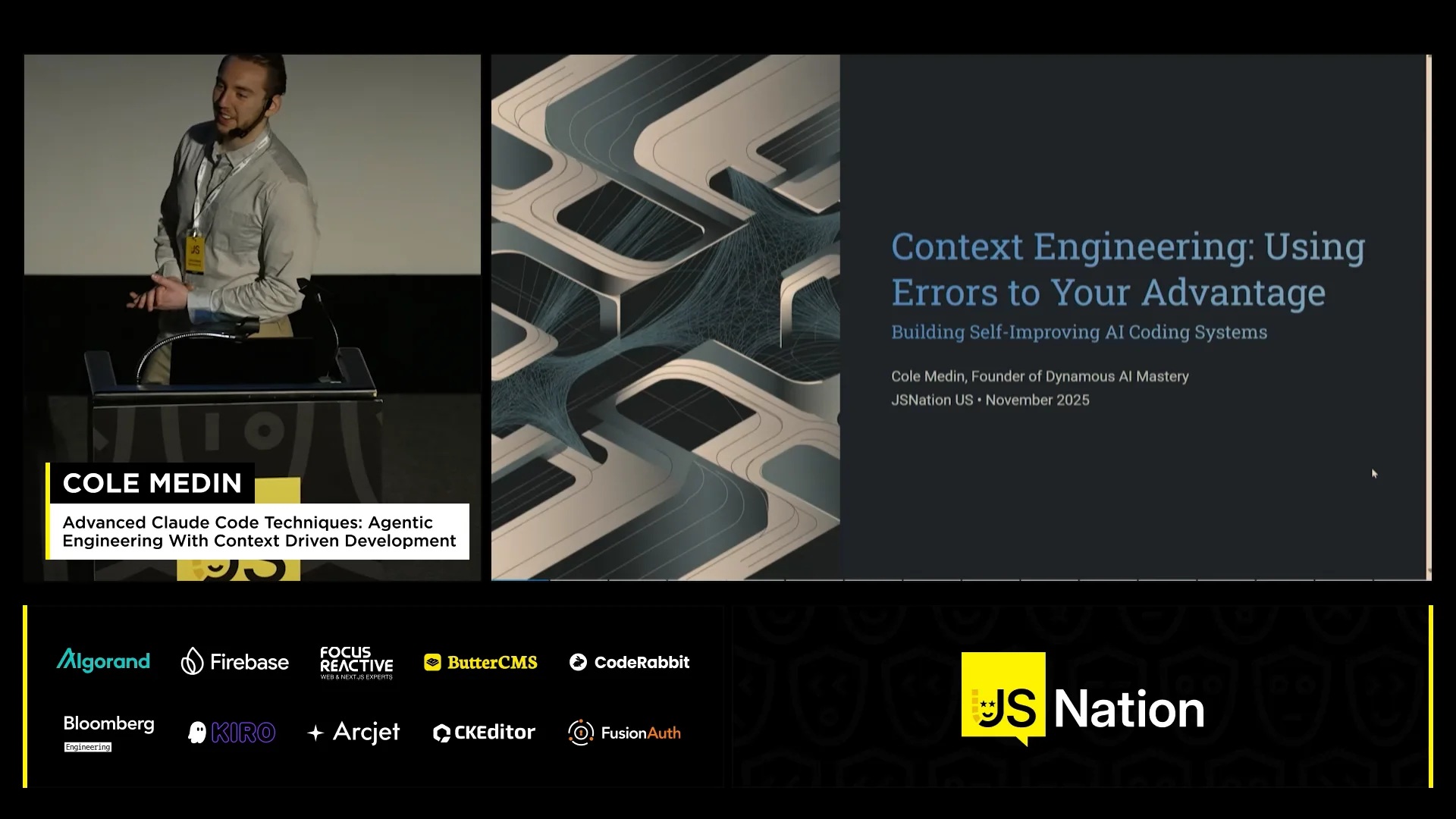
The method he taught was simple enough to fit on a slide. First, plan the feature with the assistant until both sides have the same picture of the job. Write down the relevant architecture, documentation, tasks and success criteria. Second, let the assistant implement a small, defined piece. Third, validate it with checks, code review and a person using the application. The human still chooses the goal and decides whether the result is acceptable. In that lecture, Medin was especially clear that an assistant's ability to produce code did not settle the question of whether the code worked.
The PIV loop / as Medin teaches it
There was a pleasing risk in using a live coding-agent demo for a talk about unpredictable coding agents. Medin joked about it on stage, then used the moment to show a broken web-search tool. The assistant read the failing test, found that the code accessed an API key incorrectly, changed it and ran the test harness again. The memorable part was the loop around the repair. The machine did not receive applause for guessing right first time; it got another chance because the check exposed what was wrong.
From lessons to Archon
Archon began with a more literal premise: an AI agent that could build other AI agents. Medin introduced it on his channel as an open-source project people could follow and contribute to. The idea widened. By 2025, he was presenting Archon as a command center where people and coding assistants could work from shared tasks and context. In 2026, he described a rewritten Archon as a harness builder, a way to define and run repeatable workflows across coding-agent sessions. The terminology changed as the job changed. Instead of asking one agent to remember every instruction for an entire project, Archon could arrange the steps and checks around it.
The public repository shows how much interest that idea has drawn: it had roughly 23,600 GitHub stars when checked in September 2026. Its description promises deterministic, repeatable AI coding. That is a claim about the workflow, not a claim that a language model has become deterministic. Archon lets a builder describe the sequence of work and the gates between stages, so a process can be repeated and inspected. Medin's separate context-engineering repository offers another route into the same practice, with examples for supplying project information and shaping tasks.
The educator and the toolmaker remain closely linked. His videos explain why a step exists; the repositories let viewers put it into a project. He has said his principle is to teach people how to build the thing rather than simply hand over a finished tool. That principle explains the code samples, the long workshops and the willingness to show the rough edges. It also sets up the tension in his newest project.
A factory with an unfinished test
In September 2026, Medin said he was building an open-source AI software factory. A planning document goes in; coding agents divide the work, write it, review it, merge it and deploy it. He had already run a version of that process as an experiment. It produced Dynachat, an AI tutor grounded in his teaching material, without his writing or even reading a line of its code. For an instructor who once hesitated to let an assistant implement a feature, the change is striking.
He is careful about what the example proves. Dynachat is a live application, but he has described it as a relatively modest one and said it did not truly test whether an autonomous factory is reliable for critical software. His proposed open-source version was an early alpha at the time of the announcement. That admission makes the experiment more interesting. An AI coding demo can be convincing in fourteen minutes; a dependable development process has to survive every ordinary complication after the camera stops.
Recent posts show Medin working through those complications in public. He has written about moving routine checks into hooks that fire whether an agent remembers an instruction or not. He has described putting a security scan and quality gate into an Archon workflow so a pull request cannot advance while the gate fails. He has also reflected on the danger of handing an agent broad credentials when it needs to touch live infrastructure. These are the mundane details that decide whether autonomy is useful beyond a prototype: what the agent can access, what it must prove, and who can see what happened.
His audience now extends beyond the video window. He spoke at JSNation US in 2025; GOTO Copenhagen listed him for an agentic engineering masterclass on September 29, 2026, and a talk about validation on October 2. The title of that second talk could stand over much of his work: the validation-first loop. The child building Scratch games is still visible in the teacher who wants others to understand the machinery. The difference is that the machinery can now ship code while its maker is elsewhere. Medin's next challenge is to make the checks as teachable, reusable and visible as the build itself.
“Sometimes you want to learn the thing. Sometimes you just want the thing. I'd rather give you both.”Cole Medin, September 2026
Follow the work
The videos, code and conference material offer different views of the same experiment. Start with a tutorial, open the repository beside it, and watch how the plan and checks are made explicit.