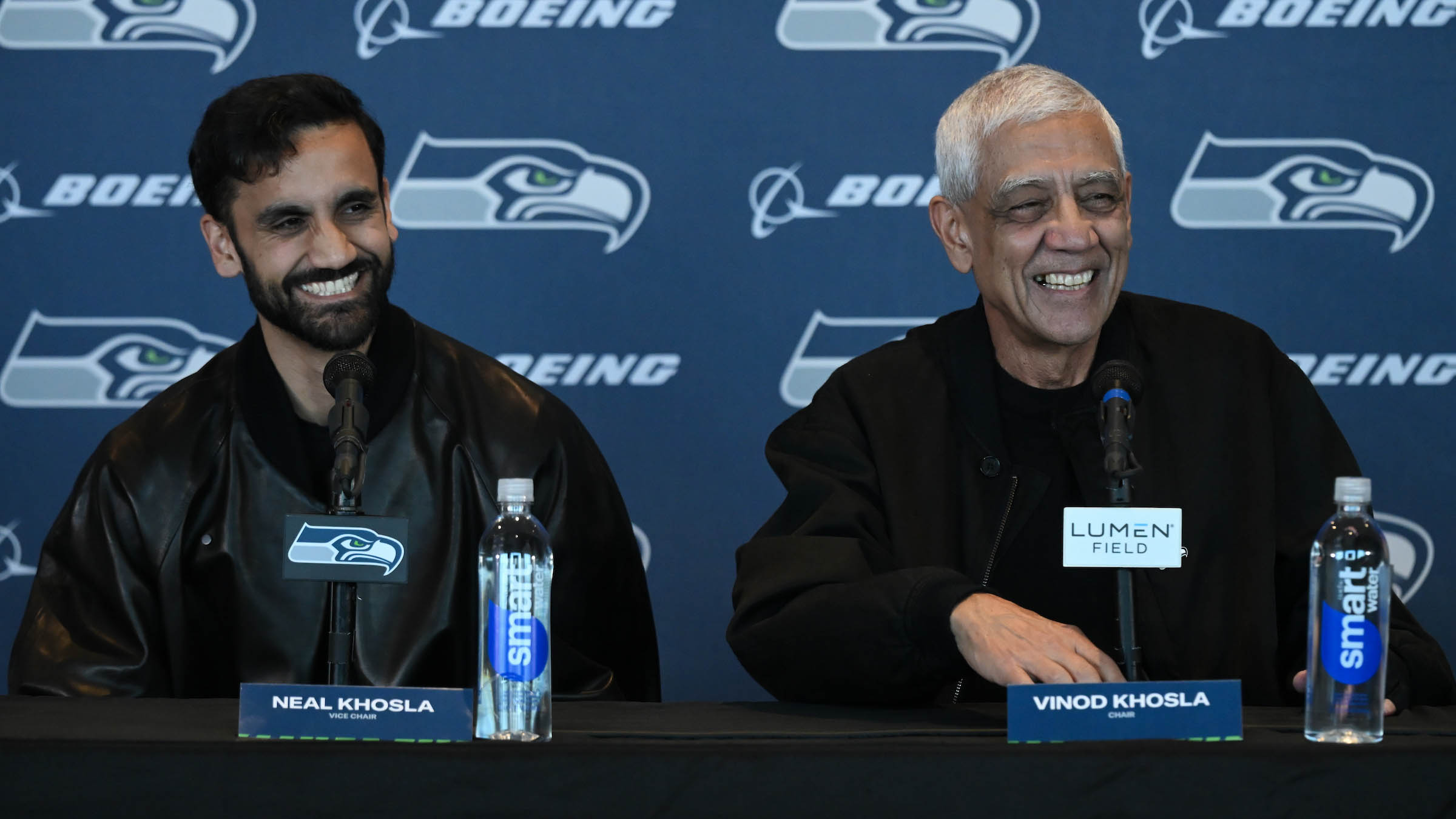
Vinod Khosla was explaining that his family did not care for fancy things. His son Neal had a small correction. “He had his jacket shipped from Italy. What are we talking about here?” The room laughed. It was September 9, 2026, at the family’s introductory Seattle Seahawks press conference. A new ownership group was meeting the public, and the younger Khosla had found a useful way to puncture the solemnity. Even an NFL microphone can occasionally serve the purposes of a dinner table.
Neal is now vice chair of the Seahawks and First & Goal LLC. He is also the cofounder and CEO of Curai Health. Those titles invite a familiar portrait of a technology entrepreneur expanding his interests. His writing suggests a more interesting subject: someone preoccupied with the possibility that a clever person can spend considerable effort reaching the wrong conclusion. Numbers appear throughout his work. So do embarrassment, indecision, and the fear of choosing an easy answer. The joke fits. A confident statement had just met an inconvenient detail.
Before the corner office, a pair of shoes
Khosla studied computer science and mathematics at Stanford, then completed a master’s in computer science with an artificial intelligence concentration. There is a pleasingly ordinary object among the technical projects associated with those years: the men’s shoe. With Amrit Saxena and Vignesh Venkataraman, he worked on an image-based recommendation system. Give it a photograph, and it would look for footwear with similar visual properties. The computer needed to notice what a shopper might notice without knowing the shopper’s vocabulary.
The project examined more than 10,000 shoes, separating characteristics such as shape, color, and texture. Its reported results belong to that particular experiment. They are also a glimpse of a recurring interest: translating a messy human preference into something a machine can work with. Shoe shopping becomes a problem of representation. What should the system preserve? Which similarities matter? Before the ambitious arguments about artificial intelligence came the practical business of persuading software to distinguish one thing from another. A shoe is a modest place to begin. It still requires making choices about the world.
The audience was part of the game
Sport offered another set of questions. Khosla coauthored a 2014 study of regional sports network television ratings with George Foster, Norman O’Reilly, Carlos Shimizu, and Ryan Murray. It covered Major League Baseball, the NBA, and the NHL. The subject was the audience around the contest: why people watched, and which characteristics of a club, player, brand, or place helped explain the ratings. Loving the game and examining its business could occupy the same afternoon.
The researchers worked with observations from 1999 through 2011, beginning with 46 independent variables and narrowing their framework to 16 factors. Their findings differed by league. That qualification matters. An explanation that travels neatly between sports may travel badly through the data. The study gives Khosla’s sports interest a history beyond the ownership announcement. Long before Seattle, there were questions about attention, attachment, and what could actually be measured. The fan was already studying the room around the scoreboard.
The programmer who shouted at his computer
His account of learning to program is less polished than the usual technology biography. He remembers getting stuck for hours or days. He also remembers shouting at his computer, a habit for which he offers his college roommates as potential witnesses. The machine, one imagines, declined to take the criticism personally. The person at the keyboard had a harder time keeping his composure.
In his essay on coder’s block, Khosla treats frustration as a predictable part of learning. He separates understanding a programming language from learning how to formulate a solution. Either can lag behind the other. He describes a sister who disliked her first computer science course and, three years later, became a professional software engineer. The point is persistence rather than a family claim to effortless talent. His mother, Neeru, helped edit the essay. Here is a small family scene preserved inside a technical argument: the son writing about difficulty, the mother helping him make it clearer. It makes his interest in learning feel considerably less abstract.
A founder with objections to the rulebook
Curai was founded in 2017. Khosla’s background also includes Google research, Stanford research, and participation in Y Combinator. His career has put him on several sides of the table: studying technology, building companies, and considering which new ventures deserve support. Recognition followed, including the 2022 Forbes 30 Under 30 list and TIME100 AI in 2023. Awards supply dates for a biography. His objections to conventional advice supply more of its personality.
Take his essay on what he calls failureship bias. He argues that investors can learn the wrong lesson from a conspicuous collapse. A company’s failure attracts an explanation; the explanation hardens into a rule; a different company is rejected for breaking it. Khosla is suspicious of how confidently that chain is assembled. He also makes the argument personal, acknowledging that he started two companies simultaneously and made unconventional organizational decisions. He presents those choices as his judgments at the time. The reader need not endorse them to see the problem he is describing: a useful warning can become a substitute for doing the work of understanding a particular case.
The risk you choose to keep
He takes the argument further in his writing about risk. Startup culture prizes learning, iteration, and removing uncertainty. Khosla asks whether a young company can become so efficient at reducing uncertainty that it abandons the very bet that made it interesting. A larger rival may be able to spend more money. A smaller venture may still be willing to attempt something the rival considers too awkward, too early, or too difficult to justify.
His proposed discipline is to identify the risks deliberately and discuss them with the team. Moving quickly and changing direction quickly are separate capabilities in his account. Neither answers the prior question of where a company intends to go. There is room to disagree with his appetite for long odds. What makes the argument useful is its demand for specificity. Which uncertainty is the company accepting? What would change its mind? A founder can use ambition to avoid questions. Khosla’s better suggestion is to make the ambition generate questions that everyone involved can see.
How a belief gets a membership card
Another essay follows an idea as it becomes an identity. A person encounters an argument, finds a community that agrees with it, and receives repeated reassurance. Eventually, challenging the argument feels like challenging the person. Khosla calls this the intellectual identity-forming loop. The danger, as he describes it, is that a belief acquires emotional protection while retaining the appearance of a reasoned conclusion.
His remedies include meeting people with different backgrounds, resisting ideological labels, and paying attention to storytelling. He includes himself among people whose reactions to facts arrive with feelings attached. That admission gives the essay its weight. The observer is standing inside the experiment. A spreadsheet may organize the evidence beautifully while its owner quietly decides which evidence deserves a row. For someone whose professional identity includes quantitative thinking, this is an awkward possibility to keep in view. It is also a useful one. Expertise brings methods for finding errors and plenty of opportunities to become attached to one’s own.
- 01Encounter an idea
- 02Find a community
- 03Receive reinforcement
- 04Defend an identity
Choosing a destination before the next step
The same concern appears in his writing about ordinary life decisions. Khosla describes how an education, a social circle, and a career can follow one another almost automatically. Each step seems sensible in isolation. Years later, the whole arrangement may look less like a choice than a series of defaults. He recommends identifying a distant goal and working backward, with exploration along the way.
That prescription makes room for experiments: try something, establish what you hope to learn, and examine what happened. It asks more of a person than the cheerful instruction to follow a passion. A passion may require discovery. A convenient next step can be taken without discovering very much at all. Read alongside his business essays, the idea suggests why he returns so often to uncertainty. Removing discomfort immediately can foreclose the experience that would have taught you something. The future becomes easier to describe when you surrender enough possibilities. Whether that makes it a future you want is a separate question.
What the builder wants from the physical world
His 2019 inventory of companies that interested him ranged across shared urban resources, hardware development, specialized computing, and ways to retrieve information at work. The range is broad, but the questions are practical. How could an expensive resource serve more people? How could a new company make hardware easier to build? How could software help someone find the useful fragment buried in workplace messages?
He pays attention to the structure of data and the operational work that makes a model possible. A clever algorithm cannot rescue a poorly framed problem. That interest also appears in his 2019 Weights & Biases talk about designing machine learning projects, which addresses framing, brainstorming, and selecting ideas. Teaching those choices puts the emphasis before the exciting demonstration. Someone has to decide what is worth attempting, and why. Across these examples, Khosla seems most engaged where a technical method meets the stubborn particulars of an activity people already perform. The world supplies the awkward details. Engineering has to accommodate them.
“What could go right?”
Neal Khosla, On Failureship Bias
An emotional rationalist, with a game to watch
On his personal website, Khosla describes himself as an “emotional rationalist.” It is a compact admission that the aspiration to think clearly coexists with an emotional brain. He also names two imagined judges: “I judge myself on what my 8 and 80 year old selves would think.” The child gets a say in what remains exciting. The older self gets a say in what will have mattered. Neither is likely to be satisfied by a beautifully formatted list of credentials.
The Seahawks role gives that private test a public setting. A longtime sports enthusiast, with experience around the 49ers and Miami Heat, now carries an ownership title in Seattle. It offers a new place to watch the relationship between analysis and attachment play out. Supporting a team is an activity in which reasonable people volunteer for unreasonable emotions. For Khosla, that ought to provide plenty to think about. The researcher can examine the assumptions. The founder can ask what comes next. And the person who caught the Italian jacket detail can keep an eye on the story everyone is telling themselves.
Keep following the questions
Read Khosla’s essays, revisit the early projects, or watch him discuss the choices that precede a machine learning model.