The package said Parmesan. The ingredient list suggested a more philosophical cheese. For Robert Wheatley, the gap between those two things was not merely a labeling nuisance. It was the entire modern problem of branding, grated finely and sitting in the dairy aisle: a company makes a promise, a customer wonders whether to believe it, and marketing has to decide whether it will decorate the promise or prove it.
Wheatley chose proof. In 2016, his Chicago agency Emergent worked with Schuman Cheese on True Cheese, a seal meant to reassure shoppers that the product inside was the real thing. Products carrying the mark would be pulled from stores and tested by an outside laboratory. The symbol was simple enough to understand at refrigerator distance. The machinery behind it was not a slogan but verification.
“Trust is the currency that fuels any kind of brand relationship,” Wheatley has written. It is the sort of sentence that sounds obvious until one notices how many marketing plans are designed to spend that currency before earning it.
A career in the relationship business
Long before “authentic” became a word applied indiscriminately to granola, banks and bottled water, Wheatley was working on the relationship between what a brand says and what a company does. He served as president and managing director at Ogilvy & Mather, then led Wheatley & Timmons, a Chicago public relations and strategy firm devoted to consumer brands. By 2008 the firm was working on food and beverage launches for names including Sargento, Quaker, Corona and Thermos.
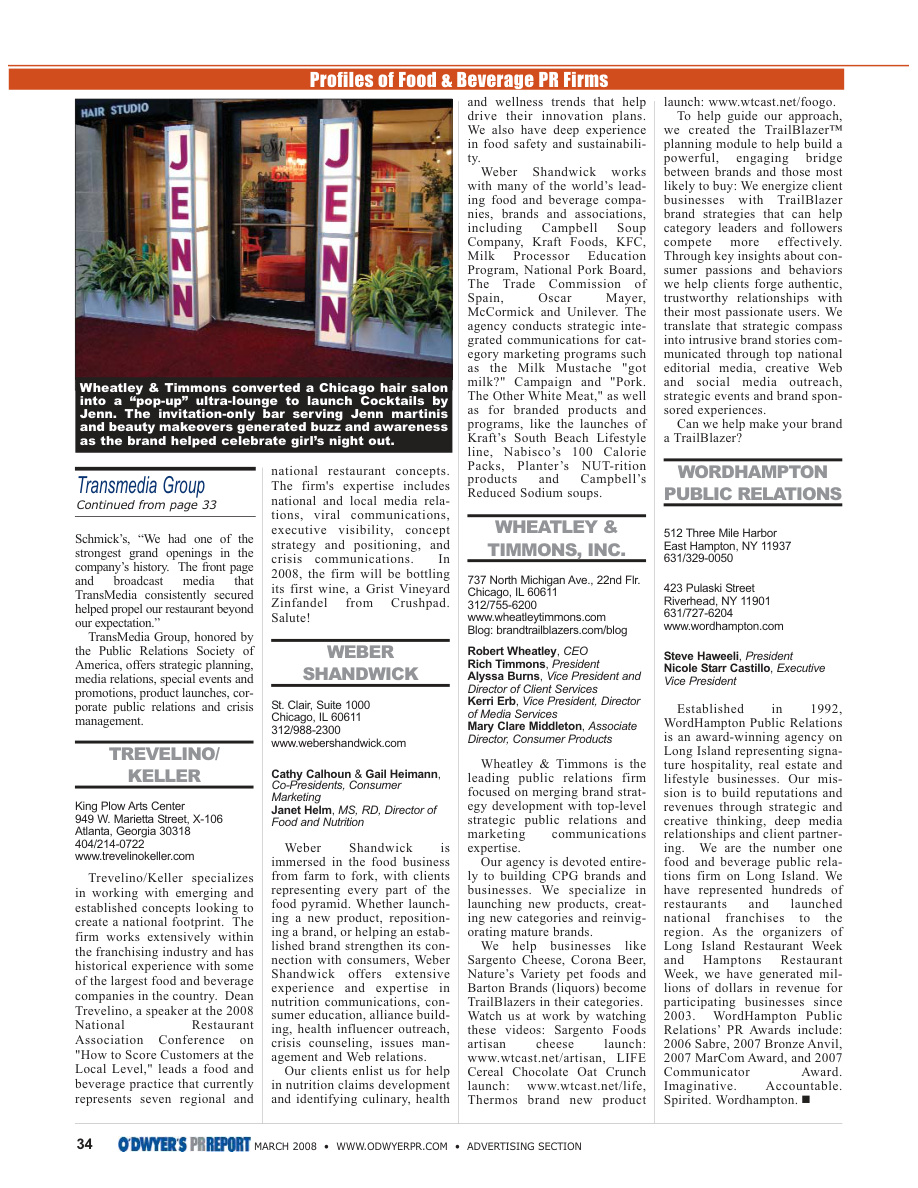
The campaigns could be theatrical. For a cocktail brand, Wheatley & Timmons converted a Chicago hair salon into an invitation-only lounge, serving martinis alongside beauty makeovers. There is a cheerful bit of mischief in the idea. It also reveals a durable piece of Wheatley's method: do not merely announce a product when you can give people a scene to enter and a story to retell.
That instinct carried into Emergent, the agency Wheatley founded around food, beverage and lifestyle companies. Its organizing idea was that healthier living was changing not only what people bought but what they expected brands to mean. The old transaction - product, message, purchase - was becoming a relationship in which ingredients, sourcing, purpose and behavior were all open to inspection.
“Consumers are not targets, they are people to build relationships with.”Robert Wheatley
This was not a plea for nicer copy. Wheatley's work treats consumer insight as a business instrument. If people are making food choices partly as expressions of the lives they hope to lead, then a brand has to understand the aspiration before it can sensibly discuss the product. It also has to survive the moment when the shopper turns the package around.
The soul cannot be bolted on
Wheatley returns often to purpose, a word that marketing has polished until it can be difficult to grip. His version has teeth. A purpose must shape strategy and operations; it cannot arrive as a messaging adjustment after the business has made every consequential decision. He has argued that legacy companies built around transactions may struggle to “acquire a soul” on command. The phrasing is wry, but the warning is stern. People can detect the seam.
The work for Jamba made the approach concrete in another way. Emergent helped the company think beyond “smoothie shop” and toward a broader healthy-lifestyle position. That involved new business channels, including schools, along with product, message and content work. The interesting move was not linguistic. It was architectural: if the brand wanted a larger role, the business needed more ways to play it.
Wheatley's public writing has followed this thesis across changing media. He wrote about crisis communications when online video made corporate response faster and less forgiving. He examined supermarkets as they became stages for experience and culinary inspiration. He called for “help over hype,” a compact phrase that gives marketing a job description and a manners lesson at once.
The cook at the table
There is a domestic detail in Wheatley's official biography that makes the professional philosophy easier to see. He loves cooking for family and friends, experimenting with techniques and ingredients that bring everyone around the table. It would be unwise to turn one hobby into a complete theory of character. Still, the resemblance is charming. His work is full of ingredients, combinations, trials and gatherings. He appears less interested in broadcasting from the kitchen than in whether anyone wants a second helping.
Food branding rewards that kind of curiosity because food refuses to remain abstract. It has flavor, memory, price, ritual and consequences. A campaign may be clever, but dinner is personal. Wheatley's writing consistently treats the consumer as a person living inside these overlapping realities, not a demographic waiting patiently beneath a funnel.
A correspondent from the next aisle
To read through Wheatley's articles is to watch one industry transition after another arrive through the supermarket door. In 2013, he was writing about snacks, restaurant menus, the tension between indulgence and healthier choice, and the transformation of Jamba's story. Later came transparency, blockchain traceability, regenerative agriculture, retail reinvention and the expanding role of corporate purpose. The subjects change, but his vantage point stays close to the shelf. He is interested in the instant when a vast cultural shift becomes a small decision made by someone holding a package.
That perspective produces an unusual rhythm. Wheatley can move from a broad claim about the relationship economy to a very particular question about ingredients, store design or the language on a label. He is not shy about coining a phrase. “Real-vertising” was his name for communication grounded in credible truth rather than self-congratulation. “Symbolic choice” described the way a purchase can express a person's values. “Help over hype” reduced an entire content strategy to three words and a useful test.
The phrases are memorable because they point back to behavior. A brand cannot claim transparency while keeping the interesting doors closed. It cannot borrow a social cause and expect instant intimacy. It cannot talk about people as a community while treating them as rows in a media plan. Wheatley has spent enough time around campaigns to know that language is powerful. He has also spent enough time studying consumers to know that language eventually meets a receipt.
His range is wider than the healthy-living label might suggest. Public biographies list crisis communications, social media, retail transformation and content marketing among his subjects. Earlier work at Wheatley & Timmons included pet food, cereal, cheese, beer and household goods. What connects them is not a dietary doctrine. It is an interest in categories where everyday products acquire emotional weight, and where a lapse in credibility can turn routine preference into permanent suspicion.
Trust after the content explosion
The arrival of generative AI gives Wheatley's old concern a new setting. When competent words and images become cheap, volume is no longer evidence of care. In recent writing he has warned that AI-authored content can disrespect an audience's expectations when brands forget the human exchange. His point is not that tools are wicked. It is that efficiency cannot perform the moral labor of credibility.
This is where his career loops neatly back to the cheese seal. A market flooded with assertions makes verification more valuable. A market flooded with content makes judgment, consistency and recognizable human intent more valuable. Technology can multiply the claim. It cannot make the customer trust it.
Wheatley's vocabulary has evolved with the industry - social strategy, content marketing, retail transformation, AI - while the underlying question remains almost stubbornly analog: what would make one person believe another? His answer asks businesses to be clear about why they exist, useful to the people they serve and willing to demonstrate what they say.
A label can carry a promise. Only behavior can carry the weight.The through line in Wheatley's work
There are louder theories of marketing. There are more fashionable dashboards. Wheatley's contribution is to keep pointing toward the awkward human on the other side of the campaign, the one with choices, memory and a talent for disappointment. Win that person's faith and the relationship may travel. Lose it and no amount of reach can make the journey meaningful.
Back in the kitchen, ingredients either work together or they do not. Around the table, people need no seminar to tell the difference. Robert Wheatley has built a career on bringing that standard into the boardroom: make something true, make it useful, and give people a reason to gather around.