The awkward moment in RNO1’s subscription experiment came after the sales pitch had worked. Clients liked the idea of an ongoing creative relationship. Some struggled to put it to use. For an agency trying to change how companies buy design, enthusiasm turned out to be an incomplete business plan.
Founder Michael Gaizutis described that early friction in a DesignRush interview. RNO1 refined its approach and found a better fit with companies able to make use of continuing support, particularly businesses moving through Series A, B and C. The lesson was practical: selling access to creative talent requires a customer ready to keep that talent busy.
Today, RNO1 packages branding, user experience, development and marketing around that continuing relationship. Its work can begin with what a company should say, extend to how its website behaves, and carry on into the campaigns that bring customers through the door. The next brief is part of the proposition.
A consultancy learns to keep the conversation going
RNO1 dates its beginnings to 2010 on the West Coast. Gaizutis had worked in advertising and brand agencies and tried a consumer technology startup aimed at competing with Quora. In his account, that experience helped draw him back to agency work. RNO1 began as a consultancy, taking on smaller assignments before larger engagements followed.
The public marker for its subscription push is November 28, 2018, when it announced Revolve. The program targeted marketing, product and founding teams whose requirements could change while work was underway. An agency could stay involved as the company evolved, carrying forward the knowledge gained from the previous assignment.
“Initially, we faced setbacks as our clients loved the idea but couldn’t fully leverage it.”
Michael Gaizutis · DesignRush interview
That admission gives the model a useful boundary. A recurring relationship needs more than a recurring invoice. Someone on the client side must have work worth doing, authority to choose priorities and enough time to respond. A company with one neatly contained assignment has a different buying problem from a product team changing direction every month.

Revolve builds it. Ryde brings people to it.
The current services menu has two named programs and room for custom engagements. Revolve covers design and development. Ryde covers digital marketing. The names are breezy; the division of labor is recognizable to anyone who has tried to get a product, a website and a campaign out the door together.
Under Revolve, the agency lists positioning, messaging, identity systems, content, website and app design, prototyping and development. Maintenance, quality assurance and performance monitoring extend the work beyond launch. Its current offer includes websites made with Framer and Webflow alongside other development work.
Ryde organizes marketing around the customer’s progress toward a purchase: discovery through paid social and search, consideration through content and affiliate activity, and conversion through email, retargeting and improvements to the buying experience. The agency describes the program as AI-enhanced. The commercial assignment remains familiar: help a brand reach people, explain itself and convert interest into action.
REVOLVEStrategy → Identity
Experience → Build
RYDEReach → Consideration
Conversion → Retention
Editorial map of the published service menu.
RNO1 also previously promoted Retrn for emerging technology companies. Its present menu emphasizes Revolve, Ryde and custom work, a useful reminder to examine an agency’s current offer before treating an older program name as a package on sale.
Seven small signs explain the design pitch
TakeUp, an adaptive hotel pricing company backed by 1848 Ventures, offers a tidy example of what RNO1 actually makes. The assignment began with brand strategy, architecture, identity and visual language, then extended to a website. RNO1 says the relationship also moved into conference demo decks and other interactive work.
The pleasing detail is in the symbol. Seven repetitions of the mathematical greater-than sign form a gear-like shape. RNO1 intended the construction to suggest improvement, automation and expansion. A hotel revenue product gets a visual idea that can travel from the corner of a screen to a much larger brand application.

The practical value of such a system is repeatability. A team can carry a recognizable idea into new formats without starting the identity discussion again. That is also where an ongoing agency relationship can earn its keep: the people making the next piece already understand why the first piece looks the way it does.
A subscription agency meets a subscription platform
Prive makes the business-model rhyme almost too easy. The ecommerce subscription platform hired an agency with a subscription proposition to develop its visual identity, language, design systems and animation. RNO1’s case study describes content strategy and website architecture organized around making the product’s value easier to grasp.
For a merchant considering subscription software, the important questions are concrete. How difficult is setup? What happens during migration? Can the arrangement grow with the business? RNO1’s account of the project emphasizes presenting Prive’s simplicity through the site’s structure and design. The product’s sales explanation and visual expression were treated as connected work.
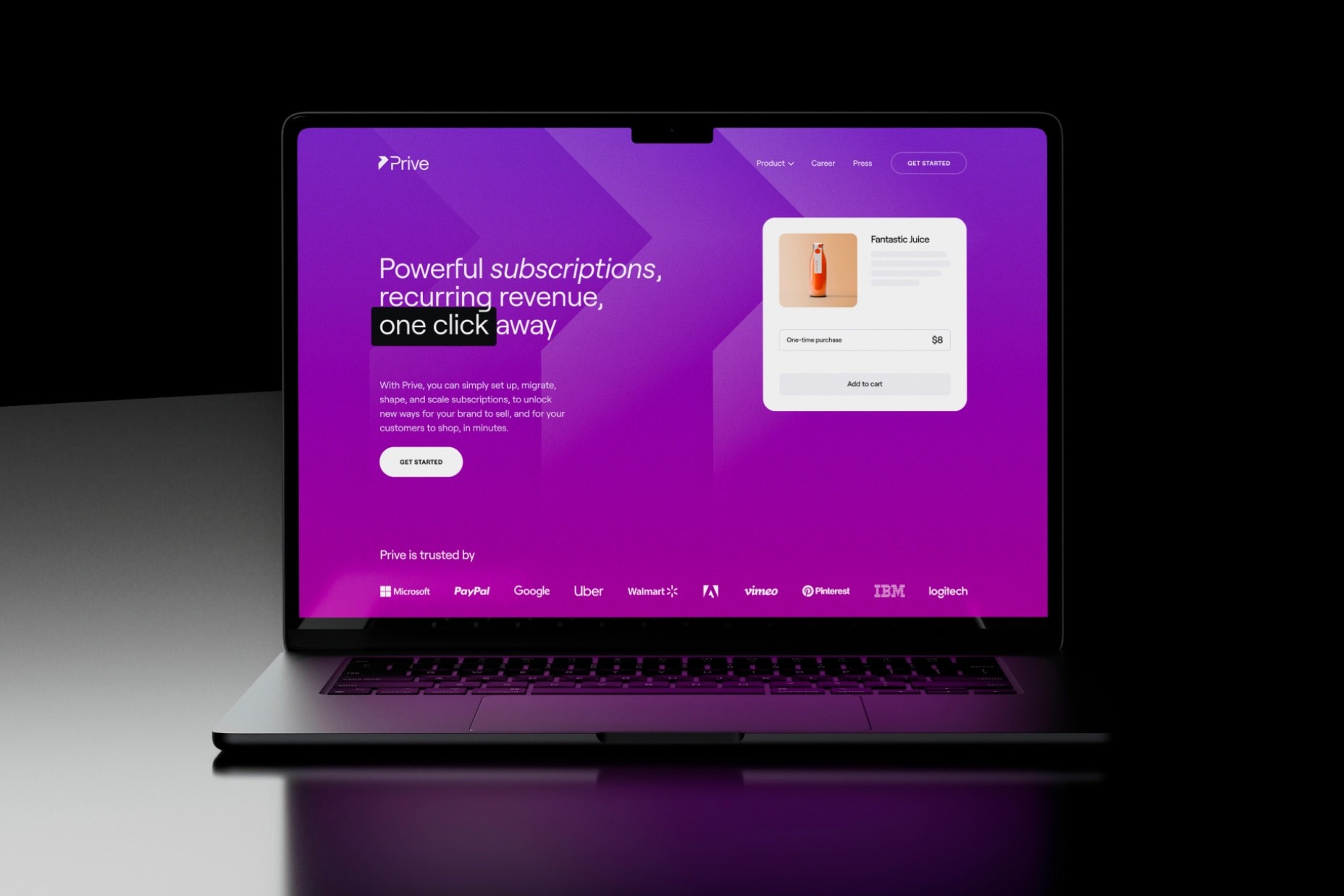
Recurly announced its acquisition of Prive in May 2025. That supplies a verifiable later chapter in the client’s story. It does not measure how much value the redesign created. A buyer evaluating RNO1 can admire the work and recognize the acquisition while keeping those two judgments separate.
Interos illustrates the same breadth in an enterprise setting. RNO1 describes a multi-year engagement with its marketing and leadership teams, spanning identity, visual language, data design, digital architecture, prototyping and web development. The assignment concerned how a complex supply-chain intelligence business presented itself across several connected surfaces.
Before the growth chart, fix the counting
Cirkul’s case study begins with less glamorous problems: fluctuating demand, unprofitable campaign spending and Facebook sales attribution that needed attention. The drinks brand engaged RNO1 for more than a year of Meta campaign management. The brief included increasing average order value and finding a profitable approach to different seasons.
RNO1 lists creative production, reporting, sales attribution work and demand management among its contributions. It reports a 23.61 percent increase in average order value, a tenfold difference between the lowest and highest order levels, and a 3,734 percent rise in online store sessions. Those are the agency’s reported results for this engagement.
Average order value during the engagement
Normalized illustration of the reported percentage change. This is an order-value measure, not profit or return on ad spend.The useful sequence is in the problem statement. Before buying more traffic, establish what the reporting means and where spending is losing money. An increase in order value answers a different question from an increase in profit. A growing store can have both more customers and more expensive customers; a good brief makes room to examine both.
The $70,000 question
RNO1’s public contact form lets prospective customers indicate budgets from $25,000 to $500,000-plus. That is a range for starting a conversation, not a monthly rate card. The services page describes monthly work cycles, planning over 30 to 60-plus days, renewal options and billing as the work develops.
A client interview published by Clutch in March 2025 adds a concrete transaction. A communications and media company’s CEO reported spending around $70,000 on a website redesigned and rebuilt between August and December 2024. The project used Next.js and the Payload content management system. Members found it easier to see upcoming events.
The buyer praised the design and scheduling but considered the price somewhat above market. The advice for future clients was to define the scope more precisely, which the CEO believed could have made the process cheaper and more efficient. That is one client’s assessment of one engagement, not a universal price comparison.
For anyone buying similar work, the implication is straightforward: ask what the budget includes, who approves changes and how priorities affect delivery. A flexible arrangement still needs decisions. Otherwise the freedom to change direction can become the freedom to discuss the same problem for another month.
The next brief is the real test
RNO1 occupies the space where branding studios, product design teams and marketing agencies overlap. Buyers can assemble those capabilities separately, hire internally or commission an agency to coordinate them. RNO1’s argument rests on breadth, continuity and a team that can remain involved as the work changes.
The company describes its culture as design-first and its delivery teams as senior-level. It wants to function as an extension of a client’s organization. Those promises are best assessed in the working relationship: who attends meetings, who makes the work and whether knowledge survives the move from strategy to execution.
Its newer portfolio includes ResiQuant, an AI property-underwriting company that engaged RNO1 to rethink its brand experience. Strategy, identity, visual language, user experience and interface design sit together in the assignment. It is another example of the agency working where technical complexity meets the need for a comprehensible public face.
The transferable lesson is modest enough to copy. Build reusable design systems. Carry the reasoning behind them into the next assignment. Choose a buying arrangement that matches how often the work changes. RNO1’s own early experience adds the final condition: a subscription becomes useful when the customer has both the need and the capacity to use it.
Follow the work
Explore the RNO1 website, its project portfolio and agency blog. Read the founder’s DesignRush interview, the client interviews on Clutch and Recurly’s Prive announcement.