At Argent Capital Management, the problem could be counted in programs. Ten of them. Each presumably had a reason to exist; together, they gave the firm ten places to look, maintain, and reconcile. In Ridgeline’s account of the switch, Argent combined those programs into one. The interesting question is what disappeared between them: the checking, copying, and small acts of translation that keep an investment office functioning.
- One shared record for investment operations, from portfolios to client reporting.
- Built for professional firms: asset managers, wealth managers, and RIAs.
- A substantial switch: the payoff depends on migration, workflow fit, and fewer manual handoffs.
The ten-program problem
Ridgeline makes cloud software for the people running investment businesses. Portfolio managers construct holdings. Traders generate orders. Compliance teams check restrictions. Operations staff reconcile records; accountants maintain the books. Client teams explain the results. Ridgeline puts these activities around shared, real-time data, so the next department need not reconstruct what the previous department already knows.
The irritation it addresses is wonderfully unglamorous. At Cornerstone Investment Partners, staff described data becoming stuck or duplicated, reporting limitations, and an exhausting upgrade cycle. Head trader Russell Brown said, “We weren’t actively looking to change.” That is the revealing detail. A firm can become accustomed to the labor its technology creates. The workaround starts looking like the job.
First the people. Then the problem.
There is an unusual origin behind this practical proposition. Dave Duffield founded Ridgeline in 2017 after building enterprise software businesses including PeopleSoft and Workday. But investment management was not the original, settled brief. The company assembled its leadership team before choosing its industry. In Dave Blair’s later telling, a discussion at Allen & Co., including George Tenet, redirected the team toward investment managers and their aging systems.
That sequence matters. Ridgeline approached finance with experience in the machinery underneath a business: permissions, records, transactions, and the people who must trust them. Blair, now CEO, brought decades at SS&C Advent. The proposition was a fresh system of record for an industry whose records already occupied many systems.

The company’s employment policies add a more domestic detail: dog-friendly offices and paw-ternity leave. Its stated values include fun alongside profitability and customer service. For a business asking customers to entrust it with daily operations, the human relationship is part of the product. A migration lasts longer than a sales presentation.
Give AI a set of facts
Ridgeline’s technical bet predates the current AI enthusiasm. A 2020 AWS interview described one version of the data, one security model, and one book of record. The team chose AWS and a serverless approach, accepting a specific cloud provider in exchange for simpler infrastructure and access to its services. The tradeoff was deliberate.
Ridgeline competes in a market that includes SS&C Advent, SimCorp, and Charles River. Other suppliers also promise connected investment operations. Ridgeline’s pitch centers on a platform built together in the cloud. Buyers still need to compare asset coverage, accounting requirements, service, and migration effort; a clean architecture does not settle every purchasing question.
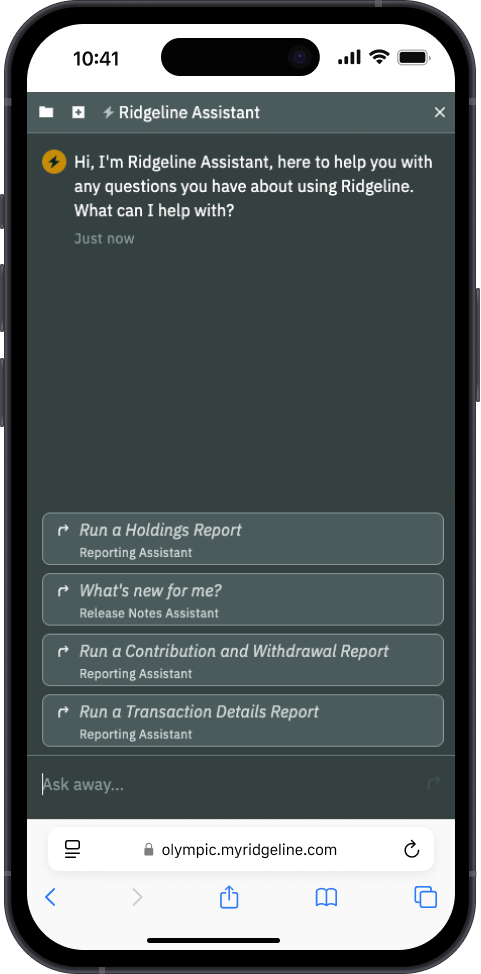
Today, Ridgeline Intelligence brings an assistant, agents, and configurable workflows into that environment. Staff can ask questions, generate reports, prepare for meetings, and build processes with AI steps. Reconciliation tools group similar discrepancies and recommend responses. Permissions, human approvals, and audit histories are part of the design. The useful question is whether the machine has the context and authority required for the task.
“What we love is that it’s the same data.”
Cole Smead / Smead Capital Management
Intelligent Outcomes takes the idea further. Firms can assign defined operational workstreams to AI-driven processes with expert oversight, including reconciliation and exception management. This extends Ridgeline’s enterprise SaaS business into operational service delivery. Customers can use their own team, a partner, or Ridgeline’s service team. The thing being purchased can become a completed process, with visibility into its status.
Nine months is still a project
Congress Asset Management supplies a useful measure of the commitment. Its customer story describes moving off forty years of legacy technology in about nine months, bringing six functions together. Geneva Capital Management completed its switch six months after signing while preserving access to more than thirty years of historical data. These are individual accounts, rather than a promise that every conversion runs to the same clock.

For buyers, the relevant price includes implementation, data preparation, testing, staff time, and the subscription. Against that bill belong retired software contracts and hours recovered from manual work. Ridgeline describes discovery, configuration, migration, end-to-end testing, and user acceptance before cutover. Its implementation partners do part of the work; the customer’s subject experts still have to show up.
The lesson is portable: inventory the handoffs before shopping for features. Ask which records are entered twice, which exceptions recur, and who checks whose numbers. A unified system makes sense when those costs are material. A firm needing one narrow tool, or unable to validate its required assets, integrations, and controls, should examine the case for a wholesale move carefully.
The customers who bought in
In September 2026, Ridgeline announced a $250 million Series E at a $1.425 billion valuation. Duffield led it; participants included Motley Fool Ventures, associates of Smead Capital Management, and Patrick O’Shaughnessy. Customer and affiliate participation gives this financing an interesting texture: some people exposed to the product also wanted exposure to the company.
Assets committed to the platform.
Commitments include the adoption pipeline; they are not a measure of revenue or proof that every asset is live.
That distinction keeps the story grounded. Ridgeline’s wager will ultimately be tested at desks like Argent’s and Congress’s, in reconciliations completed and records trusted. Investment firms are paid for judgment. The appeal of fewer moving parts is having more of the working day left to exercise it.