The revealing detail in Nirvana Solutions’ family-office case study is where the work began. A multibillion-dollar client wanted sophisticated analytics: performance by strategy, attribution against benchmarks, risk sliced by sector. Yet its administrator’s consolidated data arrived late and could not be relied upon. Nirvana describes beginning with a shadow net asset value process, checking the records before building the views. The interesting software problem was underneath the screen.
- Trading, portfolio management, and accounting share a data model.
- Operational support comes alongside the software.
- Clients can license individual modules as their needs change.
This is a useful way into a company whose product list can otherwise sound like a financial dictionary. Nirvana serves hedge funds, institutional asset managers, and family offices. Its work concerns the distance between placing an order and having a record that everyone can use. A trader needs an execution. An accountant needs a ledger entry. A portfolio manager needs an exposure number. Each is describing the same business from a different desk.
01 / The number beneath the dashboard
In the family-office account, Nirvana says it cleaned and reconciled historical and daily records, then designed tags for strategies, analysts, and sectors. Interactive dashboards followed. That sequence matters. A beautiful attribution chart cannot repair an unreliable position file. For readers running any data-heavy organization, the transferable lesson is wonderfully unglamorous: settle the meaning of the records before commissioning another way to display them.
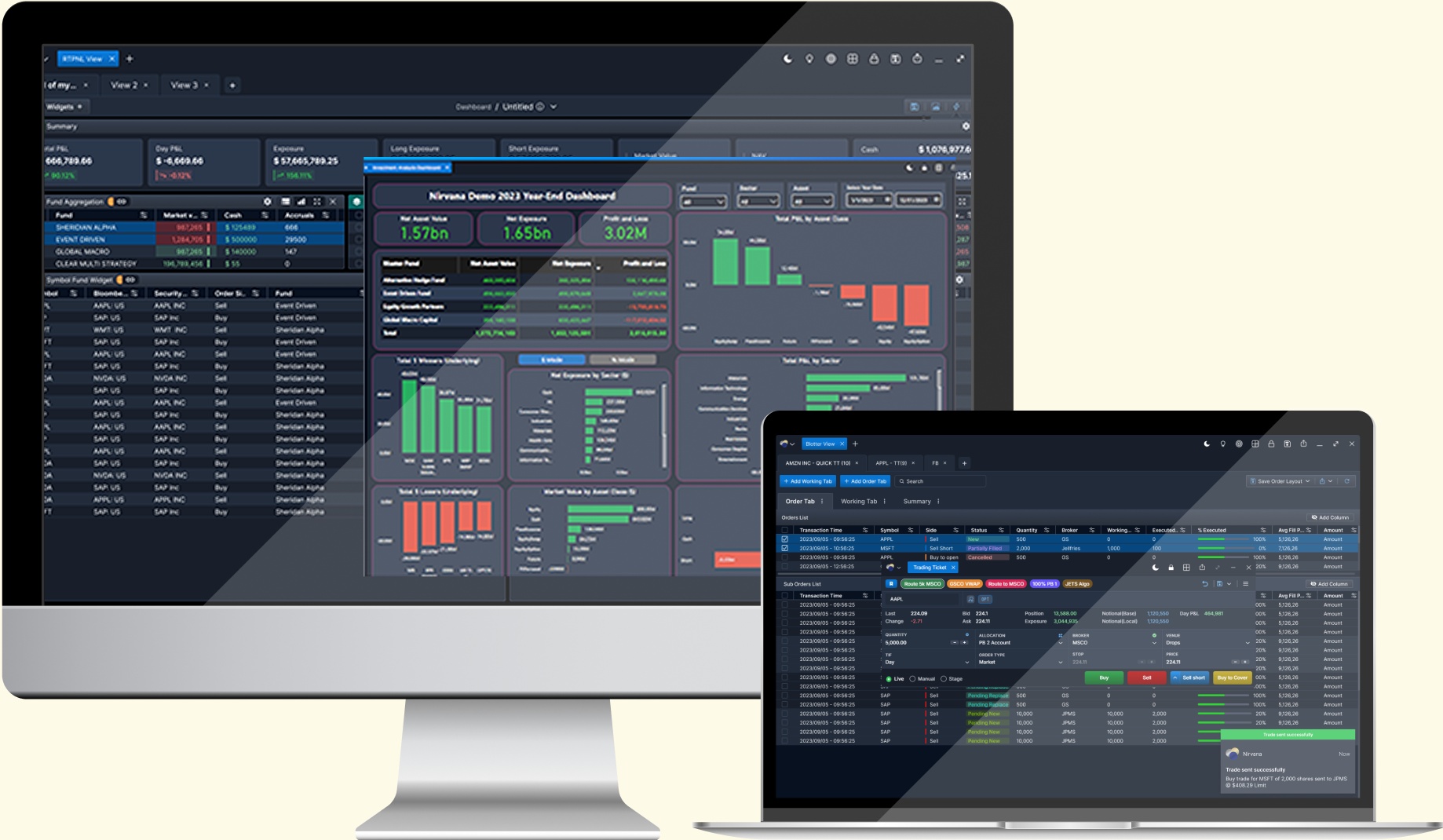
The flagship, Nirvana ONE, connects portfolio management, order and execution management, accounting, reporting, and analytics. Its stated architectural distinction is a common codebase and data model, built together. The intended payoff is fewer internal handoffs between separate applications. External records still need checking against brokers, custodians, and administrators. Moving the departments onto one system does not make the outside world agree automatically.
A separate asset-manager case study exposes the human side of that architecture. Nirvana describes working with custodians on migration, traders on order workflows and compliance rules, accounting on valuation and reporting, and portfolio managers on analytics. The installation crossed departmental boundaries. It is a reminder that replacing a fragmented stack requires agreement about responsibilities as well as a common database.
02 / Someone still has to fix the break
Nirvana calls its service model “True SaaS.” The phrase earns its place only when unpacked: the company supplies people to manage data aggregation, reconciliation, discrepancies, and corporate actions alongside the application. Buyers are therefore comparing an operating arrangement as well as software. The question in a demo becomes concrete. When tomorrow’s position disagrees with a counterparty’s record, who investigates, who resolves it, and who signs off?
The product modules divide that work into recognizable jobs. OEMS handles orders, routing, allocations, and pre-trade controls. PMS & Accounting handles portfolio records and the books. Analytics adds performance attribution, exposure analysis, and risk views. A manager can use execution without replacing the whole portfolio stack. That modularity creates a practical entry point for firms with an existing system worth keeping.
03 / The feature you never use still has a price
One anonymous hedge-fund case study makes the buying decision unusually clear. A mature global long/short fund had a functioning incumbent system, but considered it rigid and expensive. It was paying for capabilities it did not need. Nirvana describes deploying selected ONE modules around the fund’s compliance and execution requirements, then reports a reduction of more than 30% in total cost of ownership. Treat that as the vendor’s account of one engagement.
Lower total cost of ownership in Nirvana’s anonymous mature long/short fund case study. A client-specific claim, not a pricing promise.
The useful buying principle survives without turning that percentage into a forecast. Compare the work and capabilities you actually require, including staff time and migration. Nirvana licenses modules according to requirements; the commercial conversation depends on the firm’s setup. A cheaper subscription can become expensive if it leaves the daily operating burden untouched. Conversely, paying for a broad suite makes little sense when a narrower deployment covers the job.
04 / The founder kept his shares

Founder Shams Karim’s background helps explain the focus on investment plumbing. His public biography traces a career through investment banking and trading, an NYU Stern MBA, Morgan Stanley, and an earlier company, Advanced Financial Applications. Nirvana subsequently became a business that joins financial workflows with technology. Its expertise spans the trading desk and the daily operational tasks that make the desk’s activity legible to everyone else.
In July 2022, Blue Horizon Software Holdings announced a majority investment in Nirvana Financial Solutions. Karim and the management team stayed. The announcement described capital for sales, marketing, product development, and market expansion. Karim put one priority plainly: “The capital injection will allow us to invest in sales & marketing”. For a specialist software business, distribution and implementation capacity matter alongside the next feature.
The company’s stated culture also emphasizes employee ownership through an ESOP, alongside client focus and purposeful innovation. Those are management’s descriptions, rather than an independent account of working life. They do, however, fit a business whose service requires continuity: people who understand an account’s structure and remember why a particular exception mattered last month.
05 / Before the AI answer, a trustworthy book
ONE Intelligence extends the same operating idea into AI. Nirvana describes an interface that can query portfolio information, produce reports, and work with tools for risk, rebalancing, and staged trades. Its product explanation distinguishes model reasoning from established processes that execute trading and compliance workflows. That is an important boundary to inspect during evaluation: a useful explanation and an authorized transaction carry different responsibilities.
The market around Nirvana includes integrated investment platforms and firms’ own combinations of trading, accounting, and analytics tools. A shared model is a purchasing argument, rather than proof of superior results. Fit still depends on instruments, counterparties, controls, and the effort of conversion. Ask for a demonstration using your difficult workflow. Ask how an exception gets resolved. Then ask the departments separately whether they would trust the resulting number. Their answers are the real test.
There is a smaller lesson here for teams with no plans to change vendors. Follow one disputed number through its journey. Identify the file it came from, the transformation applied to it, and the person responsible for the exception. That exercise can reveal where another dashboard would merely give an old disagreement a fresh coat of paint.