Forty portfolio managers can generate plenty of investment ideas. Five or six traders must turn them into orders that actually reach the market. In a customer case published by LSEG TORA, that mismatch had become a daily burden. Even remembering to apply a swap flag to every short sale demanded human attention. The queue needed help.
TORA supplied configurable rules that could dispatch smaller orders, set parameters and amend or cancel instructions when conditions changed. The case describes a practical redistribution of work: routine orders could move automatically, while traders retained oversight. It is an unusually legible glimpse of a business usually explained through a blizzard of initials.
Those initials carry real money. In February 2022, London Stock Exchange Group agreed to pay $325 million for TORA, a cloud trading technology company founded in 2004. The acquisition completed that August. LSEG was buying a way to connect its financial data and analytics with the moment customers act on them.
The investment idea has a long commute
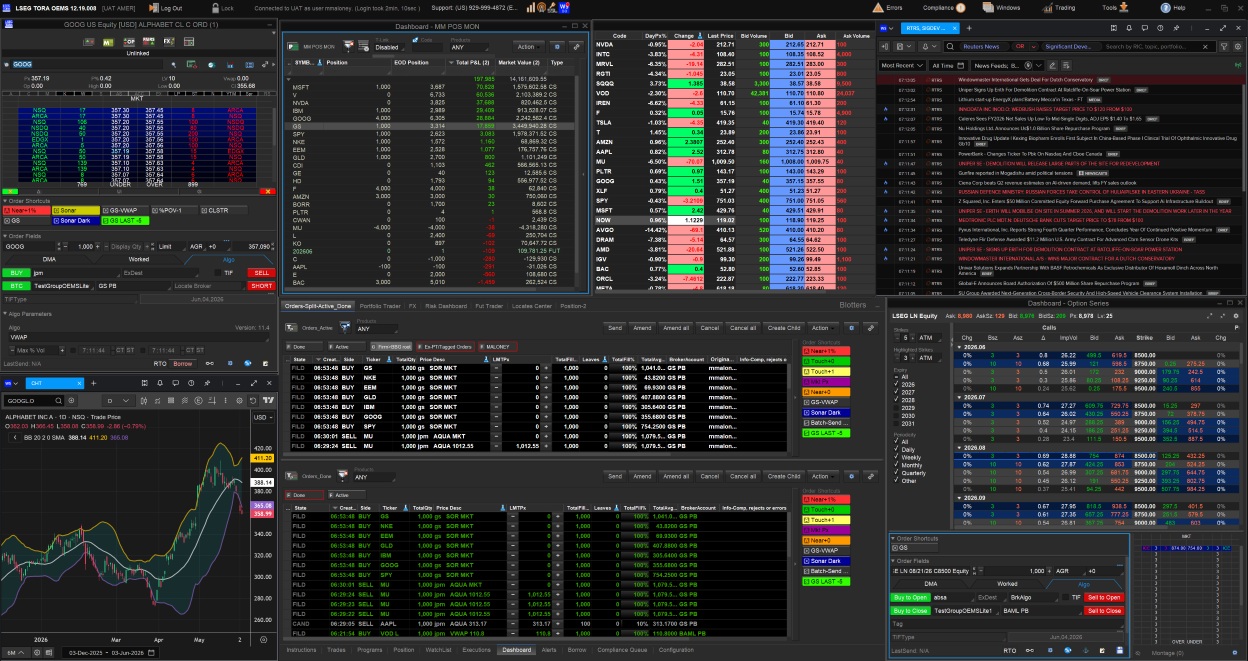
An order management system, or OMS, organises trading instructions. An execution management system, or EMS, helps send those instructions to brokers and markets. TORA combines the two in an OEMS, with related compliance, reporting and transaction cost analysis. Its institutional customers include hedge funds, asset managers, proprietary trading firms and sell-side desks.
The distinction matters because choosing an investment and buying it are separate jobs. A portfolio manager may want exposure to a company; the trading desk must decide how to acquire it, through which broker, under which constraints. After execution, the resulting transactions still need to be allocated and recorded. Every handoff gives software something useful to do.
TORA’s fact sheet describes a platform customers can adopt in full or in components, with connections to existing infrastructure. Rebalancing, position monitoring and allocation sit beside execution tools. The commercial argument is straightforward: a firm can improve a troublesome part of its workflow without assuming that every other system deserves eviction.
Before the deal, there were spreadsheets
A public recommendation on founder Keith Ducker’s LinkedIn profile supplies a more human origin scene. Brian Hafner recalled discussions around 2004 or 2005 about replacing a system built on spreadsheets and Microsoft Access. Daily trading volumes had reached $100 million to $200 million, he wrote, and the old arrangement was struggling.
“The system was creaking under the weight of trading volumes”Brian Hafner, recalling an early TORA implementation
Hafner described anxiety about changing a core system, followed by a smooth cutover and a team quick to fix problems. That is one customer’s recollection, but it identifies the stakes neatly. The first strain in this account appeared in the customer’s existing tools. A replacement had to earn trust while the trading business kept running.
Ducker had worked as a Goldman Sachs sales trader and helped deploy its RediPlus trading front end for US clients. By 2010, TORA’s Compass platform was being marketed around access to Asian markets. Goldman invested that February in a minority financing advised by FT Partners, supporting expansion beyond the company’s established territory.
The geography continued to widen. In 2016, TORA added US sales and support capacity and a site at Equinix’s NY4 data centre. CEO Robert Dykes told Markets Media the company had signed ten US clients using statistical arbitrage and global macro strategies. Its prospects included firms that had outgrown their existing technology. The spreadsheet story had acquired a larger address book.
What $325 million connected
LSEG’s acquisition announcement emphasised TORA’s reach in Asia and North America, its European operations and its coverage of traditional assets and digital assets. The logic was complementary: bring an established trading application together with the buyer’s data, analytics and customer reach. This was a purchase of capability and distribution, rather than a public promise of investment returns.
LSEG’s agreed acquisition price.
Completion followed on 9 August 2022.
The resulting product relationships are now easier to see. LSEG presents AlphaDesk as a portfolio backbone, Workspace as a source of market context and analytics, and TORA as an execution-focused environment. Autex supplies connectivity. These are related products with different jobs; understanding their roles is more useful than counting how many logos can fit on a sales slide.
One customer win gives the arrangement substance. In its first-half 2024 presentation, LSEG described an unnamed Asia-Pacific asset manager adopting AlphaDesk, Workspace, TORA and Autex Trade Route. The package displaced four competitor products from two providers. It illustrates the parent company’s opportunity: sell a connected workflow across several purchasing decisions.
- 01Portfolio decisionsAlphaDesk
- 02Data and market contextWorkspace
- 03Orders and executionTORA
- 04Routing and connectivityAutex Trade Route
The clever bit is deciding what can be routine
TORA’s automation rests on rules that traders and firms can configure. In a 2023 product essay, Ovidiu Campean described routing criteria including asset class, order size, strategy, market conditions and time of day. The useful question becomes specific: which orders should follow a repeatable route, and which deserve a person’s attention?
Transaction cost analysis helps inform those choices. Execution can be judged against benchmarks, and that evidence can feed broker algorithm selection. The aim is to make routing responsive to observed performance. A benchmark still needs interpretation: an algorithm suited to one type of order need not be the right answer for another.
The customer with more than 40 portfolio managers adopted Automated Rules Trading, or ART. Small orders could go directly to brokers; more complex cases could interact with the client’s API. The published example connects that routing with an algo wheel and analytics. The takeaway is a sequence other operations teams can copy: identify repetition, define the rule and preserve an exception route.
Developers have a place in this arrangement too. TORA exposes APIs for connecting trading models and systems. Campean describes a sandbox and coding samples for experimenting before production. That makes customisation an operating responsibility: someone must test the instructions and decide what should happen when the input changes.
One screen, different market problems
In March 2024, LSEG announced that FXall, Matching and PriceStream were integrating with TORA. The announcement covered more than 500 currency pairs and a network of over 200 market makers, with spot, forwards, swaps and non-deliverable forwards available through the workflow. For a desk trading across asset classes, keeping FX in the same environment has obvious practical appeal.
The attraction is continuity. LSEG described shared automated workflows, pre-trade controls, position management and profit-and-loss tracking. A trader can approach currency execution alongside other activity rather than treating it as a disconnected operational excursion. That does not make the instruments interchangeable; it gives their different workflows a common place to meet.
TORA’s Asian experience remains visible. A June 2025 LSEG article describes Stock Connect support and pre-trade controls addressing China-specific requirements, including ownership limits and trader identification. Here, local market knowledge becomes product detail. A generic order ticket is only the beginning of useful access to a particular market.
The same article describes outsourced trading support from a dedicated execution desk and experienced traders. TORA therefore offers an institutional buyer more than a software installation. Some firms can use outside staff to supplement trading operations, alongside the technology that organises the work.
The report card has more than one column
TORA competes in a busy institutional software market. Datos Insights’ fixed-income EMS research places it among vendors including Bloomberg, FlexTrade, Charles River and TS Imagine. Buyers are comparing asset coverage, connections and operating models. TORA’s membership of LSEG gives it a particular data-and-execution proposition, but the competing products deserve a comparison against the actual desk.
Industry recognition supports part of its pitch. The TRADE named LSEG TORA the winner for Best Multi-Asset Capabilities in the EMS category at its New York 2025 awards. That is evidence of recognition in a defined category, not a ranking of every feature or every customer experience.
The service picture is more textured. In The TRADE’s 2024 outsourced trading survey, LSEG TORA averaged 5.52, below the survey’s global average of 6.04. Client service and relationship management was its strongest category at 6.00. These findings concern outsourced trading, so they should not be mistaken for a controlled evaluation of the OEMS.
The 2025 survey reported that 32% of responses rated the provider Excellent overall, compared with 26% the previous year. Changing respondents and client mixes limit any tidy before-and-after claim. Read together, the surveys suggest a buyer should examine the service relationship as carefully as the feature list.
The price of fewer handoffs
TORA sells into institutional technology and trading budgets through a consultative sales process. The relevant buying decision includes the implementation, connections and support a particular firm requires. The $325 million acquisition price tells us what LSEG agreed to pay for the company; it tells a prospective customer little about the cost of its own installation.
A sensible evaluation would follow real orders through the proposed setup. Can the desk retain its necessary brokers? Do allocations arrive correctly? Can people inspect automated decisions and intervene? These questions follow directly from TORA’s product promise. A polished demonstration becomes useful when it resembles a difficult working day.
There are also clear limits to the fit. TORA’s materials target institutional or equivalent professional users, with availability varying by jurisdiction. Automation depends on suitable rules and dependable inputs. A desk with few repeatable tasks, or connections the platform cannot support, may find less benefit in the same features that help a busy multi-manager operation.
The wider lesson is pleasingly practical. TORA’s documented story runs through overloaded tools, international connectivity and the repetitive details of execution. Other software builders can study those handoffs in their own industries. Somewhere, a capable person is checking the same field again. That is a good place to start observing.