A good number can be very persuasive company. Give it two decimal places, a respectable chart and a familiar label, and people begin arranging decisions around it. Jonathan Caplis has spent much of his working life asking what happened before the number arrived. Who was counted? Which comparison was chosen? What would the picture look like with the missing participants included?
For Caplis, who generally goes by Jon professionally, those questions became PivotalPath. He founded the New York hedge fund research firm in 2013, after a decade working inside funds. His subsequent career has revolved around a deceptively consequential task: helping institutional investors understand the field against which they judge a manager.
The appeal of a benchmark is that it saves an argument. The danger is that it may settle the wrong one. A fund’s return means something different when placed beside similar strategies than when compared with an assortment of funds doing quite different jobs. Caplis’s work begins with the composition of that assortment. The guest list deserves as much attention as the score.
A number needs company
At PivotalPath’s tenth anniversary, Caplis returned to the uncertainty that had bothered him before he started the firm: investors were making decisions without knowing the full range of relevant options. It is an awkward predicament for an industry built on knowing things other people have missed.
The firm’s original proposition addressed an information problem. An investor might have relationships with managers, a consultant’s recommendations and access to a database, yet still lack a sufficiently broad view. Each route could be useful. None automatically guaranteed that the investor had seen the appropriate range of choices.
The distinction matters because a comparison is a decision about membership before it becomes a calculation. Even flawless arithmetic cannot answer a question the group was poorly assembled to address. A school league table, a restaurant rating and a hedge fund index all share this inconvenience. Formatting can lend authority; it cannot supply the missing context.
“how can you make an intelligent hedge fund decision when you don’t even know all of the relevant options?”
Jon Caplis · PivotalPath’s tenth anniversary, 2023
In January 2025, he discussed flawed benchmarks with Institutional Investor’s Julie Segal. The conversation examined how an incomplete view of hedge fund performance can shape judgments about the industry and decisions about allocating capital. That takes his argument beyond the question of whether an individual manager had a satisfactory year. The measuring instrument can influence how much money reaches the whole category.
Three jobs before the question became a business
Caplis studied finance at Washington University in St. Louis. His early career began at Chesapeake Partners, an event-driven hedge fund, as an analyst and trader. Later, he co-founded Global Domain Partners, a systematic hedge fund, and became its chief operating officer.
The responsibilities at Global Domain Partners were extensive: quantitative research, the investment process, trade execution, compliance and operational oversight. This was experience in the practical work beneath a fund’s results. Research had to reach a trading process. Trades had to be executed. The organization around those activities had to function.
At Campbell & Company, Caplis became co-head of portfolio allocation and risk management. He served on the investment committee and led specialized recruiting. His experience crossed the decisions about where capital should go, how risk should be managed and who should be hired to do the work.
- Chesapeake PartnersAnalyze & trade
- Global Domain PartnersCo-found & operate
- Campbell & CompanyAllocate & manage risk
- 2013 · PivotalPathResearch & compare
Seen together, these roles help explain the choice of business he made next. A person responsible for operations needs to understand how a result was produced. Someone allocating capital needs to decide what to make of it. PivotalPath occupies the space where those concerns meet.
The progression also makes the usual divide between finance and technology less helpful here. His later work uses tools to address questions familiar from the investment process: what is available, what is comparable and what deserves a closer look? The software serves a judgment that begins outside it.
The arithmetic of trust
A research company needs information that other people possess. In hedge funds, those people have reasons to be selective about sharing it. Caplis has addressed that obstacle directly: established managers may have little incentive to contribute sensitive information to commercial databases that distribute it broadly, including to competing funds.
His explanation turns a technical problem into a question of incentives. A manager may cooperate with a particular audience for a particular purpose while resisting general circulation. The person requesting the data has to explain where it will go and what will be done with it. A collection form is a small part of that conversation.
PivotalPath says it protects confidential manager information and shares insights with institutional investor clients. Its work combines research, manager screening, portfolio analysis and benchmarks. The company’s current description puts its clients’ combined hedge fund investments above $650 billion. That figure describes investments belonging to clients; it should not be mistaken for money managed by PivotalPath.
Combined hedge fund investments of PivotalPath’s institutional investor clients, according to the firm.
Client capital · not PivotalPath assets under managementThe distinction is useful for understanding Caplis’s place in the market. He runs a firm supplying research and tools to decision makers. The quality of its work depends partly on the quality of its relationships. Data collection here involves obtaining cooperation from people who have their own obligations, preferences and limits.
In June 2025, speaking with Jeff Malec on The Derivative, Caplis described coverage of roughly 3,000 funds representing about $3 trillion in hedge fund capital. He also discussed how talent, capacity and different investment structures were reshaping the industry. Those are questions about the businesses behind the returns as well as the returns themselves.
A strategy can be attractive in theory and difficult to access in practice. A manager’s capacity, available talent and chosen structure all affect the conversation. The research task grows more demanding when the investor wants to understand the opportunity that can actually be used.
When the baseline moves
Caplis’s public commentary shows how regularly he returns to context. In a 2022 article co-written with New Holland Capital’s Mike Jacobellis, he examined the dispersion beneath headline hedge fund returns. Their argument was that a broad annual result could conceal sharply different experiences across strategies and different opportunities for allocators.
That is a useful complication. A headline return gives the reader something to remember. Strategy-level analysis asks the reader to do more work. Caplis’s business rests on the proposition that this extra work can change the conclusion. The average remains a fact about the group; it does not become a biography of every member.
In early 2024, he discussed a different comparison: cash. With interest rates higher, institutions were asking more pointed questions about what hedge funds delivered above a readily available cash return. A positive result could prompt a harder conversation when the alternative had become more rewarding.
He also commented that year on the crowded market for multistrategy talent and the possibility of consolidation among firms. These observations belong together. Evaluating a fund requires attention to both the investment outcome and the conditions under which its business operates. A familiar label can contain quite different arrangements.
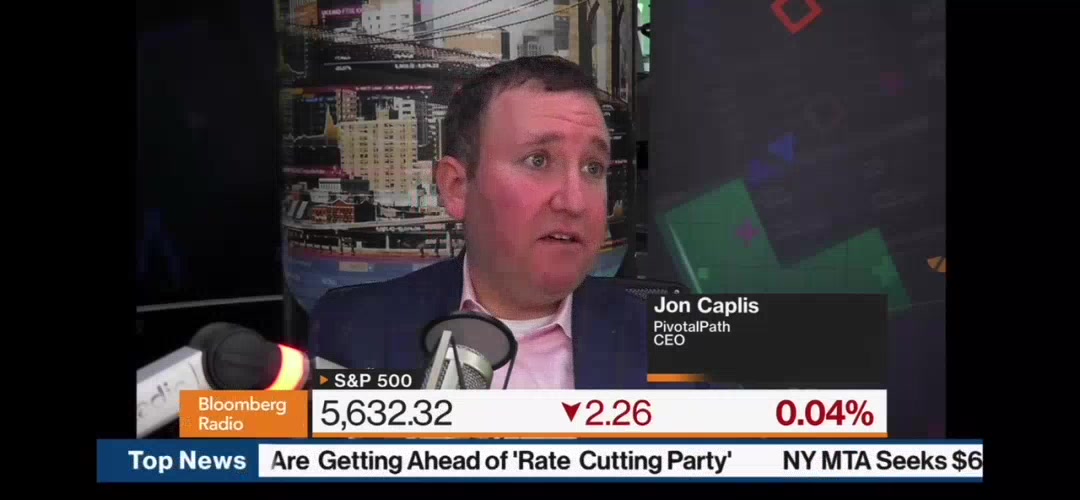
The public role has continued. He joined Bloomberg Radio to discuss the hedge fund environment around the Federal Reserve’s September 2024 rate cut. PivotalPath received Best Index Provider recognition in 2023 and appeared in Alternative Fund Insight’s 2024 Power25 ranking. The company’s work was reaching audiences beyond its own research portal.
Good information has a human cost
The early business carried personal costs. Caplis recalled going without a paycheck and starting the company in a different state from his wife and newborn son. His parents had worked in nonprofits; he has described fairness, family and candor as values that shaped him. These details give the venture a less abstract scale than the institutional sums around it.
His founder advice includes asking for help. A cold LinkedIn message to a prominent industry figure produced an important connection. There is something pleasingly consistent about that episode: even a business devoted to better information can begin with a person willing to answer a stranger.
By 2026, the conversations were taking him into different settings. A February podcast recorded during Miami’s Global Alts gathering covered industry performance, capital flows and investment structures. In March, a CAIA Singapore seminar listed him for a practical walkthrough of how allocators assess managers, the questions they ask and how managers can respond.
The Singapore agenda captures the enduring purpose of his work. People on either side of an investment decision need a way to discuss the same evidence. Caplis has built a company around making that discussion more informed. Before accepting the apparent certainty of a number, he asks the participants to examine the comparison that gave it meaning.