When Itai Damti and Doron Somech came back together to start Unit, they had an advantage that would be difficult to put in a spreadsheet. They knew they wanted to work together. The question of what to build remained open. There is something pleasingly backwards about that order. The partnership had already survived the ordinary business of making software, selling it, and discovering which parts of a plan refuse to cooperate.
They met as software engineers during their service in the Israeli army. Their first shared company, Leverate, occupied roughly a decade of their working lives. In 2018 and part of 2019, they tried separate ventures that did not succeed. Then they reunited. Damti became Unit’s chief executive; Somech became its chief technology officer. The reunion gives the company an origin more personal than a market-size slide: two people deciding that another long stretch of work would be better spent together.
Damti’s interest in programming began at 12. He taught himself, took programming jobs as a teenager, and started businesses before adulthood. During military service he began studying mathematics at the Open University. Leverate eventually demanded the time that university would have taken. He left those studies unfinished. The business became his education, with a rather unforgiving examination schedule.
The education you cannot put on a diploma
Leverate made technology for online brokers. Its work included trading platforms, market data, liquidity, risk management, and the tools needed to run a brokerage business. Damti first led engineering, then built and led the product team. In 2014 he moved to Hong Kong to head the Asia-Pacific business. Across those roles, he moved from writing the system to deciding what it should do to taking responsibility for how people bought and used it.
One detail from that period catches the practical difficulty of going global. Leverate’s trading platforms had to work in more than 20 languages. Translation was part of the product’s machinery. A financial interface must convey the same meaning to customers who have very different expectations and vocabularies. Even the apparently small words carry responsibility. Damti’s account of localization placed the quality and diversity of the team at the center of that work.
Hong Kong also gave him a subject to argue with. In 2015 he wrote about what the city would need to become a fintech hub. He was skeptical that adding accelerators or celebrating government support would, by itself, produce companies. He concentrated on the supply of founders: people who could pair technical ability with financial knowledge and commercial experience.
His own career had crossed those boundaries. Engineering, product, and regional management gave him several ways to look at the same business. The Hong Kong essay is revealing because its attention falls on the people doing the work, rather than the ceremony around them. A city can announce its ambitions beautifully. Somebody still has to build the thing.
A handshake is a poor substitute for a customer
In 2016 Damti made a striking admission. Leverate had announced at least ten partnerships since its early days, and, excluding channel partnerships, he said they had all failed. Some had consumed substantial effort and money. He described spending as much as $50,000 on partnerships that never launched or produced revenue. These were expensive lessons in the difference between an agreement and a business.
His complaint was precise. Founders used “partner” to describe customers, vendors, distribution channels, publicity opportunities, and relationships whose purpose remained unclear. Those relationships could keep a team occupied while distancing it from paying customers. His proposed remedy was to define the benefit to both parties, limit the investment, decide what success meant, and formally end experiments that had failed.
This is an unusually useful kind of founder writing. It leaves the unsuccessful attempts in the picture. A handshake photographs well; a customer’s complaint offers more to work with. The lesson also gives context to his later company. Unit depends on cooperation between banks and software businesses. In that setting, the exact meaning of a relationship becomes part of the product itself.
The bank was already somewhere else
Unit began with the observation that financial services were moving into software people already used. A business running on a software platform did not necessarily want another destination for its money tasks. It wanted those tasks to fit the work already happening there. Damti and Somech initially considered building a bank; their eventual company supplied infrastructure to banks and technology businesses instead.
They tested their thinking in public. In July 2019 they published a post called “Request for Bankers.” Investor Sheel Mohnot had been sufficiently interested in the founders to travel to Israel and brainstorm with them. Their earlier work mattered before the new company had a settled shape. It was a vote for their ability to learn a complicated business together.
Damti now leads Unit from New York. The company helps software businesses incorporate financial products through bank relationships and technology. Behind a simple customer experience sits a less photogenic collection of ledgers, controls, payment systems, and operational decisions. The appealing button is the visible tip of a large undertaking.
He also made explanation an early investment. When Unit’s first content marketing hire, John Minervini, asked why the company was hiring for that role so early, Damti linked content to trust. Minervini was its 25th employee. A company asking other companies to rely on its financial infrastructure had to explain itself carefully. Documentation and clear writing belonged near the beginning of the business.
“Apart from product, content is the best way for us to build trust with our target audience.”
Itai Damti
That choice fits the public trail Damti had already left: essays about partnership failures, communication tools, and practical budgeting. He was willing to show the working. Readers could inspect an argument, borrow a template, or disagree with a definition. Trust had something concrete to attach itself to.
The ten-minute version
Damti’s management language frequently returns to precision. He asks people to break work into smaller, useful steps rather than wait for the complete answer. The questions run from a week’s version of a task to a day’s version to a ten-minute version. The ambition stays; the first move becomes manageable.
There is a similar impulse in his older writing about communication. In 2016 he separated company communication into boards, announcements, knowledge bases, chat, and email. A release schedule and a casual announcement serve different purposes. A persistent reference document needs a different home from a passing conversation. His concern was how information would remain usable after somebody pressed send.
He even included a product-management reading reference: Ben Horowitz’s “Good Product Manager, Bad Product Manager” had been part of the knowledge base he used for product managers. The detail is small, but it explains something about his approach to leadership. Shared expectations can be written down. New colleagues need something more dependable than guessing what the founder means.
In 2020 he published the budget template Unit had used before its seed round. It tied spending to milestones and asked what would happen if launch or customer acquisition took much longer than expected. The team had kept spending low while pursuing its first bank relationship. His advice included aiming for enough cash to survive at least two years after launch with few or no customers, where possible.
A budget, in this account, tells a story with consequences. Hiring, product work, and sales have to arrive in a sensible order. The spreadsheet is allowed to spoil the plot. Better to discover the inconsistency in a cell than in an empty bank account.
A longer runway has a human cost
In May 2022 Unit raised a $100 million Series C led by Insight Partners, at a $1.2 billion valuation. The announcement included plans to expand products and invest in bank relationships, compliance, and legal teams. It was the kind of milestone that makes a company easy to describe in one number. The work that followed was harder to compress.
In March 2024 Damti described a deeper commitment to banks as customers. Unit named three jobs it needed to perform for them: risk management, profitability, and reliability. It was investing in oversight tools and revising how banks and technology companies worked together. The bank retained control and approval over its programs. Those responsibilities required systems people could inspect and use.
That June, Unit cut 15% of its workforce. Damti and Somech explained that increased regulatory scrutiny had slowed banks in the fintech ecosystem, and revenue growth was below expectations. They said they were pursuing profitability without needing another capital raise. The decision affected employees, not merely a financial model. A long-term strategy still has immediate consequences for the people inside it.
The sequence complicates an easy success story. A large funding round did not remove the need to revise spending or sharpen the product’s purpose. For a founder whose earlier writing asked what happens when assumptions go wrong, this was the question arriving at company scale.
Money moves. The questions stay.
By the update dated August 10, 2026, Unit reported $100 billion in annual transaction volume, double its earlier $50 billion milestone within twelve months. That measures activity through the infrastructure, rather than company revenue. Damti connected the increase to customers growing and their users doing more financial work within those products.
The number is useful, but the underlying behavior is more interesting. Infrastructure earns its place when people return to it in the course of ordinary work. Money moving through a familiar product becomes less of a separate errand. Damti’s attention remains on the mechanisms that make this possible, even as the mechanisms get busier.
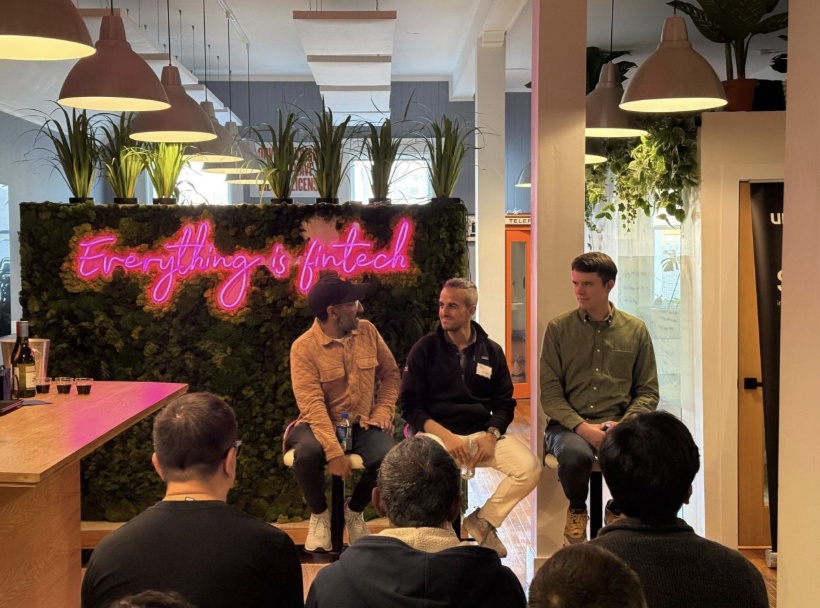
Artificial intelligence brings another set of questions. At a May 2026 fireside conversation with Housecat’s Thomas George, Damti singled out AI-enabled fraud as an underappreciated issue. He also considered whether agents would hold money in their own accounts or act on accounts people already used. These were open questions about identity, control, and relationships, rather than promises about a finished future.
The accompanying photograph supplies a small joke of its own. Behind the speakers, pink neon declares, “Everything is fintech.” Beneath that broad statement sits a conversation about the details that can make financial software difficult. The sign gets the sentence. The founders get the homework.
Damti’s career has involved several changes of seat: engineer, product leader, regional executive, mentor, founder. The recurring interest is how a system works once people depend on it. His partnership with Somech has lasted across different companies and different circumstances. Unit is their latest answer to a familiar problem: finding something worth building, then staying close enough to the details to make it work.