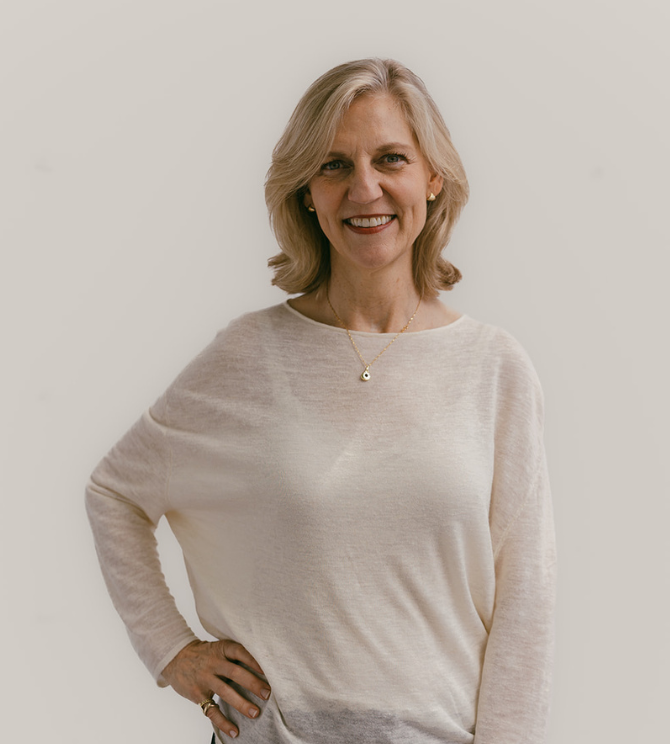
Proof, not promises
Everyone in impact investing claims to do good. Christina Leijonhufvud built a company whose entire job is to check whether they actually do.
In January 2020, Leijonhufvud co-founded BlueMark and became its chief executive. The premise was almost stubbornly plain: impact investing had grown into a movement measured in hundreds of billions of dollars, yet there was no independent party to confirm that the impact being advertised was real. BlueMark set out to be that party - an outside verifier that reviews how investors manage and report their impact, then benchmarks them against their peers.
It is unglamorous work by design. Verification does not generate headlines the way a splashy new fund does. But Leijonhufvud has spent much of her career convinced that the credibility of a whole field depends on somebody doing the quiet, rigorous part. "BlueMark aims to be the mark of impact, integrity and quality," she has said, describing independent verification as "a real antidote to the trend of impact washing and greenwashing."
That conviction did not appear overnight. It was assembled across three careers that, at first glance, have little to do with one another.
Central Asia, then Wall Street
Before finance, Leijonhufvud worked at the World Bank as country officer for Kazakhstan, Kyrgyzstan and Turkmenistan in the uncertain years after the Soviet Union collapsed. It was development economics at its most concrete - trying to understand whether money moving into fragile economies was doing what it was meant to do.
She then spent more than 15 years at J.P. Morgan, rising to managing director. There she led a ratings advisory business and ran risk management groups for the bank's credit portfolio and emerging markets trading - the disciplined, numbers-first world of measuring exposure and testing claims against evidence. That instinct for rigor would later become the backbone of her verification business.
In 2007, she did something unusual for a big bank at the time: she created and launched J.P. Morgan's Social Finance unit, one of Wall Street's first dedicated impact investment banking teams. The term "impact investing" had barely entered the vocabulary. Under her, the group published early, influential research that helped institutional investors take the field seriously, directed $100 million of the bank's own capital into impact funds, and helped structure innovative products including the Gates Foundation-backed Global Health Investment Fund.
Independent verification is a real antidote to the trend of impact washing and greenwashing.
— Christina Leijonhufvud, CEO of BlueMarkFrom measurement to management to verification
Leijonhufvud's own path traces the maturation of the entire industry. First the field learned to measure impact. Then it learned to manage it - to build impact considerations into how investment decisions are actually made. In 2014 she co-founded Tideline, an impact consulting firm, to help investors do exactly that.
But management raised a harder question: if everyone says they manage for impact, who confirms it? That third stage - verification - is the one Leijonhufvud helped invent. BlueMark spun out of Tideline in 2020 to provide the independent check that a maturing market increasingly demanded.
Measurement
Can impact be quantified at all? The industry's first task.
Management
Building impact into real decisions - Tideline's remit.
Verification
An independent party confirms the claims - BlueMark.
The timing proved shrewd. As regulators in the United States and Europe began pressing asset managers to substantiate their ESG and impact claims, BlueMark had already spent years building the tools to do it. In 2023, S&P Global led a $10 million investment in the company - a signal that one of the world's largest ratings and data firms saw verification as core financial infrastructure, not a niche.
The benchmark
Each year BlueMark publishes "Making the Mark," a report Leijonhufvud leads that aggregates its verification findings into an industry benchmark. The 2025 edition drew on 153 practice verifications for 131 distinct investors managing a combined $377 billion in impact assets, and for the first time added fund-level verifications. The report has become a mirror the industry holds up to itself: where impact management is strong, where it is thin, and where the gap between claim and practice is widest.
The approach borrows openly from the world Leijonhufvud came from. A credit rating exists so that lenders do not have to take a borrower's word about risk. BlueMark applies the same logic to impact: an outside opinion, delivered on a consistent methodology, so that an allocator does not have to take a fund manager's word about good intentions.
A quiet kind of ambition
Leijonhufvud holds three degrees across three disciplines - a BA in sociology from UCLA, an MA in international affairs from George Washington University, and an MSc in economics from the London School of Economics. It is a fitting resume for someone whose life's question keeps circling back to the same thing across development banks, trading floors and impact funds: does the money actually do what it says?
She also teaches, as an adjunct professor at Columbia University's School of International and Public Affairs, and sits on advisory bodies including Duke University's CASE i3. Her surname, an old Swedish noble name, translates roughly to "lion's head" - a quiet detail for a leader whose influence tends to work through standards and evidence rather than volume.
The aspiration she has pursued is not to make impact investing sound better. It is to make its claims verifiable and comparable, so that trust in the field is earned rather than asserted. In an industry that runs on good intentions, she picked the harder job of proving them.