A bottle of wine is an unusually agreeable place to begin a technology career story. It has a label, a year, a price, and sometimes a history its seller would prefer you did not investigate. In November 2016, Leoni Runge was at London's 67 Pall Mall explaining an Everledger collaboration with Chai Wine Vault. The subject was provenance: how to preserve a dependable record of a valuable bottle as it moved between owners. Before she founded Zaya Care, she was already working on the awkward distance between a convincing story and something people could actually trust.
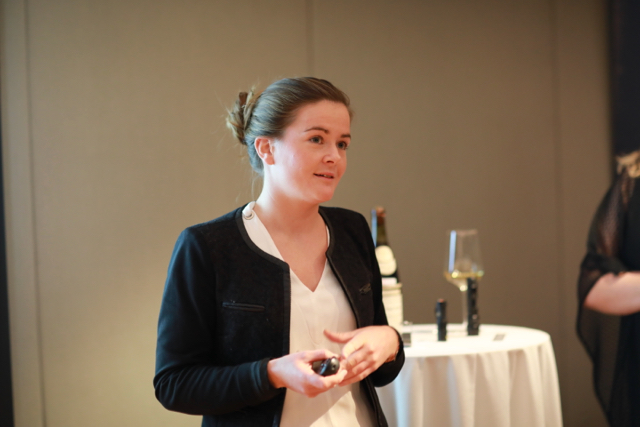
There is a photograph from that presentation. Runge stands beside a table, holding a small device, with wine glasses behind her. It is an appealingly literal introduction to product management: here is an object, here are the people who care about it, and here is the explanation that must make sense to them. The software has to earn its place in the room. A fine vocabulary alone will not get it invited back.
Her subsequent career would take her through financial technology, enterprise blockchain and the founding of a company in New York. The industries changed. The work kept returning to records, transactions, relationships and the practical business of getting people to participate. Viewed together, those jobs suggest a useful way to understand Runge: as a product operator who learned to look beneath the display window.
Business school, then the bottle
Runge studied business administration at the University of St.Gallen, with her public education record listing 2011 to 2014. She went on to a master's degree in international management at Esade. Those are business qualifications, and her early public work is recognizably concerned with the way businesses operate: what gets bought, what can be verified, and what a customer needs to do next.
At Everledger, her responsibilities included fine wine. The challenge was wonderfully concrete. A valuable bottle could travel through several hands; its original identity and its subsequent ownership needed to remain intelligible. A digital record was useful only if it could be connected to the thing someone might eventually pull from a cellar.
Human expertise remained part of the process. Runge described authentication by specialists before the information was secured digitally, identifying wine authenticator Maureen Downey as an early partner. This is a useful detail in a career that passed through blockchain's noisier years. A ledger can preserve an assessment. Someone still has to make the assessment. Technology does not acquire a nose for Bordeaux simply because its documentation is impressive.
She also explained the storage of authentication data and the use of a tamper-evident tag above a bottle's cork. The task involved a physical object as well as a database. This combination is less photogenic than a promise to reinvent an industry, but more revealing about the day-to-day work: deciding where evidence comes from, how it is preserved, and how another person will check it.
Keep the machinery out of the way
By 2019, Runge was chief product officer at BlockFactory. At a May event in Zurich, she and the company's chief financial officer, Stefan Bollier, presented on making blockchain ready for enterprise use. The phrasing matters. Enterprise customers come with existing habits, existing documents and colleagues who may be perfectly content to continue using both.
One BlockFactory application allowed documents to be certified and subsequently checked through a verification window. The checking process used drag and drop. People did not need to install software or acquire cryptocurrency to verify a document. Runge's description of the design was refreshingly plain:
“We hid all of our product geekiness and blockchain complexity behind an intuitive interface.”Leoni Runge, 2019
That sentence supplies a better introduction to her product instincts than a catalogue of fashionable technologies. The sophistication belonged behind the interface. A user had something to accomplish; making that user appreciate the engineering was optional. A beautifully complicated mechanism can be a dreadful host.
Her career also included a head-of-product role at Advanon, an invoice-financing marketplace. Here again, the setting was a transaction between businesses. Wine records, invoices and certificates are different objects, but each carries information on which someone else must be willing to act. The connection is an editorial reading of the work, rather than a claim that Runge had mapped out her future from the beginning. Careers generally look tidier after somebody has drawn the arrows.
- 2016The bottleEverledger · provenance
- 2019The documentBlockFactory · product
- 2020The companyZaya · founder
- 2026The handoffZaya · board member
How do you make something useful enough for other people to adopt?
A small launch acquired a larger audience
Runge founded Zaya in 2020. She had relocated to New York to build the business as a solo founder. Its first offering used chat, and the original launch plan was modest: a pilot for 60 people, centered around Brooklyn. A pilot that size permits attention to individual experiences. It also offers a founder the agreeable illusion that a calendar will remain in charge.
The company opened its channels to the public sooner than planned. By April 2020, Runge described hundreds of users on its chat platform and more than 1,000 viewers for an initial webinar series. The organization had to address scale earlier than expected. A small launch had become a live operating exercise.
The numbers tell us about the change in workload; they do not, by themselves, tell us that the eventual business was settled. An early audience answers one question: will anybody turn up? It leaves others open. What will they return for? What must happen behind the scenes? Which part of the service can become a repeatable operation? These are useful questions to bring to Runge's subsequent path, because Zaya's business evolved after those first experiments.
A Brooklyn launch plan, before Zaya opened its channels more widely in 2020.
The address book was part of the work
Building in another country adds an unglamorous item to a founder's job description: finding the people who can explain how things actually happen. Runge's approach included persistent LinkedIn outreach and introductions. In her later account of the experience, a particularly useful request was to ask a contact for two more people to speak with. A specific request gives a conversation somewhere to go.
Her January 2025 conversation with the podcast Follow the Gradient covered early experiments, changes in direction and the difficulty of keeping a team aligned as the business evolved. She also identified an executive coach and regular conversations with fellow founders as useful practices. The picture is of someone who sought perspective while retaining responsibility for decisions.
There is an important distinction between founding alone and doing every job alone. A solo founder remains surrounded by colleagues, customers, advisers and people whose information can change a decision. Making those relationships useful requires more than accumulating introductions. It requires listening closely enough to ask the next question, and explaining decisions clearly enough that other people can work with them.
By July 2024, Runge was describing the energy she took from a community meeting with independent practice owners who had recently started using Zaya. Sarah Ealy and Madeleine Lee helped her run the call. A meeting is a small unit of company history, easily lost beside an announcement. It is also where a business gets to hear whether the thing it has built fits into someone else's working day.
The money had names attached
Zaya raised a $7.6 million seed round in March 2022. Inspired Capital led it, with Story Ventures, Tiger Global and Operator Partners participating. Brooklyn Bridge Ventures records an earlier investment in February 2021. These dates put some shape around the transition from an initial service to a funded company.
A funding figure is easy to print in large type. Its quieter significance is that other people have agreed to take a financial interest in what happens next. Capital buys room to hire and build; it also introduces expectations. A founder's promising account of a problem has to become a business that people can inspect.
Runge later recalled an early walk with investor Jake Yormak on New York's West Side Highway and acknowledged Lucy Deland's involvement as the business changed direction. She thanked Charlie O'Donnell for her first venture-capital check. Those details give the financing history a human scale: a conversation, a person willing to engage, a relationship that survives revisions to the original plan.
Permission to buy the sweatshirt
At the end of 2025, Runge offered a small, revealing detail about expenditure. After years of being strict about nonessential purchases, Zaya had finally made company merchandise. She enjoyed seeing the company's network locations while cycling around New York. Growth had acquired both a street address and something to wear.
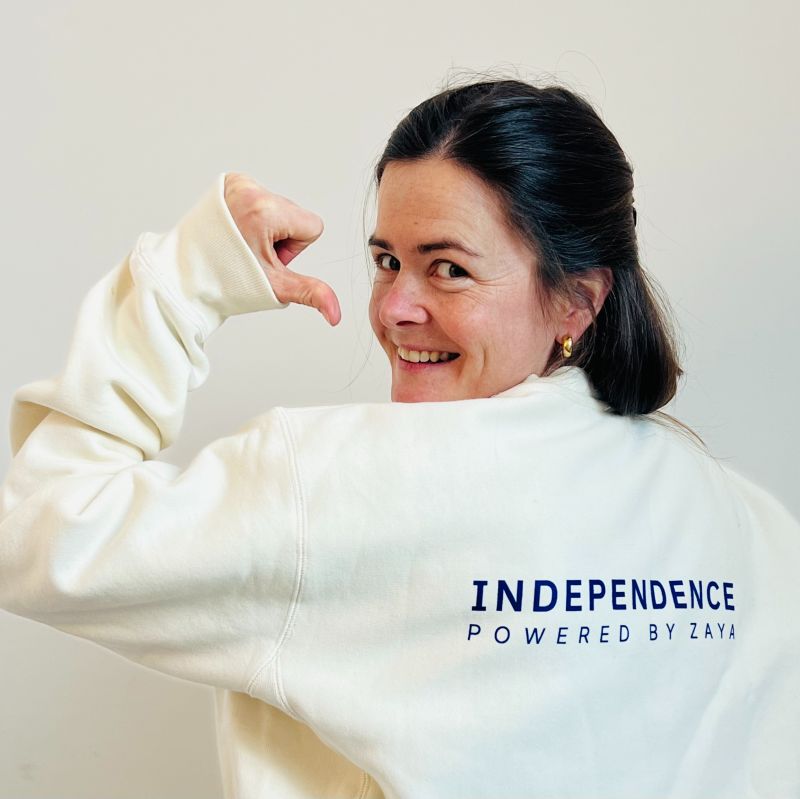
In a photograph, she looks back over her shoulder and points to the words on her sweatshirt: “INDEPENDENCE POWERED BY ZAYA.” Corporate clothing is often purchased before anybody has much to celebrate. In her telling, this purchase waited. The appeal of the anecdote is its scale. A founder who can discuss financing in millions can still make a sweatshirt sound like a considered decision.
The company continues; the chair changes
On February 10, 2026, Runge announced that she would leave the CEO role and hand operational leadership to Neel Shah. She would continue as a board member and owner. The decision places another kind of product judgment at the end of the story: deciding who should operate the company for its next stage.
Founding a business gives a person a permanent relationship with its beginning. It does not require that person to occupy the same chair indefinitely. Runge's announced role keeps her involved while changing the responsibility she carries. The bottle, the document, the company and the handoff each offer a different view of the same practical concern: what needs to happen so that somebody else can use what has been built?
There is room in that question for considerable ambition. There is also room for restraint, a clear interface, a useful introduction and, eventually, a sweatshirt. Runge's public career makes a case for paying attention to those modest objects. They are where the grander plans have to become real.