The trouble began with a grandmother. In TriPlay’s account of its origins, Tamir Koch wanted to send his mother photographs of his young children. She lived abroad and moved between home, work and errands. Should he send the pictures to her phone or her computer? A small domestic question exposed an awkward rule of digital life: the sender had to understand the recipient’s machinery.
That was 2004. The business that followed, TriPlay, made the awkwardness its subject. Music, photographs and videos ought to follow their owners. A person should not need a diplomatic mission every time a file crossed from one manufacturer’s device to another’s.
- Personal media, synchronized across mixed-brand devices.
- Free storage, with paid access and convenience.
- eMusic acquired in 2015; eStories launched in 2016.
- A proposed royalties exchange and public-market transaction in 2026.
01 / The collection was the point
MyMusicCloud, publicly promoted in 2011, served people who already had music. The task was to import a collection, synchronize it and play it across devices. MyDigipack applied the same idea to photographs and videos. The attraction was practical: fewer cables, fewer duplicate transfers, less wondering which machine held the latest copy.
This placed TriPlay between two markets. Generic cloud lockers stored files; music services supplied listening experiences. TriPlay wanted the personal collection to behave like a service. Its technology described adapting content to screen resolution, supported formats and computing resources, with synchronization and delivery designed around gaps in connectivity.
The company’s published team page helps explain the mixture. It pairs software engineering and consumer product experience with design and media marketing, including a marketer whose background included launching SiriusXM streaming services. A historical software-architect vacancy describes iterative development in a Scrum environment. Those details suit a business selling invisible coordination: the infrastructure must work, but the person opening an app must also understand what happened to the song. Technical compatibility alone does not make a pleasant afternoon.
For a collector, the distinction matters. A service’s catalog and your collection are different objects. Your files can include something obscure, personal or absent from a commercial catalog. TriPlay’s proposition gave those files a route across the devices you used.
and videos
and connection
tablet or TV
“Since our launch, we’ve believed in the power of music collections and the importance of making them available on every device, anywhere.”
Tamir Koch / MyMusicCloud relaunch, 2013
02 / Stop counting gigabytes
The pricing tells the story particularly well. In Toshiba’s August 2012 announcement, MyMusicCloud offered two gigabytes free and additional storage starting at $20 a year for ten gigabytes. The meter counted space.
In September 2013, the meter changed. Uploads became unlimited and free. A free account could access 250 tracks; unlimited access cost $40 annually. TriPlay separated keeping a collection from enjoying all of it. These were historical launch prices, but the underlying product judgment remains useful: identify the moment customers value, then put the paid feature there.
There was distribution work behind that judgment. MyMusicCloud integrated with Dropbox in 2011 and joined Toshiba AppPlace in 2012. Later came Samsung television and smartwatch apps. The partners made the promise concrete: a collection could turn up in the living room or on a wrist.
03 / Buying the other half
In October 2015, TriPlay acquired eMusic through a cash-and-stock transaction. The announced combination joined a download store and its audience to TriPlay’s player and cloud access. The purchase price was not disclosed in the announcement. The logic is easier to understand if you start with the collector: buying music and carrying it around had become adjacent jobs.
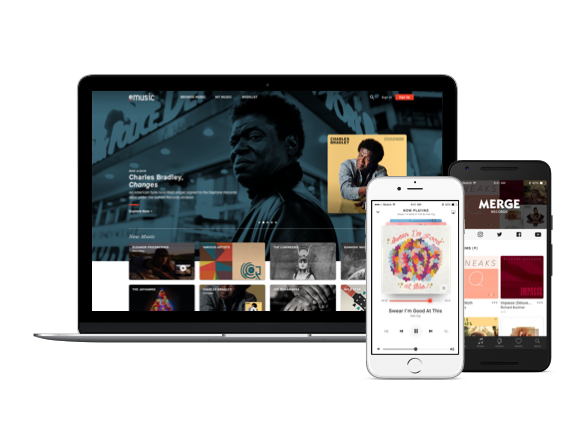
TriPlay had announced $11 million in financing that April from Fortress-affiliated funds and existing investors. Its stated uses included marketing, research and development, and strengthening its intellectual property. An earlier $5 million Series C in 2012 had financed acquisition of users, partnerships and geographic expansion.
The acquisition shifted the conversation. The customer was still someone who cared about a collection, but TriPlay now had a retail relationship as well as a technical one. Owning the plumbing and owning the shop offered different opportunities.
04 / The audiobook went first
eStories launched in July 2016, before the eMusic overhaul was finished. Koch said audiobooks presented the earliest opportunity for substantial service improvements. Feedback from listeners, publishers and industry insiders informed the redesign.
At launch, eStories offered more than 80,000 titles, plans starting at $11.99 monthly, unlimited cloud storage and synchronization across ten devices. Most titles could also be downloaded as DRM-free MP3s. Findaway supplied access to books from the Big Five publishers.
Against Audible, this was a proposition about continuity and portability. Pause a book on one device and resume on another. Download a copy where available. The same engineering that moved songs could move chapters; TriPlay did not need an entirely different technical identity to address a different listener.
05 / A patent is not a permission slip
The ambition had a harder edge. TriPlay pursued WhatsApp over messaging patents, but in March 2018 a Delaware court granted WhatsApp’s motion to dismiss on patent-eligibility grounds. That was a specific setback to the asserted claims, not a verdict on every TriPlay product.
For anyone copying the company’s approach, the distinction is useful. Building a working application, assembling a patent portfolio and establishing an enforceable claim are separate tasks. One success does not automatically purchase the others.

06 / From moving songs to moving money
By July 2018, eMusic was proposing a blockchain distribution and royalty-management system and announcing a $70 million token-sale ambition. That figure described a fundraising plan, not established proceeds. The company’s stated concern had widened from moving media between devices to moving revenue between participants.
In June 2026, Aneesh Capital announced a conditional arrangement with TriPlay at a deemed $18 million pre-money valuation. The announcement also proposed up to $2 million in concurrent financing and described eMusic Royalties eXchange as a platform under development connecting rights holders with investors. Shareholder, court and exchange approvals, financing and other conditions stood between the agreement and completion.
Here is the transferable idea: watch where control becomes inconvenient, then build around that inconvenience. But portability needs compatible devices and usable files; a royalties marketplace needs clear rights, willing investors and dependable transactions. TriPlay’s original grandmother problem was wonderfully simple. The problems it chose afterward came with rather more paperwork.